
Best Military Grade Walkie Talkies Compared by Durability

Retevis RB48, 4-Pack is the strongest match for most buyers because it combines a MIL-STD-810H claim with a four-radio pack and IP67 waterproofing in its name. Choose Retevis RB48, 6-Pack with Gang Charger instead if a six-pack and shoulder microphone matter more; the other options emphasize ruggedness but do not name the same military test standard.
“Military grade” is not a single universal durability certification, so compare the actual test standard and ingress rating rather than relying on the phrase alone.
We earn a commission if you buy through links on this page. As an Amazon Associate I earn from qualifying purchases. Products are compared on manufacturer specifications, not hands-on testing.
- Best overall: Retevis RB48, 4-Pack – Names MIL-STD-810H, IP67 protection and a four-radio pack.
- Best for six-person crews: Retevis RB48, 6-Pack with Gang Charger – Combines the MIL-STD-810H claim with a six-pack and gang charger.
- Best for long shifts: Retevis RB48A, 10-Pack – Its maker claims 23 hours of continuous use from a 2,000mAh battery.
| Product | Best for | Pack size | Battery or charging feature | Shop |
|---|---|---|---|---|
| Retevis RB48, 4-Pack | Rugged group work | 4 radios | — | Check Price on Amazon |
| Retevis RB48, 6-Pack with Gang Charger | Larger work crews | 6 radios | Gang charger | Check Price on Amazon |
| Gaswei G2Pro+, 2-Watt | Water activities | — | Rechargeable; 24-hour battery | Check Price on Amazon |
| Retevis RB48A, 10-Pack | Large work crews | 10 radios | 2,000mAh; 23-hour claim | Check Price on Amazon |
| Gaswei G2Pro+, 4-Pack | Dual-channel groups | 4 radios | — | Check Price on Amazon |
Military Grade Walkie Talkies Compared
Compare the specific durability claims, pack configurations and work features before choosing a radio for your crew.
Retevis RB48, 4-Pack

The RB48 is the closest fit for buyers prioritizing a named military test standard: its maker says the radio passed 19 tests, including rain, salt fog, vibration, shock and immersion. The four-pack is aimed at a small crew, and the product name also identifies it as an FRS radio. IP67 is a useful water-and-dust rating to compare with other radios, but it does not establish radio range or guarantee survival in every worksite condition.
Choose this set when ruggedness and a four-radio group configuration matter more than accessories such as a shoulder microphone or gang charger.
Bottom line: Pick this set if you want a four-radio group pack with a named durability test standard.
Retevis RB48, 6-Pack with Gang Charger

This RB48 configuration stands out for supplying six radios and a gang charger alongside the same MIL-STD-810H and IP67 claims associated with the RB48 line. The maker says the RB48 passed 19 environmental and durability tests, including rain, vibration, shock and immersion. The product name also identifies it as an FRS radio, so it suits crews coordinating over compatible FRS units.
The six-pack may fit a larger team better than a four-radio kit, but buyers who do not need six units may prefer a smaller group set. Confirm that the shoulder-microphone arrangement suits the crew before ordering.
Bottom line: Choose it when a six-radio set and shared charging setup fit your crew.
Gaswei G2Pro+, 2-Watt

The G2Pro+ focuses on floating waterproof operation and communication features rather than a named military test standard. Its maker identifies it as a 2-watt FRS radio and claims range figures that vary by setting, from open water to urban areas; actual range depends heavily on obstructions, elevation and interference. The product name also calls out a 24-hour battery, while its features include FM radio, SOS, NOAA weather, VOX, dual PTT and dual watch.
This option suits buyers who value water-oriented features and two-channel monitoring. It is a partial match for military-grade searches because IP67 ruggedness is not the same claim as MIL-STD-810H testing.
Bottom line: Pick it for floating, waterproof use and its radio features, not a named military test standard.
Retevis RB48A, 10-Pack

The RB48A is the largest group configuration here, with ten radios, and its maker claims a 2,000mAh battery supports 23 hours of continuous use under a specified standby, talk and listen pattern. The maker also claims coverage up to 300,000 square feet, a 25-story building or 0.5–2 miles depending on terrain and conditions. Noise reduction and a 1,000mW speaker target busy work environments, and the product name identifies IP67 protection.
This model suits sizable crews that need many radios and long-shift features. It is a partial match because its name does not include a MIL-STD-810H claim.
Bottom line: Choose it for a ten-radio crew set with a long-use battery claim.
Gaswei G2Pro+, 4-Pack
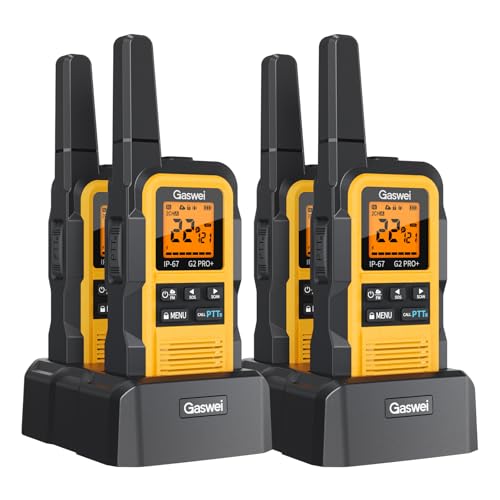
The distinguishing feature of this G2Pro+ four-pack is dual-channel coordination: the maker describes dual PTT buttons and monitoring two channels at once. Its name also calls out IP67 waterproofing and floating construction, making it relevant to group outings where accidental drops in water are a concern. The pack offers four matching radios, while the features emphasize switching between groups and left- or right-handed operation.
Choose it for water-oriented group use and dual-channel monitoring.
Bottom line: Pick it when four radios with dual-channel monitoring are the priority.
What military grade means for walkie talkies
MIL-STD-810H is a US Department of Defense test-method standard for environmental engineering, but a product claim does not mean every device underwent every method or is formally certified for all military uses. Test procedures and severities are tailored to the intended environment. IP ratings address ingress protection separately: IP67 means dust-tight and protection against temporary immersion under defined laboratory conditions, not unlimited underwater use. For a work radio, compare the actual named standard, IP rating and physical use case rather than treating one label as proof of every kind of ruggedness.
How to choose a rugged radio for your crew
Start with how many people need radios at the same time, then compare channel compatibility and the work environment. A radio only communicates with another unit when both use compatible frequencies, channel settings and any privacy-code settings; privacy codes do not make a conversation private. FRS radios in the US do not require an individual FCC license, but FRS equipment has specific power, antenna and operating limits. If your work needs repeaters, removable antennas or greater coverage, check the radio service category before buying: those requirements may point away from FRS. For water exposure, look for an explicit IP rating, and for a named durability standard, check which tests the manufacturer says were performed.
FRS range and channel limits
FRS range is highly dependent on terrain, buildings, antenna height and interference, so a maker’s distance figure is not a guaranteed working radius. Under FCC FRS rules, channels 8–14 are limited to 0.5 watt, while channels 1–7 and 15–22 can use up to 2 watts; handheld radios generally have short-range performance compared with elevated or repeater-based systems. Buildings, hills and dense vegetation can reduce usable distance sharply. A practical choice rule is to select a radio service with repeater capability if your site has repeated dead zones or spans beyond reliable handheld coverage, rather than assuming a higher advertised distance will solve the problem.
| Need | Useful comparison |
|---|---|
| Small crew | Four-radio pack |
| Larger crew | Six- or ten-radio pack |
| Water exposure | IP rating and floating design |
| Named ruggedness tests | Specific standard and test conditions |
Waterproof ratings and safe use
IP67 indicates dust-tight protection and temporary immersion protection under controlled test conditions; it is not a promise of indefinite submersion or safe use in every aquatic setting. Salt water, impact damage, worn seals and open charging ports can change how well a radio resists water. Follow the product’s charging and port-sealing requirements, and do not charge a wet radio unless its manual specifically permits it. A floating design helps recover a dropped unit, but does not replace a personal flotation device or water-safety practices. For radios used around water, keep charging contacts dry and inspect seals after drops or rough handling.
Frequently Asked Questions
Does MIL-STD-810H mean a radio is military certified?
No; MIL-STD-810H is a standard of environmental test methods, not a single blanket military certification. Check which methods and conditions the manufacturer says apply to the specific radio.
Do FRS walkie talkies need an FCC license?
No individual FCC license is required to operate FRS radios in the US. FRS use is still limited by FCC rules, including channel-specific power limits and equipment requirements.
What does IP67 mean on a walkie talkie?
IP67 means dust-tight and rated for temporary immersion in water under defined test conditions. It does not mean a radio can be submerged indefinitely or that seals remain effective after damage.
How far can handheld FRS radios communicate?
There is no dependable single range for every setting; terrain, buildings, antenna height and interference all affect coverage. Test communication at the actual work locations, especially around walls, hills or dense structures.
Are walkie talkie privacy codes private conversations?
No; privacy codes generally filter which transmissions a radio plays, but they do not encrypt the signal. Another compatible receiver on the same channel may still hear the conversation.