
Best Shoulder Brace for Labrum Tear: 4 Supports Compared

For most people seeking a shoulder brace for a labrum tear, Fightech Rotator Cuff Brace, Large/X-Large is the strongest match because its maker describes medium-to-strong support and names labrum tears. Choose Sparthos Rotator Cuff Shoulder Brace, Universal instead for gentler compression and more movement; it is not intended for severe immobilization.
We earn a commission if you buy through links on this page. As an Amazon Associate I earn from qualifying purchases. Products are compared on manufacturer specifications, not hands-on testing.
- Best overall: Fightech Rotator Cuff Brace, Large/X-Large – Its maker identifies labrum tears and describes medium-to-strong shoulder support.
- Best for hot or cold packs: AidPRO Shoulder Support, Universal – The wrap has an internal pocket for a hot or cold pack, which is not included.
- Best for gentle support: Sparthos Rotator Cuff Shoulder Brace, Universal – Its adjustable straps offer compression and moderate stabilization while allowing movement.
| Product | Best for | Fit | Support | Distinct feature | Shop |
|---|---|---|---|---|---|
| Fightech Rotator Cuff Brace, Large/X-Large | More support | Large/X-Large; bicep 12–17 in | Medium to strong | Labrum tear named | Check Price on Amazon |
| Sparthos Rotator Cuff Shoulder Brace, Universal | Gentle compression | Universal | Moderate stabilization | Adjustable chest and arm straps | Check Price on Amazon |
| AidPRO Shoulder Support, Universal | Pack pocket | Universal; left or right | Customizable compression | Hot/cold pack pocket | Check Price on Amazon |
| Komoko Shoulder Brace, Adjustable | Neoprene wrap | Adjustable; left or right | Support and stability | Neoprene rubber | Check Price on Amazon |
Shoulder Braces for Labrum Tears
Compare each wrap’s support, sizing, and practical features before choosing one for your shoulder.
Fightech Rotator Cuff Brace, Large/X-Large

Among these options, this wrap is the one whose maker specifically names labrum tears and describes medium-to-strong support. It is an adjustable shoulder compression sleeve intended to provide steady pressure and remind the wearer not to overextend the shoulder. The Large/X-Large size fits a 12–17-inch bicep, so measure before choosing this size. Its use also includes post-op SLAP surgery, but a brace is not a substitute for a clinician’s instructions after surgery. The limitation is that the size range may not fit people outside that bicep measurement.
Bottom line: Choose this if its 12–17-inch bicep fit works and you want a wrap explicitly identified for labrum tears.
Sparthos Rotator Cuff Shoulder Brace, Universal

Unlike the more supportive option, this universal wrap is positioned for mild-to-moderate discomfort and moderate stabilization while preserving freedom of movement. Its adjustable chest and arm straps use hook-and-loop closures, and it fits either the left or right arm. The maker names labrum tears among its intended uses, making it relevant for a buyer who wants adjustable compression rather than pronounced restriction. The important limitation is explicit: it is not intended for severe immobilization, so it is a poor match when a clinician has prescribed that level of restriction.
Bottom line: Choose this for adjustable, moderate support when unrestricted movement matters more than immobilization.
AidPRO Shoulder Support, Universal

The distinguishing feature here is the internal pocket for a hot or cold pack; the pack itself is not included. This neoprene wrap offers adjustable compression and stability while allowing movement, and its maker describes use for shoulder discomfort, rotator cuff injuries, strains, and sprains. Universal sizing and left-or-right fit may appeal when a simpler one-size wrap is preferred. The maker does not specifically identify labrum tears, so this is a related shoulder-support option rather than the closest named match for this search. Confirm a clinician approves the support style for your injury.
Bottom line: Choose this if the pack pocket is useful and your clinician approves this general shoulder wrap.
Komoko Shoulder Brace, Adjustable
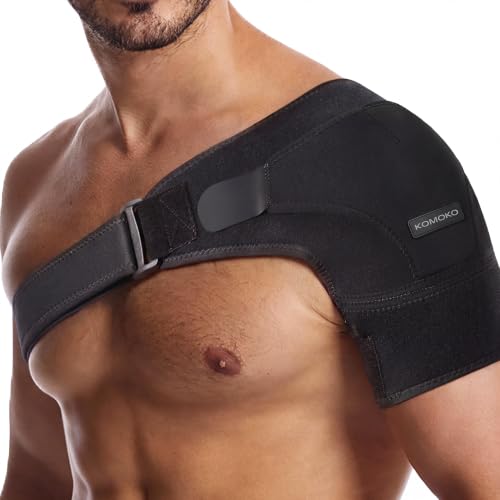
This adjustable neoprene brace is presented as a shoulder support that combines stability with mobility, rather than as a labrum-specific device. Its maker highlights durable material and stitching, repeated washing, and use for shoulder strain and AC joint pain; the wrap is designed for either arm. That may suit someone seeking a general shoulder brace for activity, but the specifications do not identify labrum tears or a measurable support grade. For a labrum injury, that makes it a less direct match than the braces whose makers explicitly name the condition.
Bottom line: Choose this only if you want a general adjustable shoulder wrap rather than a labrum-specific match.
How to choose a shoulder brace for a labrum tear
Start with the support level a clinician recommends, then match the brace’s fit and design to that instruction. Shoulder wraps generally use compression and straps to limit some movement; they are not all equivalent to a sling or rigid immobilizer. A decision rule from these options is clear: if severe immobilization is required, avoid Sparthos Rotator Cuff Shoulder Brace, Universal, whose maker explicitly says it is not intended for that use. If a brace is part of post-operative care, confirm the allowed shoulder motion and wear schedule with the surgeon before using any adjustable wrap.
Fit affects whether a wrap stays positioned: measure the upper arm where the manufacturer specifies, and verify the size range and left/right orientation. A universal size does not guarantee a comfortable fit on every body. Look for adjustable chest and arm straps when you need to tune compression without overtightening.
Shoulder brace support types and features
Shoulder braces range from elastic compression sleeves to wraps with chest straps and slings; the more a design restricts motion, the more important clinician guidance becomes. Compression can provide a sense of support, but a flexible wrap should not be treated as a device that repairs a labral injury. A pack pocket is a convenience, not evidence of stronger stabilization; any hot or cold pack should be used with a protective layer rather than directly against skin.
This comparison separates the specific features buyers can assess from these four options.
| Need | Relevant feature |
|---|---|
| Moderate support with movement | Adjustable compression wrap |
| Named labrum-tear use | Maker explicitly identifies the condition |
| Hot or cold pack placement | Internal pocket; pack may be separate |
| Severe immobilization | Confirm a suitable device with a clinician |
How to size and wear a shoulder brace
Measure the body part specified for the exact size range rather than relying on clothing size. For Fightech Rotator Cuff Brace, Large/X-Large, the Large/X-Large fit is a 12–17-inch bicep; a measurement outside that span is a reason to select another size or product. Universal sizing is convenient, but strap adjustment still needs to hold the wrap in place without causing numbness, tingling, discoloration, or increased pain.
Shoulder wraps can cover skin and create heat, pressure, or rubbing, so check the skin regularly, especially during initial wear. Stop and seek medical advice for new numbness, color change, worsening pain, or hand weakness. Follow a clinician’s plan for wear duration, particularly after surgery or a dislocation.
When a shoulder brace needs medical guidance
A brace choice should follow an assessment when shoulder pain follows trauma, the joint looks deformed, or arm movement is suddenly very limited. Labral injuries can coexist with instability or other shoulder damage, and compression alone does not establish what injury is present. Seek urgent care for a cold or pale hand, severe sudden pain, or loss of sensation.
After surgery, the allowed range of motion and timing for removing a brace are specific to the procedure; do not substitute a flexible support wrap for a prescribed sling or immobilizer. For exercise or return to sport, progress only within a clinician’s guidance rather than using the brace as permission to push through pain.
Frequently Asked Questions
Can a shoulder brace heal a labrum tear?
A shoulder brace can support or limit movement, but it does not heal a labral tear on its own. Diagnosis and treatment depend on the injury and symptoms, so seek clinical evaluation for persistent pain or instability.
How tight should a shoulder brace feel?
A brace should feel secure without causing numbness, tingling, skin discoloration, or increased pain. Loosen or remove it and get medical advice if those symptoms appear.
Can I sleep in a shoulder brace?
Sleep use depends on the injury and the clinician’s plan, especially after surgery or dislocation. Ask whether overnight wear is appropriate and check that straps do not create pressure or numbness.
Should I use ice with a shoulder brace?
A pack pocket can hold a hot or cold pack when the brace includes one, but the pack may need to be obtained separately. Keep a cloth layer between cold packs and skin, and check the skin regularly.
Can I exercise while wearing a shoulder brace?
A brace does not make every exercise safe for a labrum injury. Resume activity only within a clinician’s guidance, and stop for worsening pain, weakness, or new numbness.