
EverStart Platinum AGM Battery: Group Sizes Compared

The EverStart Platinum AGM battery itself is not among these options; for most Group 48 applications, Weize Platinum AGM Group 48 matches the 70Ah, 760 CCA and 120-minute reserve-capacity specifications. Choose another size when your vehicle calls for Group 47 or 49, since battery dimensions and terminal position must match the vehicle.
We earn a commission if you buy through links on this page. As an Amazon Associate I earn from qualifying purchases. Products are compared on manufacturer specifications, not hands-on testing.
- Best overall: Weize Platinum AGM Group 48 – Group 48 fit with 70Ah, 760 CCA and 120-minute reserve capacity.
| Product | Best for | BCI group size | Shop |
|---|---|---|---|
| Weize Platinum AGM Group 48 | Group 48 fit | 48 (H6) | Check Price on Amazon |
| Platinum AGM Group 48 H6 | Group 48 alternative | 48 (H6) | Check Price on Amazon |
| Mighty Max MM-H6 Group 48 | Sealed AGM design | 48 | Check Price on Amazon |
AGM automotive batteries by group size
Compare case size and power figures, then match the battery group and terminal orientation to the vehicle’s requirements.
Weize Platinum AGM Group 48

Among the Group 48 options, this Weize battery gives the same 70Ah capacity, 760 CCA and 120-minute reserve capacity as Platinum AGM Group 48 H6, with a 36-month warranty. Its case measures 10.94 by 6.89 by 7.48 inches, and the tapered terminals place negative on the left and positive on the right. The maker says it supports start-stop systems and allows charging current up to 18A at 14.4–15.0V. The key limitation is fit: those dimensions and terminal positions suit only vehicles designed for that layout, so check the original battery before choosing.
Bottom line: Choose this for a vehicle requiring a Group 48 battery with left-negative terminals.
Platinum AGM Group 48 H6
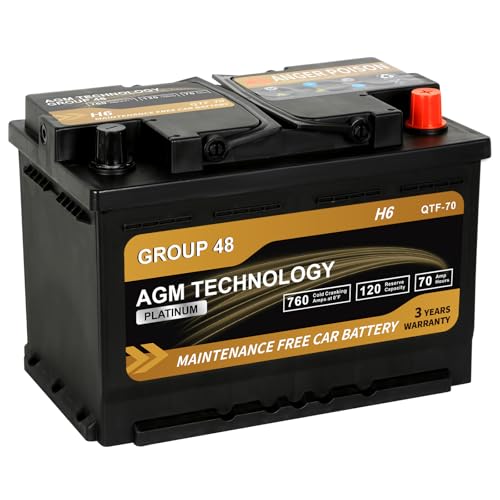
This Group 48 option matches Weize Platinum AGM Group 48 on capacity, cold-cranking amps, reserve capacity, case dimensions and terminal orientation, while its product name does not identify a separate brand. It is a 12V, 70Ah battery rated at 760 CCA and 120 minutes of reserve capacity, with a 36-month warranty. The case measures 10.94 by 6.89 by 7.48 inches and uses tapered terminals, negative left and positive right. The figures make it a fit candidate only when the vehicle takes Group 48; the shared size and output do not establish vehicle compatibility on their own.
Bottom line: Choose this if your vehicle’s required battery is Group 48 with the matching terminal layout.
Mighty Max MM-H6 Group 48

Unlike the two Platinum-named Group 48 batteries, the Mighty Max MM-H6 explicitly describes its AGM design as sealed and spill-proof. Its features also cite resistance to shock and vibration, but those are maker claims rather than a fit guarantee. Confirm that the terminal layout and hold-down match your vehicle before selecting it; matching Group 48 and power figures alone is not enough.
Bottom line: Pick this when the Group 48 case and sealed AGM design meet your needs and terminals match.
How to choose an AGM car battery
Start with the vehicle’s required BCI group size, then compare cold-cranking amps (CCA), capacity in amp-hours (Ah) and reserve capacity (RC). Group size determines the case footprint and terminal arrangement; CCA rates starting output at 0°F, while Ah measures stored charge and RC is minutes a fully charged battery can deliver 25A at 80°F before reaching 10.5V. A higher CCA or Ah figure does not make a battery compatible if its case or terminals do not fit. AGM batteries use absorbent glass mats to hold electrolyte rather than free-flowing liquid, and are commonly used where the vehicle’s charging system and battery specification call for AGM. Compare the original battery label and vehicle manual rather than choosing on output alone.
Group size and terminal fit
Battery fit is decided by group size, case dimensions, terminal polarity and hold-down—not by the model name alone. A Group 48 (H6) case here measures 10.94 by 6.89 by 7.48 inches; Group 47 (H5) is 9.52 inches long, and Group 49 (H8) is 13.9 inches long. Measure the battery tray and note whether the positive terminal is on the right or left when the terminals face you, matching the vehicle’s actual orientation. A mismatch can leave cables too short or reverse polarity, which can damage vehicle electronics. If available clearance is under 11 inches, a Group 49 cannot fit by length; still verify width, height, hold-down and cable reach before installation.
| Vehicle battery requirement | Compare these attributes | Choice rule |
|---|---|---|
| Group 47 / H5 | 9.52-inch length; 60Ah; 680 CCA | Choose only if Group 47 is specified |
| Group 48 / H6 | 10.94-inch length; 70Ah; 760 CCA | Match terminals and hold-down |
| Group 49 / H8 | 13.9-inch length; 95Ah; 900 CCA | Requires tray clearance for longer case |
AGM versus conventional lead-acid batteries
AGM batteries are a type of lead-acid battery whose electrolyte is absorbed in fiberglass mats, helping contain liquid and resist spills if the case remains intact. AGM models are typically sealed and can be mounted in more orientations than flooded batteries, but they still need the vehicle-approved position and secure hold-down. Charging voltage matters: an AGM battery can be damaged by an incompatible charging profile, and the included Group 48 model specifies 14.4–15.0V. Do not infer that every vehicle can use AGM simply because the battery fits; confirm the vehicle’s battery chemistry and charging-system requirements. Replacing a battery may also require registration or battery-management-system reset on some vehicles.
Safe battery replacement and care
Car batteries can deliver hundreds of amps, enough to cause burns or a fire if a tool bridges the terminals. Turn off the ignition, keep metal tools away from both posts at once, and remove the negative cable first; reconnect the negative cable last. Wear eye protection and gloves, keep sparks and flames away, and do not charge a frozen or visibly damaged battery. Many conventional batteries last about 3–5 years, though heat, short trips and repeated deep discharge shorten service life; AGM batteries also benefit from avoiding prolonged low charge. A battery tester can check state of charge and starting health, while a charging-system check helps identify an alternator problem that could damage a replacement.
Frequently Asked Questions
What does 760 CCA mean on a car battery?
A 760 CCA rating means the battery is rated to deliver starting current at 0°F under the cold-cranking test conditions. Compare the rating with the vehicle’s minimum requirement; excess CCA does not fix an incorrect case size or terminal layout.
Can I replace a Group 48 battery with Group 49?
Only if the vehicle allows Group 49 and the tray accommodates its 13.9-inch case length. Group 49 is 2.96 inches longer than the Group 48 case here, so check the hold-down, width, height and cable reach too.
How long does a car battery usually last?
A typical car battery lasts about 3–5 years, with high heat, frequent short trips and deep discharges often shortening that span. A battery tester can reveal declining charge or starting performance before a no-start.
Does an AGM battery need a special charger?
An AGM battery needs a charger with an AGM-compatible setting and voltage profile. The Group 48 battery here specifies 14.4–15.0V charging voltage, so use a charger that can stay within the battery maker’s range.
Can AGM batteries be installed on their side?
Many sealed AGM batteries tolerate more mounting orientations than flooded batteries, but vehicle installations should remain upright unless the battery maker and vehicle allow otherwise. Secure hold-down matters because vibration can damage the case or terminals.