
Walker Shopping Carts for Elderly: 5 Options Compared

For a true walking aid with a seat and hand brakes, Rollator Shopping Cart, Aluminum Frame is the clearest fit because it is identified as a rollator walker and has a dual braking system. Choose a shopping cart instead if you mainly need grocery storage; most carts here are not described as medical walking aids.
Before relying on any wheeled cart for balance, confirm that its brakes and handle setup are appropriate for your walking needs.
We earn a commission if you buy through links on this page. As an Amazon Associate I earn from qualifying purchases. Products are compared on manufacturer specifications, not hands-on testing.
- Best overall: Rollator Shopping Cart, Aluminum Frame – It is explicitly a rollator walker and includes dual brakes.
- Best for seated breaks: 4-Wheel Shopping Cart with Seat – It has a padded seat, foldable footrest, and dual brakes.
- Best for light carrying: Strolee Stability Shopping Cart – Its aluminum frame weighs under 13 pounds and has a 75-pound total capacity.
| Product | Best for | Frame / weight | Load capacity | Seat / brakes | Shop |
|---|---|---|---|---|---|
| Rollator Shopping Cart, Aluminum Frame | Walking support | Aluminum; 13.2 lb* | 290 lb | No seat stated; dual brakes | Check Price on Amazon |
| 4-Wheel Shopping Cart with Seat | Seated breaks | Carbon steel; — | 220.46 lb | Padded seat; dual brakes | Check Price on Amazon |
| Strolee Stability Shopping Cart | Lightweight carrying | Aluminum; under 13 lb | 75 lb total | No seat stated; — | Check Price on Amazon |
| 2-Tier Folding Stroller Shopping Cart | Two-tier storage | Stainless steel; 15 lb | 80 lb | No seat stated; rear brakes | Check Price on Amazon |
| Dyna-Living Adjustable-Handle Shopping Cart | Adjustable-handle | Aluminum; 11 lb | 70 lb | No seat stated; — | Check Price on Amazon |
Walker Shopping Carts for Elderly Shoppers
These options range from rollator-style walking aids to carts intended mainly for carrying groceries.
Rollator Shopping Cart, Aluminum Frame
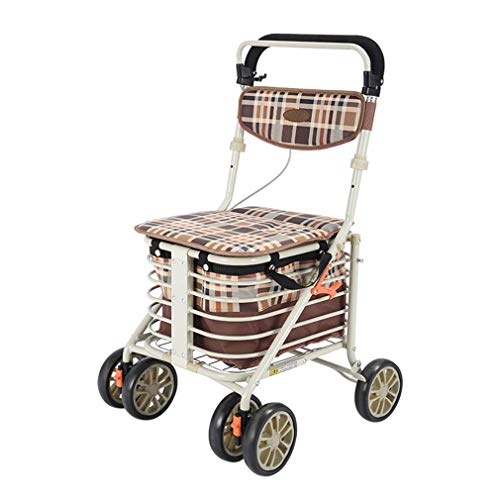
Unlike the grocery carts here, this product is identified as a rollator walker, with a dual braking system operated by both hands. It has a detachable storage bag for daily items and folds for storage in a car. Because those frame and weight descriptions conflict, confirm the model’s specifications before relying on them. It suits shoppers prioritizing a walking aid, but a seat is not described.
Bottom line: Choose this if you need a rollator-style walking aid with hand-operated brakes.
4-Wheel Shopping Cart with Seat
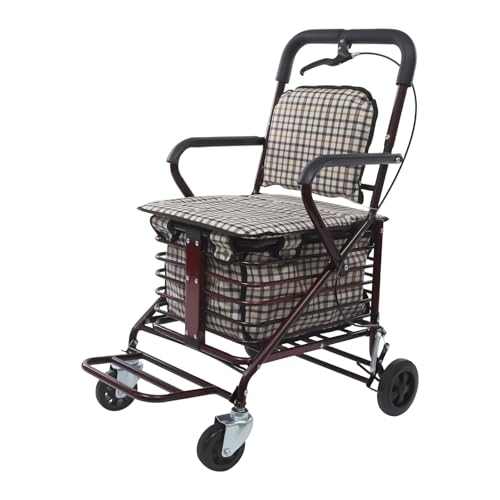
Among these carts, this one emphasizes taking seated breaks: it has a padded seat and foldable footrest, as well as dual brakes. The carbon-steel frame is rated by the maker to support 220.46 pounds, and its four wheels are described as suitable for sidewalks, gravel, grass, and uneven paths. Its focus is a shopping cart with a seat, not a designated rollator walking aid, so it may not meet a buyer’s needs for medically appropriate walking support. The cart capacity refers to the frame, not necessarily the seat.
Bottom line: Pick this for errands where a built-in seat matters more than rollator designation.
Strolee Stability Shopping Cart

Its maker gives the large shopping bag a 55-pound limit and the entire frame a 75-pound limit; folded dimensions are 25.5 by 23 by 9.5 inches. The maker calls it an assisted walker, but it does not describe hand brakes or a seat. That makes it more suitable for carrying groceries than for buyers seeking the features of a rollator.
Bottom line: Choose this for a lightweight grocery cart when a seat is not required.
2-Tier Folding Stroller Shopping Cart

This cart separates itself with a two-tier layout and a lower storage pocket, rather than a seat or rollator-style setup. Its maker gives it an 80-pound capacity and describes a one-hand folding mechanism, tool-free wheel attachment, and two rear wheels with brakes. The 15-pound weight and 33-inch height are useful comparisons with the lighter options, but no adjustable-handle or seat is described. It is a grocery transporter, not a specified walking aid, so buyers who need balance support should look at a rollator instead.
Bottom line: Choose this for divided grocery storage and a one-hand folding mechanism.
Dyna-Living Adjustable-Handle Shopping Cart

The adjustable-handle distinguishes this cart from the other carrying-focused options: its height range is 32.2 to 42.5 inches. It weighs 11 pounds, uses an aluminum frame with 600D Oxford cloth, and has a 70-pound total load capacity. The maker describes 360-degree swivel wheels, but no seat or braking system is included in the features. It suits shoppers who want a height-adjustable grocery cart; it should not be treated as a rollator just because it has wheels and a handle.
Bottom line: Pick this if handle-height adjustment is the main priority.
How to choose a walker shopping cart
Start by deciding whether you need a walking aid or a cart that carries groceries. A rollator is intended as a mobility aid and commonly combines hand brakes, a seat, and a storage compartment; a shopping cart may have a handle and wheels without being designed for balance support. If you need to sit during errands, verify that the seat is explicitly intended to support a seated person and check its capacity separately from the cart’s load rating. If you need support while walking, favor a product identified as a rollator and discuss fit with a clinician or mobility-equipment specialist. Do not assume a high grocery load rating means the handle or brakes are suitable for walking support.
Fit and safe use for older shoppers
Handle height and brake access matter more than a cart’s maximum load when it will be used while walking. Set handles near wrist height when standing upright with arms relaxed; a handle that forces a hunched posture or elevated shoulders is a poor fit. For a rollator, users should be able to reach and operate the brakes without letting go of the handles. Keep the load low and balanced, and stay within the capacity; overloaded or unevenly loaded carts can be harder to control. Practice stopping and turning on level ground before using a wheeled aid outdoors. If balance is uncertain, get a professional fitting rather than using a grocery cart as a substitute for a prescribed mobility aid.
Rollators and shopping carts compared
A rollator is the relevant category when the primary job is walking support; a shopping cart is the relevant category when the primary job is transporting purchases. A seat, brakes, and an explicit mobility-aid designation help distinguish the former, but individual designs vary. Use this table to narrow the type before comparing carrying capacity.
| Need | Better-matched type | Key check |
|---|---|---|
| Walking support | Rollator | Hand brakes and correct fit |
| Resting during errands | Cart with seat or rollator | Seat capacity and stability |
| Grocery transport only | Shopping cart | Total load limit and storage |
Do not infer walking-aid suitability from four wheels, a tall handle, or a senior-focused label. Verify the intended use and practice using any brakes before carrying a load.
Understanding load limits and storage
A cart’s maximum capacity can refer to the frame, the bag, or both, so distinguish those limits before loading groceries. For example, a product may assign one maximum to its bag and a higher one to the full frame; the lower applicable limit governs what you carry. Keep heavier items close to the base to reduce the chance of tipping, and avoid hanging extra bags from the handle unless the maker permits it. Folded dimensions matter for car trunks and narrow closets: measure the storage space, including room needed to lift the folded cart in and out. Capacity is not a measure of brake strength or suitability as a walking aid.
Frequently Asked Questions
Can a shopping cart replace a rollator walker?
A shopping cart should not be treated as a rollator unless it is identified and designed as a mobility aid. A rollator commonly has hand-operated brakes and may have a seat; confirm the design and fit if you need walking support.
How high should a walker handle be?
A handle near wrist height with relaxed arms is a useful starting point when standing upright. If the setup causes hunched shoulders or requires reaching down, ask a mobility professional to check the fit.
How much weight can a shopping cart carry?
Use the lower applicable limit when a cart lists separate bag and frame capacities. Keep the load balanced and low, and never exceed the limit.
Are four-wheel carts safe on uneven paths?
Four wheels alone do not establish that a cart is safe on uneven ground. Check its intended terrain and brake design, then practice stopping and turning on level ground before going outdoors.
What should I check before sitting on a cart?
Confirm that the product has an intended seat and a seat-specific capacity; a frame’s grocery load rating does not establish the seat’s safe limit. Set the brakes before sitting and use level ground.