
Hidden Car Radio Aerials: 3 Models Compared

For a hidden car radio aerial, Bingfu AM/FM 10-Foot Patch Antenna is the most straightforward choice because it supports AM and FM and has a 10-foot cable with a windshield adhesive mount.
We earn a commission if you buy through links on this page. As an Amazon Associate I earn from qualifying purchases. Products are compared on manufacturer specifications, not hands-on testing.
- Best overall: Bingfu AM/FM 10-Foot Patch Antenna – AM/FM reception support and a 10-foot cable suit a broad range of hidden installations.
- Best for flexible positioning: CHHLIUT Mini Adhesive Antenna – An adhesive label mount lets you adjust where the small antenna sits.
| Product | Best for | Cable length | Connector | Shop |
|---|---|---|---|---|
| Bingfu AM/FM 10-Foot Patch Antenna | AM/FM installation | 10 ft | DIN plug | Check Price on Amazon |
| Bingfu AM/FM 6-Foot Glass-Mount Antenna | Short cable runs | 6 ft | DIN plug | Check Price on Amazon |
| CHHLIUT Mini Adhesive Antenna | Adjustable placement | 10 ft | — | Check Price on Amazon |
Hidden car radio aerials compared
Compare the radio bands, cable reach and connection type before choosing a concealed antenna for your vehicle.
Bingfu AM/FM 10-Foot Patch Antenna
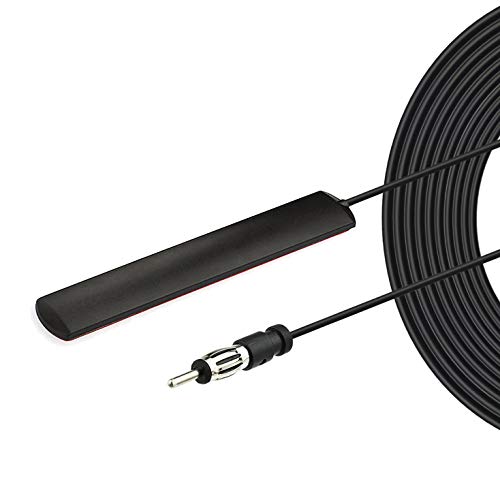
Bingfu AM/FM 10-Foot Patch Antenna supports both AM and FM, unlike the FM-only amplified option in this group. Its windshield adhesive mount and 10-foot cable give you room to route the lead toward an in-dash receiver; the DIN plug is the connection type to match against your stereo. The working ranges are 80–108 MHz for FM and 520–1,710 kHz for AM. This suits drivers who want a concealed patch antenna for a car, truck or SUV. The limitation is the fixed DIN connector, which may not mate directly with every receiver.
Bottom line: Choose this if you need AM and FM with a longer cable.
Bingfu AM/FM 6-Foot Glass-Mount Antenna

Bingfu AM/FM 6-Foot Glass-Mount Antenna has the same AM/FM working ranges and DIN plug as Bingfu AM/FM 10-Foot Patch Antenna, but its cable is 6 feet rather than 10. That shorter reach can be useful when the receiver is close to the chosen glass mounting point and you want less excess cable to route. The antenna is intended for adhesive windshield or window mounting and is compatible with car stereo receivers and marine boat stereo receivers. Buyers with a long route from glass to head unit should measure first: the shorter lead may not reach cleanly.
Bottom line: Pick this for a nearby receiver and a shorter cable route.
CHHLIUT Mini Adhesive Antenna

CHHLIUT Mini Adhesive Antenna stands apart with an adhesive label mounting approach that allows the antenna location to be adjusted. Its compact body measures 4.53 × 0.85 × 0.22 inches, and the 10-foot cable supports routing across varied vehicle interiors. The maker identifies cars, motorcycles, boats, campers and golf carts as possible uses, making it a fit beyond standard passenger vehicles. The connector type and radio frequency range are not included in the specifications, so match its connection to your receiver before choosing it.
Bottom line: Choose this when adjustable positioning is the priority.
How to choose a hidden car radio aerial
Start with the radio bands and receiver connector, then measure the cable route. AM/FM antennas cover both broadcast bands; an FM-only amplified antenna does not replace AM capability. DIN plugs are common on aftermarket car stereos, but connector shape alone does not establish compatibility with every factory head unit. Measure from the planned antenna position to the receiver, following the route around trim rather than a straight line. A 6-foot cable fits only if that measured route leaves enough slack for routing and service access; choose a 10-foot lead when the path is longer. Avoid choosing by the antenna body’s small size alone, because mounting location and lead reach determine whether installation works.
Where to mount a concealed windshield antenna
Adhesive windshield antennas need a clean, dry mounting area and a cable path that avoids pinching under trim. Keep the antenna away from metal obstructions where possible, since metal can shield radio signals and affect reception. Before peeling adhesive backing, temporarily position the antenna and check that the cable reaches the head unit without tension. Windshield heating elements, tint films and other embedded coatings can affect reception, so test a candidate position before fixing it permanently. Route the lead clear of airbag deployment areas and moving controls; trim gaps are not safe cable paths if they cross an airbag zone.
AM/FM and amplified FM aerials compared
AM/FM patch aerials serve receivers that need both bands, while an amplified FM aerial is a narrower choice for FM-only listening. A built-in amplifier requires power, so the vehicle’s 12V connection must be compatible and wired appropriately rather than left loose behind the dash. Amplification can raise a weak received signal but cannot restore reception blocked by a poor mounting location or a damaged cable. Use this quick rule: if AM listening matters, select an AM/FM antenna; if the stereo is FM-only and you need an amplifier, the powered option is relevant.
| Need | Choose |
|---|---|
| AM and FM reception | AM/FM adhesive aerial |
| FM with built-in amplification | Powered FM aerial |
| Receiver near mounting point | 6-foot cable option |
| Longer cable route | 10-foot cable option |
Common hidden antenna installation mistakes
The most common mistake is attaching the aerial before confirming cable reach and connector fit. Test the receiver connection and route the cable loosely first; a stretched cable can pull the mount loose or force a sharp bend. Do not coil excess coax tightly beside power wiring, and keep connections away from moisture. For amplified antennas, confirm a suitable 12V supply and secure the wiring so it cannot interfere with pedals, steering or airbag deployment. Reception troubleshooting should begin with moving the antenna to a clearer glass area and checking the plug and cable for damage, not by assuming that more amplification will solve every weak signal.
Frequently Asked Questions
Do hidden car aerials receive AM and FM?
Some concealed aerials support both bands, while amplified models may be FM-only. Check the specified frequency ranges when AM reception is needed.
How much cable length does a hidden antenna need?
Measure the actual route from the mounting point to the receiver, including the path around trim. A 6-foot cable suits a route that is shorter than 6 feet with some slack; a longer route calls for a 10-foot lead or another longer option.
Can a windshield antenna work through tinted glass?
Reception can vary with window materials and coatings, including some tint films and embedded windshield elements. Test the antenna position before permanently attaching it.
Does an amplified car aerial need power?
A powered amplifier needs a suitable vehicle power connection; the amplified option here specifies 12V DC. Secure its wiring away from pedals, steering components and airbag deployment zones.
Can I connect a DIN antenna plug to any car stereo?
No; the receiver must have a compatible antenna socket or an appropriate adapter. Confirm the stereo’s connector and the antenna lead before installation.