
Tool to Make Circles: 5 Options by Size and Style

Westcott Ball Bearing Compass suits most people who need a tool to make circles because it draws circles up to 13 inches in diameter, more than the 8-inch limit of Mr. Pen Professional Geometry Compass. Choose a template for quick, repeatable fixed-size circles, or a woodworking compass when marking and scribing are also needed.
We earn a commission if you buy through links on this page. As an Amazon Associate I earn from qualifying purchases. Products are compared on manufacturer specifications, not hands-on testing.
- Best overall: Westcott Ball Bearing Compass – Its 13-inch circle capacity accommodates larger drawings than the 8-inch geometry compass.
- Best for woodworking: CYUXING Adjustable Woodworking Compass – The adjustable tool combines circle making with equidistant scribing.
- Best for fixed-size circles: Acooruiteng Circle Template – The compact plastic template provides multiple circle openings in a 4.53-inch format.
| Product | Best for | Circle capacity | Material | Tool style | Shop |
|---|---|---|---|---|---|
| Westcott Ball Bearing Compass | Large drawing circles | Up to 13 in diameter | Nickel-plated metal | Adjustable compass | Check Price on Amazon |
| Mr. Pen Professional Geometry Compass | Precise geometry | Up to 8 in diameter | Nickel-plated metal | Adjustable compass | Check Price on Amazon |
| CYUXING Adjustable Woodworking Compass | Shop scribing | Adjustable; range unspecified | Aluminum alloy | Compass and marking gauge | Check Price on Amazon |
| Acooruiteng Circle Template | Portable templates | Template about 4.53 in wide | Plastic | Fixed-opening stencil | Check Price on Amazon |
| CUALORK Two-Piece Geometry Compass Set | Two-compass set | Capacity unspecified | Plated carbon steel | Two adjustable compasses | Check Price on Amazon |
Tools to Make Circles
Choose by the circle size you need and whether you want an adjustable compass, a scribing tool, or a fixed-opening template.
Westcott Ball Bearing Compass
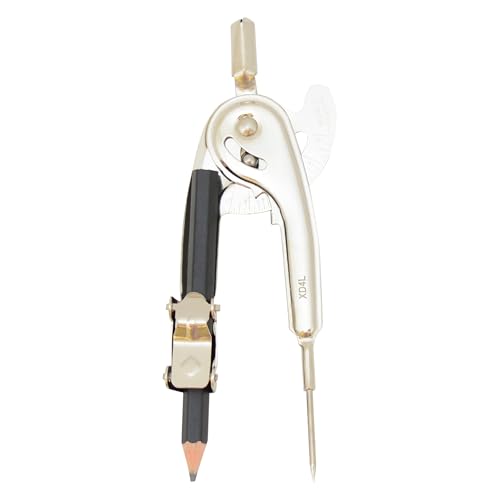
For the largest circle capacity here, this ball-bearing compass draws circles up to 13 inches in diameter. Its nickel-plated metal construction and ergonomic grip are suited to repeated classroom or studio drawing, while the dual-scale capability supports measurement during geometry and drafting work. A compass makes a circle by pivoting one leg around a center point as the pencil leg traces the circumference; the maximum diameter is twice the radius setting. The tradeoff is that a pointed pivot needs a stable surface and can mark paper, so this is less convenient than a template when you only need common fixed sizes.
Bottom line: Choose this when your drawings may need circles up to 13 inches across.
Mr. Pen Professional Geometry Compass

For controlled geometry work in a smaller range, this metal compass draws circles up to 8 inches in diameter and has a spring bow head with a center wheel intended to prevent unintentional leg movement. The center wheel adjusts the opening, which sets the circle’s radius; an 8-inch diameter therefore requires a 4-inch radius. Extra lead is included, and the compass comes in a reusable pouch for storage. Its main limitation is reach: choose another option if your drawing requires circles wider than 8 inches, such as the 13-inch-capacity compass.
Bottom line: Choose this for geometry circles that stay within an 8-inch diameter.
CYUXING Adjustable Woodworking Compass

Unlike a classroom compass, this adjustable aluminum-alloy tool also functions as a marking gauge for equal-distance scribing. The maker describes a metal bearing and dual-ruler linkage for rotation, with a locking radius to hold the setting while marking. It suits carpenters, architects, or students who need both circle layout and parallel marks. As with any scribing tool, secure the material before rotating the point or marking edge.
Bottom line: Choose this when circle layout and equal-distance scribing both matter.
Acooruiteng Circle Template

For preset circles without adjusting compass legs, this plastic stencil is a fixed-opening template measuring about 4.53 inches across. Multiple openings allow repeatable circles in different sizes, and the template’s compact format fits easily into a bag for school or office use. A stencil trades adjustable reach for speed: align the desired opening, hold the template flat, and trace its edge. The 4.53-inch measurement is the template’s overall diameter, not the diameter of every circle it can draw, so choose an adjustable compass if you need a specific large circle or a continuous range of sizes.
Bottom line: Choose this for portable, repeatable circles within its openings.
CUALORK Two-Piece Geometry Compass Set

This set contains two plated carbon-steel compasses, making it the only two-piece compass option among these choices. Each has a spring bow head, center wheel, and automatic locking mechanism intended to keep the legs from shifting while drawing. Turning the wheel adjusts the radius, so check whether the resulting diameter fits your drawing before committing the pencil to paper. A fixed template is simpler when you only need repeatable preset openings.
Bottom line: Choose this if having two adjustable compasses matters more than a specified range.
How to Choose a Circle-Making Tool
Start with the largest diameter you need, then choose an adjustable compass or a fixed-opening template. A compass draws a circle as its point stays at the center and its pencil travels around; the radius is half the diameter, so a 10-inch circle needs a 5-inch compass opening. A template is faster for repeated preset sizes but cannot make a size between its openings. A marking-gauge style tool adds straight, parallel scribing to circle layout. For a required circle wider than 8 inches, select a tool with a capacity above that size rather than guessing from its overall length.
Compass Range and Circle Size
Circle diameter is twice the distance between a compass pivot and pencil tip, so set the opening to half the target diameter. The capacity of Westcott Ball Bearing Compass is 13 inches in diameter, while Mr. Pen Professional Geometry Compass reaches 8 inches; these figures describe different maximum circles, not the physical length of the tools. The woodworking compass is adjustable, but its range is not supplied, so verify the maximum before choosing it for a particular panel or drawing. A larger circle also needs enough clear, flat area for both the compass sweep and your hand. Keep the pivot steady while changing radius to avoid shifting the circle center.
Compass or Circle Template
Choose an adjustable compass for circles whose diameter changes from one drawing to the next, and choose a stencil for repeated preset openings. A compass setting follows the radius, so a 6-inch circle calls for a 3-inch point-to-pencil span. A circle template avoids radius adjustment, but the opening size—not the template’s outside width—sets the circle diameter. Use this comparison when deciding which tool style fits your task.
| Need | Tool style | Tradeoff |
|---|---|---|
| Variable circle sizes | Adjustable compass | Requires setting and holding a radius |
| Repeated preset openings | Circle template | Limited to its opening sizes |
| Circles plus equal-distance marks | Compass and marking gauge | Verify its working range |
Safe and Accurate Circle Drawing
Keep the pivot point controlled and the work surface stable; a sharp compass point can puncture paper or scratch a tabletop. On wood, clamp or otherwise secure the piece before rotating a scribing point, and keep fingers outside its sweep. For clean geometry, set the radius before drawing, place the pivot at the intended center, and maintain the same opening through a full rotation. A template needs a flat hold, because slipping between openings or while tracing can distort the circle. If the task involves a specific size limit, confirm the tool’s circle capacity rather than relying on its overall dimensions.
Frequently Asked Questions
How do I set a compass for a circle?
Set the distance from the pivot to the pencil tip to half the desired diameter. For example, a 12-inch circle needs a 6-inch radius setting. Keep the pivot at the center as you rotate the pencil leg.
Does a 4.53-inch template make a 4.53-inch circle?
No; 4.53 inches is the template’s overall width, not the diameter of each opening. Trace a specific opening to make a circle matching that opening’s diameter. Check the opening itself when a precise circle size matters.
Can a geometry compass draw large circles?
Some can, but the maximum depends on the compass’s reach. Among these options, one is rated for circles up to 13 inches in diameter and another up to 8 inches; choose based on the largest circle you need.
How can I keep a circle from shifting while drawing?
Keep the pivot point planted and hold the compass legs at a steady opening throughout the rotation. A center wheel or locking mechanism can help maintain the setting, but it does not replace a stable hand and flat work surface.
When should I use a circle template instead?
Use a template when you need repeatable circles from its preset openings rather than a continuous adjustable range. Hold it flat while tracing; a compass is the better fit for a circle size that does not match an opening.