
Best Fingerless Motorcycle Gloves for Open-Air Control

For most riders choosing fingerless motorcycle gloves, Milwaukee Leather SH216 Gel-Padded Gloves stands out for its perforated cowhide leather and gel-padded palm. Choose SUJAYU Knuckle-Protection Fingerless Gloves or SUJAYU Outdoor Fingerless Gloves instead if molded knuckle protection matters more than leather construction; all three leave the fingers exposed.
Fingerless gloves are half-finger gloves that preserve fingertip access but cannot cover or protect the exposed skin there. They are not a substitute for full-finger gloves when fingertip coverage is a priority.
We earn a commission if you buy through links on this page. As an Amazon Associate I earn from qualifying purchases. Products are compared on manufacturer specifications, not hands-on testing.
- Best overall: Milwaukee Leather SH216 Gel-Padded Gloves – Perforated cowhide leather and a gel-padded palm distinguish it from the microfiber options.
- Best for knuckle coverage: SUJAYU Knuckle-Protection Fingerless Gloves – Combines hard knuckle protection with a reinforced palm panel.
- Best for palm reinforcement: SUJAYU Outdoor Fingerless Gloves – Pairs molded knuckles with a reinforced palm and EVA knuckle cushion.
| Product | Best for | Construction | Palm feature | Knuckle feature | Shop |
|---|---|---|---|---|---|
| Milwaukee Leather SH216 Gel-Padded Gloves | Leather palm comfort | Perforated cowhide leather | Gel-padded palm | Open knuckle | Check Price on Amazon |
| SUJAYU Knuckle-Protection Fingerless Gloves | Knuckle protection | Stretchable microfiber | Reinforced palm panel | Hard padded knuckles | Check Price on Amazon |
| SUJAYU Outdoor Fingerless Gloves | EVA knuckle cushion | Stretchable microfiber | Reinforced artificial-leather palm | EVA knuckle cushion | Check Price on Amazon |
Best Fingerless Motorcycle Gloves
Compare their construction and impact-protection features against the coverage you need.
Milwaukee Leather SH216 Gel-Padded Gloves

Perforated cowhide leather and a gel-padded palm set these gloves apart from the microfiber choices. The unlined, lightweight design has stretch sides and an adjustable wrist strap, giving riders a way to tune the fit around the wrist. The maker says the gel padding helps with grip and vibration reduction. This is the clearest choice for someone who wants a leather half-finger glove with palm padding, but its open-knuckle design lacks the molded knuckle coverage found on the SUJAYU options.
Bottom line: Choose this if you prefer perforated leather and gel padding over molded knuckle coverage.
SUJAYU Knuckle-Protection Fingerless Gloves
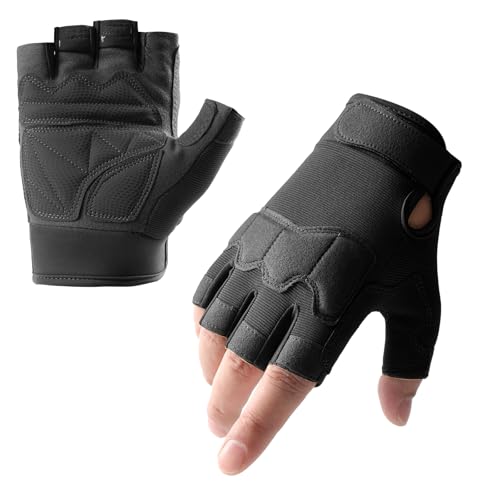
Hard padded knuckles distinguish these gloves from the leather Milwaukee pair, while the reinforced palm panel adds a separate wear-focused feature. The stretchable microfiber construction and adjustable wrist strap are intended to accommodate movement and fit adjustment. The maker says the exposed fingers allow phone use and easier donning; that same open-finger design leaves fingertips uncovered. Choose these for a half-finger glove where knuckle coverage is a priority, but not if you want full-finger protection.
Bottom line: Choose these when hard knuckle protection matters more than fingertip coverage.
SUJAYU Outdoor Fingerless Gloves
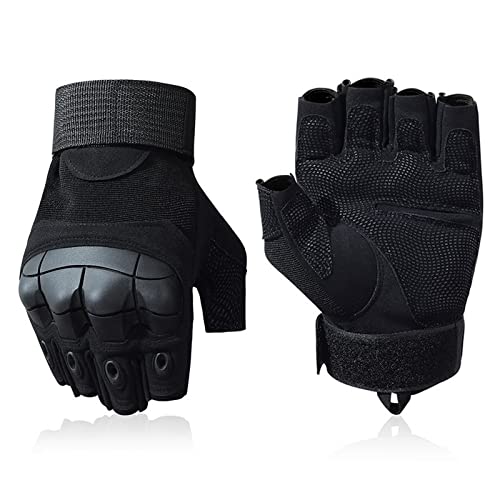
An EVA knuckle cushion and artificial-leather palm panel distinguish this SUJAYU model from the other options. The maker describes the knuckles as hard molded and the palm panel as wear-resistant; an adjustable wrist strap lets the wearer tighten the fit. Like other half-finger gloves, the design keeps fingertips exposed, so it is a poor match when skin coverage across the whole hand is the priority. It suits riders seeking a fingerless style with knuckle cushioning, though the feature set does not include the cowhide construction of Milwaukee Leather SH216 Gel-Padded Gloves.
Bottom line: Choose these if you want an EVA knuckle cushion with a reinforced palm.
How to choose fingerless motorcycle gloves
Start with the coverage tradeoff: fingerless gloves expose the fingertips, so riders prioritizing skin coverage should choose a full-finger design instead. Next, compare palm reinforcement and knuckle coverage as separate features; one does not guarantee the other. Leather and textile gloves both appear in this set, but material alone does not establish a safety rating. Check that the glove sits securely at the wrist and that seams do not bunch when you close your hand around the grips. A measurable rule helps: if the glove shifts enough to expose more of the palm when you flex your wrist, try a different fit rather than relying on the strap alone. Treat padding as a comfort or construction feature, not proof of certified impact protection.
Fingerless versus full-finger motorcycle gloves
Fingerless gloves trade fingertip coverage for access and airflow, while full-finger gloves cover the ends of the fingers. That distinction matters in a fall because exposed skin has no glove layer between it and the ground. The following comparison is a quick way to match the design to the priority; coverage describes the glove shape, not a safety rating.
| Priority | Fingerless | Full-finger |
|---|---|---|
| Fingertip access | Fingertips exposed | Fingertips covered |
| Airflow at fingers | More direct airflow | Less direct airflow |
| Skin coverage | Partial hand coverage | Coverage across fingers |
Choose fingerless gloves for tasks where exposed fingertips are useful, not as a shortcut to full-hand protection. For longer road rides or situations where abrasion protection is the priority, compare full-finger motorcycle gloves and verify their protective construction independently.
How wrist fit and palm padding affect control
A secure wrist fit helps keep a glove in place as the hand moves between the throttle, brake and clutch. Adjust the closure snugly without restricting circulation or wrist movement, then flex your hand around a grip-sized object to check for bunching at the palm. Palm padding can change how a glove feels against vibration and pressure, but thicker padding is not automatically better: excess material can alter grip feel. Fingerless gloves also leave finger pads exposed, so test whether the open edge interferes with your control reach before riding. Replace gloves if seams split or padding shifts, since damaged construction can change fit and coverage.
Common mistakes with half-finger riding gloves
The most important mistake is treating knuckle protection as complete hand protection. Hard or padded knuckles cover only part of the hand, and exposed fingertips remain unprotected; a reinforced palm also does not cover the fingers. Another mistake is choosing solely by material or padding without checking glove fit against the controls. Check that the wrist closure stays secure and the palm does not fold under your hand. For wet or cold conditions, consider that exposed fingers have no fabric barrier, so a half-finger design may not suit the ride. Match coverage to the conditions and the protection you need rather than assuming a motorcycle label alone establishes a certification.
Frequently Asked Questions
Do fingerless motorcycle gloves protect fingertips?
No, fingerless gloves leave the fingertips exposed. Choose full-finger gloves when coverage over the entire finger is important.
Are fingerless gloves suitable for highway riding?
Fingerless gloves leave skin on the fingertips uncovered, regardless of speed. Riders prioritizing abrasion coverage should use a full-finger motorcycle glove with appropriate protective construction.
How tight should motorcycle gloves fit?
A motorcycle glove should stay put without restricting wrist movement or circulation. Flex around a grip and check that the palm does not bunch or the glove shift at the wrist.
Does palm padding reduce motorcycle vibration?
Palm padding can add cushioning, but the result depends on the glove design and fit. It does not replace a secure grip or provide fingertip coverage.
When should motorcycle gloves be replaced?
Replace gloves when seams split, closures no longer hold, or padding shifts out of position. Those changes can affect fit and the areas the glove covers.