
Best Epoxy for Plastic to Metal: 4 Options Compared

Gorilla Epoxy Ultimate 0.85 oz is the best epoxy for plastic to metal for most repairs because it is formulated for both materials and sets in 10 minutes. Choose Starbond 5 Minute Epoxy Pro Kit instead when a flexible, clear bond and vibration resistance matter more; for plastic types beyond those named by each maker, confirm compatibility before ordering.
We earn a commission if you buy through links on this page. As an Amazon Associate I earn from qualifying purchases. Products are compared on manufacturer specifications, not hands-on testing.
- Best overall: Gorilla Epoxy Ultimate 0.85 oz – Bonds metal and plastic, sets in 10 minutes, and cures black.
- Best for flexible bonds: Starbond 5 Minute Epoxy Pro Kit – Its toughened formula is designed to absorb vibration and resist brittle cracking.
- Best for heat exposure: WAN2TLK 5 Minute Epoxy Kit – The maker says it withstands heat up to 300°F.
| Product | Best for | Set time | Finish | Package size | Shop |
|---|---|---|---|---|---|
| Gorilla Epoxy Ultimate 0.85 oz | Quick black repairs | 10 minutes | Black | 0.85 oz | Check Price on Amazon |
| Starbond 5 Minute Epoxy Pro Kit | Flexible clear bonds | 5 minutes | Clear | 8 oz | Check Price on Amazon |
| Tylove Metal Glue Heavy-Duty Epoxy | Sandable repairs | 30 minutes | Silver and beige | 1.76 oz | Check Price on Amazon |
| WAN2TLK 5 Minute Epoxy Kit | Heat exposure | 5 minutes | Clear | 250 ml | Check Price on Amazon |
Epoxy for Plastic to Metal
Compare the mixed-material claims, set times, and finishes to match the adhesive to your repair.
Gorilla Epoxy Ultimate 0.85 oz

Gorilla Epoxy Ultimate 0.85 oz sets in 10 minutes, faster than the 30-minute option here, and is a direct fit for plastic-to-metal repairs because its maker names both materials. The 0.85-ounce dual syringe dispenses the epoxy, and the cured bond is black and waterproof. The maker gives a 4,250 PSI strength figure, but that number alone does not establish how a specific joint will perform; surface fit and preparation matter. The black cure can show on light-colored parts, so choose a clear adhesive when the seam needs to blend in.
Bottom line: Choose this for a fast-setting, waterproof bond when a black finish is acceptable.
Starbond 5 Minute Epoxy Pro Kit

Starbond 5 Minute Epoxy Pro Kit stands out for its toughened, flexible formula, which the maker says absorbs vibration and stress without brittle cracking. The 8-ounce kit mixes at a 1:1 ratio, sets in about 5 minutes to handling strength, and reaches full cure in 24 hours. Its clear finish suits repairs where a black or dark gray seam would be conspicuous. The maker names ABS and PVC among compatible plastics, but that does not establish compatibility with every plastic; identify the material before relying on the bond.
Bottom line: Pick this when you need a clear bond that can accommodate vibration.
Tylove Metal Glue Heavy-Duty Epoxy
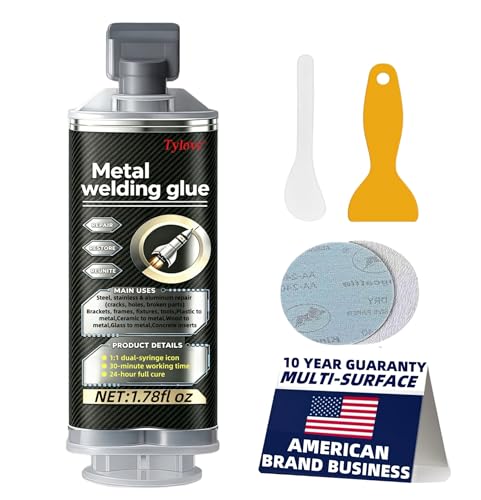
Tylove Metal Glue Heavy-Duty Epoxy gives plastic-to-metal repairs a longer 30-minute set than the faster formulas, which can leave more time to align parts. The 1.76-ounce epoxy is described as waterproof and can be sanded, drilled, and painted after curing; the maker says full cure takes 24 hours. Its silver-and-beige coloring may remain visible, so it is less suitable when the joint needs a clear appearance.
Bottom line: Choose it when finishing the cured repair matters more than a fast set.
WAN2TLK 5 Minute Epoxy Kit

WAN2TLK 5 Minute Epoxy Kit is a clear two-part epoxy for mixed-material projects, with plastic and metal among the materials named by its maker. The maker says it allows about 5 minutes of working time, reaches functional cure in 1 hour, and achieves full bonding strength in 24 hours. It is also described as heat resistant up to 300°F, making temperature exposure a relevant selection factor.
Bottom line: Pick this for a clear repair when the maker’s heat limit is useful.
How to choose epoxy for plastic to metal
Match the epoxy to the plastic type, joint movement, finish, and time available for alignment. Plastic is not one bonding surface: ABS, PVC, polyethylene, and polypropylene behave differently, and many general-purpose epoxies do not bond every type equally well. Check the molded resin code or manufacturer documentation first, and test an inconspicuous area when the plastic is unknown. For a rigid, well-fitting joint, a standard two-part epoxy may work; vibration or flex favors a toughened formulation. A 5-minute set is useful for small, accurately aligned parts, while a 30-minute set allows more positioning time. Keep the repair unloaded through the full cure, not merely the set period.
Prepare plastic and metal surfaces
Surface preparation often decides whether epoxy grips metal and plastic: remove oil, dust, oxidation, and loose coating before mixing. Lightly roughen bare metal and compatible rigid plastic with fine abrasive, then remove the residue and allow both surfaces to dry fully. Avoid sanding thin or brittle plastic aggressively, and do not use a solvent that softens or crazes the part. Mix two-part epoxy thoroughly in the maker’s specified ratio; an uneven mix can leave soft or weak areas. Apply enough adhesive to wet both faces without forcing all of it out during clamping. Use steady alignment pressure rather than excessive clamping, which can starve the joint of adhesive.
Set time, cure time, and joint strength
Set time is not the same as full cure: an epoxy that can be handled after minutes may need hours before it reaches its intended bond strength. A practical rule is to keep the joint stationary and unloaded for the full cure period, especially when the repair will carry weight or see vibration. Strength figures in pounds per square inch or shear strength are not direct predictions for every repair; test conditions, bonded area, surface preparation, and the direction of force all affect results. A broad overlap joint generally distributes force better than a narrow edge-to-edge seam. Do not use an adhesive repair on a safety-critical load unless the part’s design and manufacturer support that repair.
Common epoxy mistakes on mixed-material repairs
The most common mistake is assuming that an epoxy labeled for plastic works equally well on all plastics. Polyethylene and polypropylene are notably difficult for ordinary adhesives to bond, so choose a product specifically validated for the identified resin instead of relying on a broad plastic claim. Another mistake is moving the parts during the early set or exposing the joint to service before full cure. Avoid mixing too much at once: two-part epoxy begins reacting after the components are combined, and larger batches can heat more quickly. Wear gloves, protect the work surface, and provide ventilation; keep uncured resin and hardener away from skin, eyes, children, and pets.
Frequently Asked Questions
Can epoxy bond polyethylene to metal?
Many ordinary epoxies struggle to bond polyethylene reliably. Use an adhesive specifically validated for polyethylene or a surface-treatment process designed for that resin, and do not assume a general plastic claim covers it.
How long should epoxy cure before loading a repair?
Wait for the maker’s full-cure period before applying service loads; quick set time only indicates early handling strength.
Does plastic need sanding before epoxy is applied?
Lightly roughening a rigid, compatible plastic can improve mechanical grip, while aggressive sanding can damage thin or brittle parts. Remove sanding dust and make sure the surface is dry before applying adhesive.
Is epoxy stronger in shear or peel?
Epoxy joints generally handle shear better than peel, because peeling concentrates force at an edge. Design the repair with a broad overlap and support the joint so the load does not pull the surfaces apart.
Can cured epoxy be used near heat?
Heat limits depend on the specific formula, and a heat-resistance figure should not be treated as a guarantee for a loaded joint at that temperature. One choice gives a maker-stated limit of 300°F; confirm the adhesive’s limit suits both the operating temperature and load.