
Cigarette Lighter to Electrical Outlet: Inverters

For a cigarette lighter to electrical outlet, PiSFAU 200W Car Power Inverter suits most people who want two AC outlets plus several USB ports in a compact inverter that converts a car’s 12-volt DC power to AC. Choose BESTEK 300W Car Power Inverter instead if you need its 300 watts of continuous output, and check your vehicle’s socket limit before connecting an inverter.
We earn a commission if you buy through links on this page. As an Amazon Associate I earn from qualifying purchases. Products are compared on manufacturer specifications, not hands-on testing.
- Best overall: PiSFAU 200W Car Power Inverter – It combines two AC outlets with four USB charging ports in a 5-inch body.
- Best for higher output: BESTEK 300W Car Power Inverter – The maker specifies 300 watts continuous output and two AC outlets.
- Best for USB-C: 200W Car Power Inverter with USB-C – Its four USB ports include USB-QC and USB-C outputs.
| Product | Best for | USB ports | Dimensions | Shop |
|---|---|---|---|---|
| PiSFAU 200W Car Power Inverter | Multi-device charging | 4 | 5 × 2.7 × 1.4 in | Check Price on Amazon |
| BESTEK 300W Car Power Inverter | Higher AC output | 2 | 4.8 × 3.1 × 1.9 in | Check Price on Amazon |
| 200W Car Power Inverter with USB-C | USB-C charging | 4 | 5 × 2.7 × 1.4 in | Check Price on Amazon |
Cigarette Lighter to Electrical Outlet Inverters
Compare the outlet count, charging ports and body size to find an inverter suited to your devices and vehicle.
PiSFAU 200W Car Power Inverter

Two AC outlets and four USB charging ports distinguish this compact PiSFAU inverter, which converts 12-volt DC power from a car socket to 110-volt AC. Its 5 × 2.7 × 1.4-inch body weighs about 8.5 ounces, making it suited to travelers who want to charge several smaller devices without carrying a large unit. The maker describes its circuit and heat-dissipation design as quiet and efficient, and the ABS shell is insulated. The product name gives a 200-watt rating, but the vehicle socket may not support that full load; verify its limit before use.
Bottom line: Choose this if you want two AC outlets and four USB charging ports in a compact inverter.
BESTEK 300W Car Power Inverter
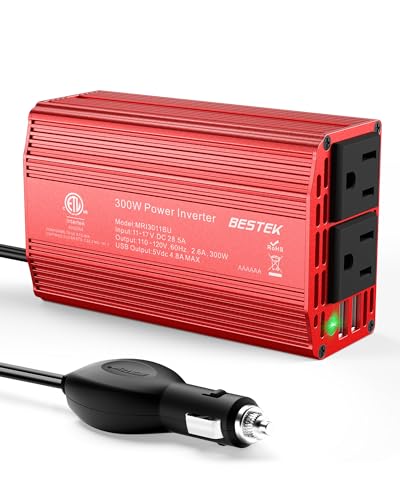
Among these options, BESTEK 300W Car Power Inverter is the one whose maker specifies 300 watts of continuous output and 700 watts instantaneous output. It converts 12–17 volts DC to 110-volt AC and has two AC outlets plus two 4.8-amp USB ports. The 4.8 × 3.1 × 1.9-inch unit weighs 0.9 pounds and has a 32-inch cigarette-lighter plug cord, which can help with placement inside a vehicle. It suits users who need more stated continuous AC capacity than the 200-watt models offer, but that rating does not override a car socket’s own power limit.
Bottom line: Pick this when its 300-watt continuous output matters and your vehicle socket supports the load.
200W Car Power Inverter with USB-C

A USB-C port rated at 20 watts and a USB-QC port rated at 18 watts set 200W Car Power Inverter with USB-C apart from the other 200-watt option. The inverter converts 12-volt DC to 110-volt AC and provides two AC outlets and four USB ports, suited to a mix of plug-in and USB devices on a trip or at a campsite. Its dimensions are 5 × 2.7 × 1.4 inches, about phone-sized. The specifications do not give a continuous AC rating, so buyers planning to run an AC device should confirm the needed output and vehicle-socket limit before using it.
Bottom line: Choose this for the USB-C and USB-QC charging outputs alongside AC outlets.
How to choose a car inverter
Choose an inverter by matching the device’s power draw to both the inverter rating and the vehicle outlet’s limit. A 12-volt socket is commonly fused for about 10 to 15 amps, equivalent to roughly 120 to 180 watts before conversion losses; the vehicle manual or socket label determines the actual limit. For example, a 150-watt socket cannot safely deliver a 300-watt load just because an inverter advertises that capacity. Check the device label for watts, or multiply volts by amps when only those figures are given. Allow headroom rather than choosing an inverter that exactly matches a device’s running draw, especially for equipment with a motor or other startup surge.
AC outlets versus USB charging ports
AC outlets power devices with a standard household-style plug, while USB ports charge devices designed for USB power. A phone or tablet can often use a USB port directly; a laptop with an AC adapter needs an AC outlet unless it supports charging through the inverter’s USB-C port. USB-C wattage varies by port, so compare its rating with the device’s required input. A multi-port unit can have enough sockets but still share a limited total output across them. Add the wattage of devices used at the same time and keep the combined load within the inverter rating and vehicle outlet limit.
| Need | What to compare | Practical check |
|---|---|---|
| Household plug | AC watts and outlet count | Match device draw to both power limits |
| USB device | Port type and rated watts | Match USB-C or USB-A requirements |
| Several devices | Total simultaneous load | Add their wattage before connecting |
Using an inverter safely in a vehicle
Keep an inverter’s vents clear and place it where it cannot be covered by bags, blankets or clothing; power conversion produces heat even in a compact unit. The vehicle socket, plug and cord should remain accessible, and the inverter should not sit where it can interfere with pedals or driving. Do not exceed the socket’s fuse rating: if a device needs more power than the socket permits, use only an inverter and connection method explicitly intended for that vehicle and load. Disconnect the unit when it is not needed, since some vehicle outlets remain energized after the engine is off and can drain the battery.
When an AC-to-car adapter is the right direction
A cigarette-lighter-style socket is a 12-volt DC outlet, while a wall receptacle supplies AC; a converter may transform in either direction, so check which side is the source. Car inverters take vehicle DC and provide AC for plug-in devices. A wall-powered adapter does the reverse, converting household AC to 12-volt DC for a car accessory. Those reverse-direction adapters often have low current limits; at 500 milliamps and 12 volts, the output is only about 6 watts, far below the needs of high-draw equipment such as an air compressor. Match voltage, polarity and current before connecting a 12-volt device.
Frequently Asked Questions
Can a car inverter run a laptop?
Yes, if the inverter’s AC output and the vehicle socket can both support the laptop charger’s draw. Check the charger label in watts and allow extra capacity for startup or charging peaks.
How many watts can a cigarette lighter socket handle?
Many 12-volt vehicle sockets are fused around 10 to 15 amps, or roughly 120 to 180 watts before conversion losses. The vehicle’s manual or socket label gives the limit to use.
Can an inverter drain a car battery?
Yes, an inverter can drain the battery when used with the engine off, especially over extended periods. Disconnect it when not in use, and avoid running high loads without the engine running.
What is the difference between an inverter and a wall adapter?
A car inverter converts 12-volt DC from a vehicle socket into household-style AC. A wall adapter that has a car socket instead converts household AC into 12-volt DC, so check the power direction before choosing.
Can I plug an air compressor into a car inverter?
Only if the compressor’s running and startup requirements stay within both the inverter’s rating and the vehicle outlet limit. Motor startup can draw more power than normal operation, so a small socket-powered inverter may not be suitable.