
Best Outdoor TV Antenna for Rural Areas: 5 Compared

The Televes DAT BOSS Mix LR is the strongest fit for many rural homes because its directional design and automatic gain control target challenging long-range reception. Choose PBD 360° Motorized Outdoor Antenna instead if you want remote-controlled rotation, or Antennas Direct ClearStream 4V if a multi-directional design better suits towers in several directions.
Outdoor TV antennas receive local over-the-air broadcasts through VHF and UHF signals; actual reception depends on tower distance, terrain, trees, and building materials.
We earn a commission if you buy through links on this page. As an Amazon Associate I earn from qualifying purchases. Products are compared on manufacturer specifications, not hands-on testing.
- Best overall: Televes DAT BOSS Mix LR – Its directional design, band-specific automatic gain control, and interference filtering target fringe reception.
- Best for remote aiming: PBD 360° Motorized Outdoor Antenna – A wireless remote controls its 360-degree motorized rotation.
- Best for multiple tower directions: Antennas Direct ClearStream 4V – Its multi-directional design uses four loops, Hi-VHF elements, and reflectors.
| Product | Best for | Maker’s range claim | Aiming design | Notable signal feature | Shop |
|---|---|---|---|---|---|
| Televes DAT BOSS Mix LR | Fringe reception | Up to 100 miles | Directional | TForce gain control; FM/LTE filters | Check Price on Amazon |
| PBD 360° Motorized Outdoor Antenna | Remote aiming | Up to 150 miles | Motorized 360° rotation | Built-in amplifier; dual outputs | Check Price on Amazon |
| Antennas Direct ClearStream 4V | Multi-directional reception | Long-range; miles not given | Multi-directional | Four loops; Hi-VHF elements | Check Price on Amazon |
| GE Outdoor HD Digital Antenna 29884 | Attic or outdoor | 70+ miles | — | ATSC 3.0 support | Check Price on Amazon |
| Five Star Outdoor HDTV Antenna | Multi-TV setup | Up to 200 miles | Multi-directional | VHF/UHF; ATSC 3.0 ready | Check Price on Amazon |
Outdoor TV Antennas for Rural Areas
Compare reception design and signal features against your tower directions and likely obstructions.
Televes DAT BOSS Mix LR

For a rural location with weak or fluctuating signals, this directional antenna stands apart with TForce automatic gain control that adjusts amplification independently by band. The maker claims reception up to 100 miles and gives gain figures of 38 dBi for High VHF and 46 dBi for UHF. Integrated FM, LTE, 4G, and 5G filtering is intended to reduce interference. Its directional design suits a home where the main transmitters are in a known direction; aiming matters, and it is less suited to towers spread around the horizon. A power supply is included.
Bottom line: Choose it for a known tower direction and challenging reception conditions.
PBD 360° Motorized Outdoor Antenna

Remote-controlled aiming is the distinguishing feature here: a motor turns the antenna through 360 degrees, so you can change its direction without physically repositioning it. The maker claims reception up to 150 miles and describes a built-in high-gain, low-noise amplifier. Dual TV outputs support connecting two televisions. This can suit rural homes where towers lie in different directions or signal conditions make aiming a recurring task. The range figure is a maker claim, not a guarantee; terrain, trees, and tower direction still affect reception. A mounting pole and 40-foot RG6 cable are included.
Bottom line: Pick it when remote rotation and two TV outputs are priorities.
Antennas Direct ClearStream 4V
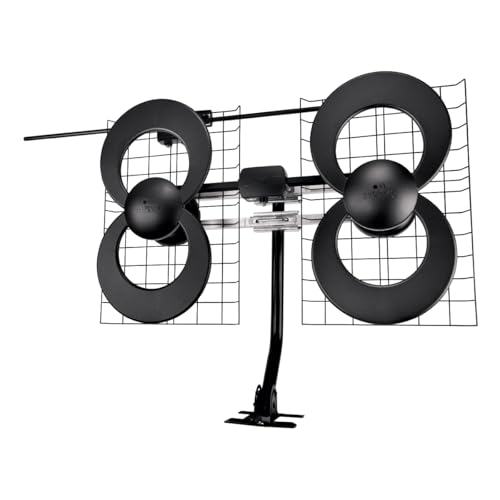
Unlike a narrow directional setup, this antenna is described as multi-directional, with four loops, Hi-VHF elements, and reflectors. That design can suit a rural site where useful transmitters are not clustered in one direction. The manufacturer recommends it for suburban and rural installation and says trees, tower distance, and building materials affect reception. Its 27.8-inch width and 17.4-inch height call for more mounting space than the compact GE antenna. The 20-inch mast is useful for mounting, but this model does not offer the remote motorized rotation found on PBD 360° Motorized Outdoor Antenna.
Bottom line: Choose it when tower directions vary and you have room for its wider frame.
GE Outdoor HD Digital Antenna 29884

Attic flexibility is the main distinction: this weather-resistant antenna is designed for hidden attic installation as well as outdoor mounting. The maker claims reception from up to 70+ miles and says it supports ATSC 3.0 broadcasts where available. Its 16.6-inch width is narrower than the ClearStream 4V, which may help when mounting space is limited. The range does not account for every home’s terrain or obstructions, so a distant tower behind hills or dense trees may remain difficult to receive. It includes a J mount and works with TVs or converter boxes using a standard coax connection.
Bottom line: Pick it for a compact attic-capable option with a J mount.
Five Star Outdoor HDTV Antenna
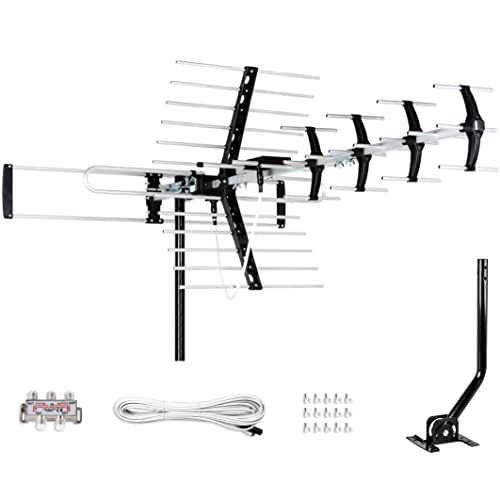
A multi-TV installation kit and J mount distinguish this antenna from the other options. It is described as multi-directional and supports VHF and UHF reception; the maker claims a range up to 200 miles and says the antenna is ATSC 3.0 ready. That setup may appeal to rural households planning several television connections. The 200-mile figure is a maker claim, not a reliable prediction for a specific address; terrain, trees, obstacles, and local tower placement can limit reception. Its dimensions are 17.5 inches long, 11.3 inches wide, and 6.3 inches high.
Bottom line: Choose it if the included multi-TV installation kit suits your setup.
How to choose an outdoor TV antenna for rural areas
Start with the direction and distance of the broadcast towers, then account for terrain and obstructions. A directional antenna can focus on a known tower cluster, while a multi-directional design can suit transmitters spread across different bearings. A motorized model lets you change aim remotely. The range numbers in product claims are not a guarantee for your location: hills, dense trees, and long distance can weaken reception. Before choosing, check a broadcast coverage map for your address and note the compass directions of the stations you want. If the desired towers are in one direction and reception is fringe, favor a directional model with filtering or gain control; if they are scattered, consider multi-directional reception or rotation.
Mounting height, aiming, and obstructions
Higher, unobstructed mounting generally gives an antenna a clearer path to broadcast signals, but roof height alone cannot overcome a hill between the home and tower. Keep the antenna clear of nearby metal surfaces and dense foliage where possible, and secure outdoor mounts against wind. Directional antennas need careful aiming toward the desired transmitters; small changes can affect reception, so rescan channels after adjusting the direction. With towers in several directions, a multi-directional antenna or a rotating model can reduce the need to re-aim by hand. Check that the chosen mounting location has safe access and enough clearance for the antenna and mast before installation.
VHF, UHF, and interference filtering
Over-the-air television uses both VHF and UHF bands, so check that an antenna covers the bands used by the local stations you want. Channel numbers shown by a TV do not always identify the broadcast frequency band, so use a local station guide rather than guessing from the displayed number. Nearby cellular signals and FM broadcasts can interfere with reception; built-in filters can help reduce some of that interference, but they do not improve a blocked path to a tower. Amplifiers can help with weak signals and long cable runs, but too much amplification can overload a receiver. For a fringe location, gain control and filtering are useful features to compare.
Choose an antenna by tower layout
Use tower direction and installation needs to narrow the antenna type before weighing advertised range claims. A directional model suits concentrated towers, while rotation can help when stations lie across different bearings. The comparison below focuses on those practical distinctions.
| Site condition | Useful design | Trade-off |
|---|---|---|
| Transmitters cluster in one direction | Directional antenna | Needs accurate aiming |
| Transmitters lie in several directions | Multi-directional antenna | Reception still varies with obstructions |
| Aim may need adjustment | Motorized rotation | Requires power and setup |
| Potential nearby signal interference | Built-in band filtering | Cannot remove terrain blockage |
Safe outdoor installation and channel scanning
Outdoor antenna installation near power lines can be deadly: keep the antenna, mast, and tools well away from overhead electrical wires, and do not install during storms or high winds. A stable mount and weather-rated connections matter because wind and water can loosen or corrode a system over time. After mounting and aiming, run the television’s channel scan; repeat it after major direction changes because the tuner must search again for available stations. Use the antenna manufacturer’s grounding guidance and applicable local electrical rules for the mast and coax installation. If a roof position is hard to reach safely, hire a qualified installer rather than climbing onto a steep or wet roof.
Frequently Asked Questions
Will a 100-mile antenna reach every rural TV tower?
No; a range claim cannot account for every address. Hills, tree cover, tower height, and antenna placement affect whether a signal arrives clearly, so compare the tower path and direction before choosing.
Does an outdoor antenna need to point toward the tower?
Directional antennas generally need to face the desired transmitters for best reception. If stations lie in several directions, a multi-directional antenna or motorized rotation may be more suitable.
Can an antenna receive stations through hills or dense trees?
Hills and dense tree cover can weaken or block broadcast signals even with a long-range antenna. Try to mount with a clearer path toward the tower; extra amplification cannot restore a signal fully blocked by terrain.
Do I need an amplifier for rural television reception?
An amplifier can help when signals are weak or a coax run is long, but excessive gain can overload a TV tuner. Compare an amplified option with a filtered or gain-controlled design when nearby cellular or FM signals may interfere.
How often should I rescan TV channels?
Rescan after changing the antenna’s direction or mounting position so the TV searches again for receivable stations. A scan does not improve a weak signal by itself, so adjust placement or aim when reception is poor.