
Styrofoam for Artificial Flowers: 5 Blocks Compared

For most artificial-flower arrangements, 6-Pack Large Floral Foam Blocks offers the largest rectangular base at 8.9 × 4.1 × 2.7 inches, so it suits broader displays than the smaller blocks. Choose a smaller block when your vase or project has limited space, or round foam when a circular base fits better.
Floral foam is a lightweight, cuttable base that holds stems in place; for artificial flowers, use it dry rather than soaking it.
We earn a commission if you buy through links on this page. As an Amazon Associate I earn from qualifying purchases. Products are compared on manufacturer specifications, not hands-on testing.
- Best overall: 6-Pack Large Floral Foam Blocks – Its 8.9 × 4.1 × 2.7-inch block provides the largest rectangular base in this group.
- Best for round bases: SUPKING Round Floral Foam, 4-Pack – Four round pieces, each 3.15 inches across, suit compact circular arrangements.
- Best for multiple projects: 6-Pack Floral Foam Blocks, 5.5-Inch – Six blocks measuring 5.5 × 3.1 × 1.6 inches give you several small rectangular bases.
| Product | Best for | Shape and dimensions | Pack count | Shop |
|---|---|---|---|---|
| 6-Pack Large Floral Foam Blocks | Large displays | Rectangular, 8.9 × 4.1 × 2.7 in | 6 | Check Price on Amazon |
| SUPKING Round Floral Foam, 4-Pack | Round containers | Round, 3.15 in diameter × 1.6 in | 4 | Check Price on Amazon |
| 6-Pack Floral Foam Blocks, 5.5-Inch | Small projects | Rectangular, 5.5 × 3.1 × 1.6 in | 6 | Check Price on Amazon |
| AYNAUHX Floral Foam Blocks, 6-Pack | Shallow bases | Rectangular, 5.5 × 3.1 × 1.6 in | 6 | Check Price on Amazon |
| FLOFARE Floral Foam Blocks, 3-Pack | DIY crafts | Rectangular, 6 × 3 × 1.75 in | 3 | Check Price on Amazon |
Styrofoam for Artificial Flowers Compared
Match each foam shape and size to the container and stem layout you have in mind.
6-Pack Large Floral Foam Blocks

6-Pack Large Floral Foam Blocks is the largest rectangular option here, with each block measuring 8.9 × 4.1 × 2.7 inches. The set contains six green blocks, and the maker says they are individually wrapped and can be cut to shape. That extra surface area suits wide containers or arrangements with more stems than a compact centerpiece. For artificial flowers, use the foam dry; the water-holding feature is relevant to fresh stems, not a reason to soak a synthetic arrangement. The block’s height may be excessive for a shallow vessel, so measure the usable interior before choosing it.
Bottom line: Choose it for a wide arrangement that needs a large rectangular base.
SUPKING Round Floral Foam, 4-Pack

SUPKING Round Floral Foam, 4-Pack is the only round option, with four pieces measuring about 3.15 inches across and 1.6 inches high. That shape can sit more naturally in a small round bowl or cup than a rectangular brick, and the compact pieces are easy to position in small projects. The maker says the foam works dry for artificial flowers and can also absorb water for fresh cut stems. Its limited diameter makes it a poor fit for broad centerpieces unless several pieces can be arranged together; check that the 3.15-inch circle fits the container opening.
Bottom line: Pick it when a small, circular foam base matches your container.
6-Pack Floral Foam Blocks, 5.5-Inch

6-Pack Floral Foam Blocks, 5.5-Inch supplies six green blocks, each 5.5 × 3.1 × 1.6 inches, making it a useful choice when you need several compact rectangular bases rather than one oversized block. The maker says the pieces can be cut for containers and crafts, and specifies one-time use for arrangements. Dry placement is the relevant mode for artificial flowers; reserve water absorption for fresh stems. Because the blocks are only 1.6 inches high, they may not provide enough depth for long or heavy stems that need substantial anchoring.
Bottom line: Choose it for several smaller arrangements using shallow rectangular bases.
AYNAUHX Floral Foam Blocks, 6-Pack

AYNAUHX Floral Foam Blocks, 6-Pack contains six green blocks at 5.5 × 3.1 × 1.6 inches each, the same size and count as another option here. The maker emphasizes trimming the blocks to fit vases, bowls, or baskets, which makes them adaptable when a standard brick shape needs adjustment. The rapid absorption feature applies to fresh-flower use; artificial stems can be placed in the foam dry. Since this block is shallow, it is better suited to low arrangements than tall designs that rely on deeper stem insertion for support.
Bottom line: Pick it when you want trim-to-fit blocks for low arrangements.
FLOFARE Floral Foam Blocks, 3-Pack
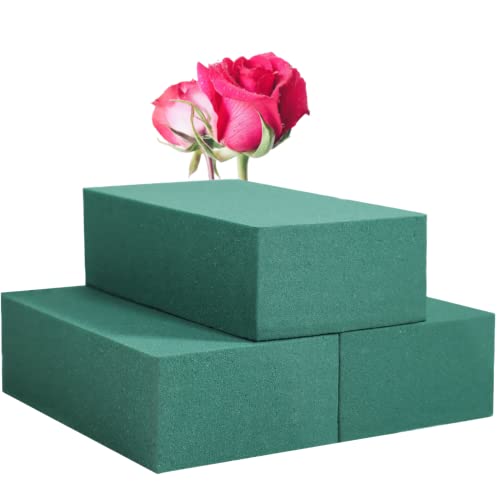
FLOFARE Floral Foam Blocks, 3-Pack has three green blocks measuring 6 × 3 × 1.75 inches, slightly longer and taller than the 5.5 × 3.1 × 1.6-inch bricks, but with half the pieces of the six-packs. That modest extra height can help with a little more stem insertion depth while keeping the base compact. The maker says the blocks are easy to shape and suitable for dry artificial-flower work as well as wet fresh-flower use. A three-piece pack is less suited to projects requiring many separate arrangements, so count your bases before selecting it.
Bottom line: Choose it for a few compact crafts needing a little extra foam depth.
How to choose floral foam for artificial flowers
Start with the container’s interior dimensions and the depth available for the foam, then select the smallest block that leaves room for stems. These options range from round pieces 3.15 inches across to rectangular blocks 8.9 inches long; size matters more than water absorption for synthetic flowers. Dry floral foam holds stems by friction and puncture, while wet floral foam is designed to take up water for fresh cut flowers. For a low vase or shallow tray with less than 2 inches of interior depth, choose a block no taller than 1.75 inches and trim its footprint to fit. A wider base gives more room for stem placement, but can crowd a narrow opening.
Keep the foam stable inside the container so added stems do not tip the arrangement. If the foam shifts when lightly pressed, cut it to fit more snugly or use a container shape that supports its edges.
Rectangular versus round foam blocks
Rectangular bricks are the practical choice for rectangular baskets and broad, flat containers because they offer straight edges that are easy to trim. A round piece can fit a small bowl with less cutting, but its 3.15-inch diameter limits the arrangement footprint. The five options here are green; color can show through open gaps, so place stems closely or conceal exposed foam with decorative material suited to the project. A common mistake is choosing by total pack size rather than the footprint of each piece: six small bricks do not create the same single base as one large block unless they are secured together.
The table compares the two shapes and guides selection by container form.
| Container or arrangement | Foam shape | Fit rule |
|---|---|---|
| Long basket or broad tray | Rectangular | Match block length and width to interior footprint |
| Small round bowl | Round | Check opening is at least 3.15 inches across |
| Shallow vessel | Low rectangular block | Keep foam height within available depth |
How to place stems and keep arrangements stable
Insert stems in deliberate positions and avoid repeatedly pulling them out, because each puncture can loosen the foam around that opening. For a balanced display, distribute stems across the base instead of crowding all of them at one edge; tall stems also create more leverage and can tip a lightweight container. Foam is a support, not a substitute for a stable vase. Trim the block so it sits securely, and test stability on the intended surface before adding decorative elements. Do not force a thick stem into a narrow opening; make an opening suited to the stem rather than splitting the foam with excessive pressure.
Dry use is appropriate for artificial flowers. Wet foam is intended to absorb water for fresh flowers, and soaking it for synthetic stems can add unnecessary moisture to the container and surrounding materials.
Cutting and handling floral foam
Cut foam over a work surface that can be cleaned, using a sharp craft knife and short controlled strokes. Trim small amounts at a time so the block does not become loose inside the container; a snug fit helps resist movement as stems are arranged. Keep fingers out of the blade path and work away from children and pets, since small foam fragments can scatter during cutting. Gather scraps promptly rather than leaving them on a floor or table. If a block is too short in one direction, changing its orientation may solve the fit better than joining scraps, which can shift under stem pressure.
Foam blocks are single-use when saturated for fresh flowers according to one maker’s guidance; for artificial arrangements, avoid soaking them and store unused pieces dry and protected from crushing.
Frequently Asked Questions
Can you use floral foam without soaking it?
Yes, artificial flowers can be placed in dry floral foam. Soaking is intended for fresh cut flowers that need a water source, not synthetic stems.
How deep should artificial flower stems go?
A useful starting point is to insert stems at least 1 to 2 inches into the foam when the stem length allows it. Taller or heavier stems need more depth and a stable container to reduce tipping.
How do you stop floral foam from moving?
Trim the block so it fits closely against the container walls, leaving no large gaps. For a tall arrangement, use a heavier, stable vessel because foam alone cannot prevent the whole display from tipping.
Can floral foam be cut to fit a vase?
Yes, these blocks can be trimmed to fit containers. Cut off small sections at a time, and keep the final block snug rather than undersized so it stays in place.