
Multi Angle Measuring Rulers Compared for Layout Work

For a multi angle measuring ruler, 16-Sided Aluminum Alloy Ruler suits the widest range of layouts in this group because its 16 sides can form varied shapes and its scales show inches and centimeters. Choose a model with a hole pattern or four-arm layout instead if that matches the cut or marking task.
We earn a commission if you buy through links on this page. As an Amazon Associate I earn from qualifying purchases. Products are compared on manufacturer specifications, not hands-on testing.
- Best overall: 16-Sided Aluminum Alloy Ruler – Its 16 sides adjust to varied shapes, and laser-engraved scales show inches and centimeters.
- Best for three hole sizes: 12-Sided Ruler with Three Holes – It includes three positioning apertures measuring 0.98, 1.57 and 1.77 inches.
- Best for four-arm layouts: PEC Tools Four-Piece Metal Ruler – Four locking arms transfer a set angle and dual scales show inches and centimeters.
| Product | Best for | Layout | Locator apertures | Scale | Shop |
|---|---|---|---|---|---|
| 16-Sided Aluminum Alloy Ruler | Versatile layouts | 16 sides | — | Inches and centimeters | Check Price on Amazon |
| 12-Sided Ruler with Three Holes | Three-hole layouts | 12 sides | 0.98, 1.57, 1.77 in | — | Check Price on Amazon |
| 16-Sided Ruler with Five Openings | Multiple hole sizes | 16 sides | 0.98, 1.57, 1.77, 2.16, 2.95 in | Inches and centimeters | Check Price on Amazon |
| PEC Tools Four-Piece Metal Ruler | Four-arm transfer | 4 arms | — | Inches and centimeters | Check Price on Amazon |
| 12-Side Aluminum Alloy Template Ruler | Compact templates | 12 sides | — | Centimeters and inches | Check Price on Amazon |
Multi Angle Measuring Rulers
Compare the adjustable layouts, locator openings and markings to match a ruler to your next template or transfer task.
16-Sided Aluminum Alloy Ruler

The 16-sided layout and dual-scale markings distinguish this ruler from the 12-sided and four-arm options. Its aluminum alloy body has laser-engraved inch and centimeter markings, and the maker says it suits tile, glass, wood, stone and other layout work. Choose it when you need to shape a template and read either unit system. The maker does not give locator-hole diameters, so confirm the opening size before ordering if a specific drilling template is essential.
Bottom line: Choose this for varied shape layouts with inch-and-centimeter markings.
12-Sided Ruler with Three Holes
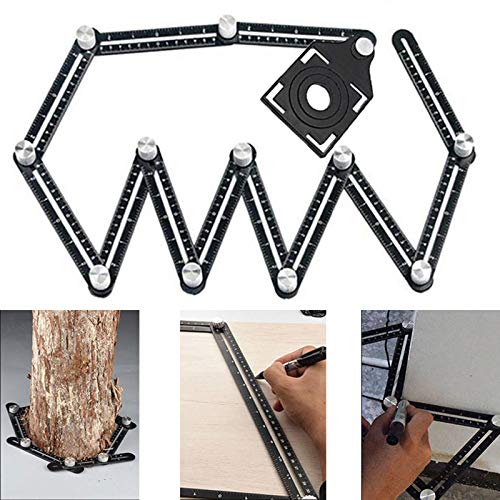
Three positioning apertures make this 12-sided ruler the clearest match when a layout needs one of three opening sizes. The aluminum alloy tool has six metal knobs for adjusting and locking its shape; its apertures measure 0.98, 1.57 and 1.77 inches. Choose it for tile-hole marking or similar transfer work where one of those openings fits. Its 12 sections offer fewer pivot points than the 16-sided designs, which matters when a template needs a more finely segmented outline.
Bottom line: Choose this when one of its three aperture sizes matches the job.
16-Sided Ruler with Five Openings

Five locator diameters distinguish this 16-sided ruler: 0.98, 1.57, 1.77, 2.16 and 2.95 inches. It also has laser-engraved inch and centimeter scales, a 5 mm-thick powder-coated aluminum alloy body, and rubber washers between the joints. The maker says the knobs lock the shape for transfer to another surface. Pick it when several opening sizes matter; the measurements are discrete, so a required diameter between them may call for another marking method.
Bottom line: Choose this when the five stated opening diameters cover your layout needs.
PEC Tools Four-Piece Metal Ruler

Four adjustable arms set this ruler apart from the polygon-style models, making it a straightforward choice for transferring one angle or outline to multiple pieces. Knurled metal knobs lock the arms, and the laser-etched scales show inches and centimeters. The maker says the rigid construction resists flexing under normal marking pressure on materials such as tile, drywall, lumber and laminate. Its four-arm layout is less suited to tracing many-sided shapes, so choose a polygon-style tool if the outline needs more pivot points.
Bottom line: Choose this for locking and repeating a four-arm angle or outline.
12-Side Aluminum Alloy Template Ruler

This 12-sided option pairs a flexible polygon layout with centimeter and inch units, unlike the four-arm transfer tool. Its aluminum alloy construction is described by the maker as abrasion-resistant, and the markings are intended to remain readable. Choose it for tracing adjustable shapes where a three-hole template is not needed.
Bottom line: Choose this for a 12-sided adjustable template when no particular hole size is required.
How to choose a multi angle measuring ruler
Choose by the shape you need to transfer: a four-arm ruler handles simple angles, while 12- or 16-sided rulers provide more pivot points for irregular outlines. A locator opening matters only when its diameter matches the hole or fixture being marked. For a repeatable layout, set the arms against the workpiece, lock the joints, then trace the shape without shifting the tool. Engraved scales help with direct measurements, but they do not replace a square or a straightedge when establishing a perpendicular or baseline. If the task requires a specific hole diameter, use a ruler with that stated opening; otherwise, mark the center and verify the hole size with a separate measuring tool.
Using hole locators and adjustable joints
Hole locators work best when the opening is close to the required diameter and the template stays flat against the work surface. Check the tool’s opening size against the fitting or hole before marking; even a small diameter mismatch changes the cut. Tighten each joint after setting the shape, because loose pivots can shift as the ruler is lifted or traced. For a repeated pattern, retain the locked shape while moving between matching pieces and check the first transfer before repeating it. Keep fingers clear of drill and saw paths, and wear eye protection when cutting tile or other brittle material.
Multi angle ruler layouts compared
A higher side count gives more adjustable segments, but the right layout depends on the shape and openings required. Use this guide to narrow the style before checking dimensions and scale units.
| Layout need | Suitable style | What to verify |
|---|---|---|
| Simple angle transfer | Four-arm ruler | Arm reach and locking stability |
| Irregular outline | 12- or 16-sided ruler | Shape fits within the adjusted arms |
| Drilling template | Ruler with locator apertures | Opening diameter matches the required hole |
More segments can follow a complex perimeter more closely, but they do not guarantee greater measurement accuracy. Joint play, how firmly the tool is locked, and how it is held against the work all affect the transferred line.
Frequently Asked Questions
How do you keep an adjustable ruler from shifting?
Set the arms against the shape, tighten each joint, and trace while keeping the ruler flat. Check the first transfer against the original before repeating the layout.
Are inch and centimeter markings interchangeable?
No; choose one unit system for a measurement and keep it consistent through the layout. One inch equals 2.54 centimeters, so rounding during conversion can introduce small errors.
How do you choose a hole locator diameter?
Match the aperture to the required opening rather than choosing the nearest size by eye. If the diameter falls between available openings, mark the center and verify it with a separate measuring tool.
Can a multi angle ruler replace a protractor?
An adjustable ruler transfers an angle or outline, while a protractor reads an angle in degrees. For a specified angle, measure it with a protractor first, then set and lock the ruler to transfer the line.
What safety gear is useful when cutting tile?
Wear eye protection and a properly fitted particulate respirator when cutting tile, because cutting can create sharp fragments and fine dust. Keep hands clear of the blade and use a stable work surface.