
Best Auxiliary Fuel Tank for Motorcycle Service Work

For most motorcycle service work, the MOTO4U 1 L auxiliary tank suits buyers who want the largest capacity and a shutoff valve; these tanks provide temporary fuel while the main tank is removed or bypassed. Choose a smaller reservoir for brief tuning tasks where compact size matters more than run time.
We earn a commission if you buy through links on this page. As an Amazon Associate I earn from qualifying purchases. Products are compared on manufacturer specifications, not hands-on testing.
- Best overall: MOTO4U 1 L Auxiliary Fuel Tank – Its 1 L capacity and shutoff valve make it the largest option here for temporary fuel supply.
- Best for carburetor tuning: Porotmotor 500 mL Tank with Vent – The 500 mL reservoir has a vent and scale lines for controlled adjustment work.
- Best for measuring fuel use: TAURISH 300 mL Workshop Tank – Embossed increment lines and a fuel tap support workshop checks.
| Product | Best for | Capacity | Flow control | Vent | Shop |
|---|---|---|---|---|---|
| MOTO4U 1 L Auxiliary Fuel Tank | Longer service tasks | 1000 mL | Shutoff valve | Lid air outlet | Check Price on Amazon |
| Porotmotor 500 mL Tank with Vent | Carburetor adjustment | 500 mL | Valve | Vent | Check Price on Amazon |
| Royal Vintage 300 mL Spare Tank | Compact diagnostics | 300 mL | In-line shutoff valve | — | Check Price on Amazon |
| TAURISH 300 mL Workshop Tank | Carburetor balancing | 300 mL | On/off fuel tap | — | Check Price on Amazon |
Auxiliary fuel tanks for motorcycle service
Compare capacity and flow features first, then match the tank to the service task and fuel connection.
MOTO4U 1 L Auxiliary Fuel Tank

The MOTO4U tank has the largest capacity in this group, holding up to 1 L for temporary fuel supply during service. It includes a hose for a 1/4-inch interface, a cut-off valve and a lid air outlet. The maker says it works with fuel-injected models with external fuel pumps as well as carbureted motorcycles, and it can also be used for transmission-oil refilling on some motocross bikes. This suits longer workshop tasks; the 1 L reservoir is bulkier than the compact tuning tanks.
Bottom line: Choose this for service work where a larger temporary fuel reserve matters.
Porotmotor 500 mL Tank with Vent

The Porotmotor tank is the middle-capacity choice, with a 500 mL reservoir and vent for small-engine work and carburetor tuning. Its valve and scale lines let the user control fuel flow while the tank bypasses the motorcycle’s original tank. That makes it a fit for adjustments or testing before final assembly, rather than tasks needing the longest possible supply. The 500 mL capacity is half the MOTO4U tank’s volume, so it may require more frequent refilling for extended service.
Bottom line: Choose this for measured fuel-flow control during carburetor work.
Royal Vintage 300 mL Spare Tank
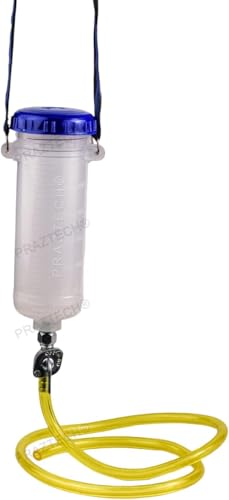
The Royal Vintage is a compact 300 mL gravity-fed reservoir, making it the smallest capacity among these motorcycle service tanks. Its flexible hose and in-line shutoff valve provide a temporary fuel feed for diagnostics, tuning and servicing when the original tank is removed or inaccessible. It is aimed at carbureted engines and also names other small engines and equipment as possible uses. The limited 300 mL volume is best suited to short checks, not longer sessions that need a larger fuel reserve.
Bottom line: Choose this for brief diagnostic checks where a compact reservoir is enough.
TAURISH 300 mL Workshop Tank

The TAURISH 300 mL tank stands out for its embossed fuel-increment measuring lines and handlebar strap, useful when setting up a temporary supply during motorcycle servicing. It has an on/off fuel tap and is described for carburetor balancing, tuning and test runs. Its 300 mL capacity matches the Royal Vintage tank, while the measuring marks and strap give it a more workshop-oriented setup. Buyers needing a longer uninterrupted fuel supply should look to a larger-capacity tank instead.
Bottom line: Choose this for carburetor balancing when visible fuel increments are useful.
How to choose an auxiliary fuel tank for motorcycle work
Choose by the job’s expected duration and the fuel connection, not by capacity alone. Small service reservoirs in this group range from 300 mL to 1 L; larger capacity means fewer interruptions, while a smaller bottle is easier to position for a short diagnostic run. A shutoff valve is useful for stopping flow without disconnecting the hose. Match the hose interface to the motorcycle’s fuel connection before starting, and confirm that the tank can be safely secured upright above the feed point for gravity flow.
Gravity-fed tanks and fuel flow
Gravity-fed auxiliary tanks need the fuel reservoir positioned above the carburetor inlet, with an open vent so air can replace the fuel leaving the tank. A blocked vent can slow or stop flow, and a kinked hose can do the same. The MOTO4U tank has an air outlet in its lid, while the Porotmotor has a vent; the other two specify a flow valve but no vent feature. For a gravity setup, keep the tank stable, route the hose away from hot exhaust parts, and use the shutoff before repositioning the reservoir.
Safe setup for temporary motorcycle fuel
Gasoline is highly flammable, so auxiliary tank work belongs outdoors or in a well-ventilated work area away from flames, sparks and hot surfaces. Use a stable mounting point and keep the hose clear of the exhaust, moving parts and sharp edges. Start with the valve closed, check the hose and connections for leaks, then open fuel flow only when the engine is ready for the task. Do not leave a temporary tank unattended or run a motorcycle on a hanging reservoir; secure it so vibration cannot tip or spill it.
Common mistakes with motorcycle auxiliary tanks
The most common setup mistake is choosing capacity without considering the service task: 300 mL works for brief checks, while a longer run may benefit from a 500 mL or 1 L reservoir. Another mistake is assuming every tank connects to every motorcycle; hose diameter, fuel-pump arrangement and carburetor inlet setup can differ. Shut off fuel before disconnecting a hose, and keep a suitable fuel container nearby for draining the reservoir safely. Never use a workshop auxiliary tank as a permanent road-going fuel extension unless it is specifically designed and installed for that purpose.
Frequently Asked Questions
How much fuel should a motorcycle auxiliary tank hold?
A workshop tank in this group holds 300 mL to 1 L. Choose 300 mL for short diagnostics and a larger capacity when the task may run longer between refills.
Can an auxiliary tank run a fuel-injected motorcycle?
Some auxiliary tanks can support fuel-injected motorcycles, but the fuel-pump arrangement matters. The MOTO4U maker specifies compatibility with fuel-injected models that use external fuel pumps; verify the connection and feed setup for the bike.
Where should a gravity-fed auxiliary tank sit?
A gravity-fed tank needs to sit above the carburetor inlet so fuel can flow downward. Secure it upright and keep the hose away from heat and moving parts.
Why does an auxiliary fuel tank need a vent?
A vent lets air enter as fuel drains, helping maintain steady flow. If a vent is blocked, gravity-fed fuel can slow or stop even when the valve is open.
Can I use a motorcycle auxiliary tank while riding?
Workshop auxiliary tanks are intended for temporary service use, not as riding fuel extensions. A loose reservoir or hose can spill fuel near hot or moving parts, so use one only while the motorcycle is stationary and secured.