
Solar Automatic Transfer Switches Compared by System Fit

MOES 50A Off-Grid Solar ATS is the closest fit for most off-grid solar setups because it supports 12V, 24V or 48V batteries and switches between battery power and grid power. Choose CXSW200A3 Generac PWRcell ATS instead for a Generac PWRcell whole-home system, or MOES Smart Off-Grid ATS with Hub if app-based monitoring and control matter more than an amp rating.
A solar automatic transfer switch changes between power sources; the right choice depends on the system it is designed to connect and the current and voltage of the loads.
We earn a commission if you buy through links on this page. As an Amazon Associate I earn from qualifying purchases. Products are compared on manufacturer specifications, not hands-on testing.
- Best overall: MOES 50A Off-Grid Solar ATS – Supports 12V, 24V or 48V batteries and switches between battery and grid power.
- Best for PWRcell whole-home backup: CXSW200A3 Generac PWRcell ATS – Designed for Generac PWRcell systems and rated 200A for 120/240V single-phase service.
- Best for remote monitoring: MOES Smart Off-Grid ATS with Hub – Adds Wi-Fi, app control and an included Bluetooth hub to off-grid solar switching.
- Best for 100A AC changeover: W2R 100A 2-Pole AC110V ATS – Provides a 100A, 2-pole AC110V transfer option with automatic or manual switching.
| Product | Best for | AC voltage | System fit | Shop |
|---|---|---|---|---|
| MOES 50A Off-Grid Solar ATS | Off-grid battery backup | 100–120V / 220–240V | 12V, 24V or 48V battery | Check Price on Amazon |
| CXSW200A3 Generac PWRcell ATS | PWRcell whole-home backup | 120/240V | Generac PWRcell system | Check Price on Amazon |
| MOES Smart Off-Grid ATS with Hub | App-connected solar switching | 110V / 220V | Off-grid solar or wind | Check Price on Amazon |
| W2R 100A 2-Pole AC110V ATS | 100A AC changeover | 110V | Mains, generator or photovoltaic | Check Price on Amazon |
Solar Automatic Transfer Switches
Match each switch to the power sources, service voltage and load rating of the system it will control.
MOES 50A Off-Grid Solar ATS
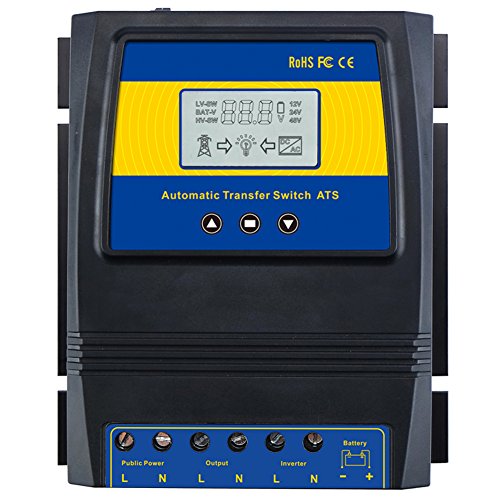
Battery-voltage flexibility is the main distinction of this 50A MOES switch: it supports 12V, 24V or 48V DC battery systems and automatically changes between battery-powered inverter output and grid power. The cutoff and recovery voltages are user-defined, with recovery set above cutoff; the maker says the switch can distinguish AC voltage and frequency automatically. It is intended for off-grid solar or wind systems using compatible battery voltages. Its 50A rating is a key limit, so it is not the choice for a service or load that requires a higher-rated transfer device.
Bottom line: Choose it for an off-grid system using a supported battery voltage and loads within 50A.
CXSW200A3 Generac PWRcell ATS

Generac PWRcell compatibility and a 200A service rating set this switch apart from the smaller off-grid changeover units. It is designed for PWRcell solar and battery storage and supports 120/240V single-phase residential systems for whole-home backup transfer. The enclosure is NEMA 3R, a rating associated with outdoor use and protection from rain and sleet. This is a specialized system component, not a general substitute for an inverter-level switch: choose it only when the installation uses the compatible PWRcell ecosystem and has a matching service configuration.
Bottom line: Pick it for a compatible PWRcell installation requiring 200A whole-home transfer.
MOES Smart Off-Grid ATS with Hub

Remote control features distinguish this MOES model: it includes a Bluetooth hub and supports MOES app and Bluetooth control alongside automatic switching between inverter and public power. For off-grid solar or wind use, it switches toward grid power when battery voltage falls below the cutoff and returns to inverter power at the recovery threshold. The specifications give no amp rating, so confirm the switch’s current capacity against the intended loads before selection. The included hub supports connectivity beyond Bluetooth range, according to the maker.
Bottom line: Choose it when app-linked monitoring matters and its verified rating matches the loads.
W2R 100A 2-Pole AC110V ATS

A 100A rating and automatic-or-manual operation make this 2-pole W2R switch different from the battery-threshold solar units. It is intended to change between two AC power sources, and the maker says it can accept mains, generator or photovoltaic sources. The specifications specify AC110V and 50/60Hz, so it suits a matching AC setup rather than a DC battery transfer role. Its compact DIN-rail format may suit a suitable distribution arrangement, but verify pole configuration and wiring compatibility before installation.
Bottom line: Select it for a compatible 110V AC arrangement needing 100A, 2-pole changeover.
How to choose a solar automatic transfer switch
Start with the source types and electrical rating, not the solar label: an inverter-to-grid switch, an AC source changeover, and a service-rated whole-home ATS serve different parts of a system. Match DC battery voltage where the switch senses or controls battery status, then match AC voltage, phase, current rating and the loads being transferred. A 120V branch-circuit device is not interchangeable with 120/240V whole-home equipment. If the load exceeds the switch rating, select properly rated transfer equipment rather than relying on the solar array’s wattage. For fixed residential wiring, use equipment approved for the application and have a qualified electrician verify installation requirements.
Use the intended connection point as the decision rule: battery/inverter backup calls for a device designed for that role; service-level backup requires service-rated equipment compatible with the inverter ecosystem.
Battery voltage, AC voltage and load fit
Battery voltage and AC voltage are separate checks: a 48V battery does not mean the connected AC load is 48V. Off-grid inverter systems commonly use 12V, 24V or 48V battery banks, while US household circuits are typically 120V and larger appliances may use 240V. The inverter converts battery DC into AC, and the transfer device must match the AC system it switches as well as any battery sensing requirements. Compare amps at the intended transfer point; do not infer amp capacity from a watt figure alone without knowing the voltage and circuit arrangement. Where an exact rating is unclear, verify it before connecting loads.
For whole-home equipment, match the service configuration and inverter system. For a small inverter setup, check the total current of every load intended to remain powered during transfer.
Transfer-switch types and source control
Transfer switches differ by where they sit and what source they select. Inverter-level units move selected loads between inverter output and utility power; service-rated units can transfer a broader residential supply; compact AC changeover switches select between two compatible AC sources. A manual switch requires a person to change sources, while an automatic switch detects a configured condition and transfers without manual action. Battery-triggered models use cutoff and recovery thresholds, so the recovery value must be above cutoff to avoid rapid back-and-forth switching. Source labels alone do not establish compatibility: confirm whether a unit is meant for an inverter, a service entrance or a specific storage ecosystem.
The table distinguishes typical roles; it is a screening aid, not a substitute for matching the equipment rating to the installation.
| Switch role | Typical use | Fit check |
|---|---|---|
| Battery/inverter ATS | Off-grid backup with grid fallback | Battery thresholds, inverter output and load amps |
| Service-rated ATS | Whole-home backup | Service amps, voltage, phase and compatible system |
| AC source changeover | Two AC sources | Poles, voltage, frequency and source wiring |
Installation and backfeed safety
Transfer equipment must keep power sources isolated so an inverter or generator cannot energize utility wiring unexpectedly. Never connect two sources in parallel through an ordinary changeover switch unless the equipment is specifically designed and approved for that operation. Service-level and hardwired transfer installations involve lethal voltage and can affect utility conductors; a qualified electrician should select and install the equipment under applicable electrical requirements. Outdoor installations also need an enclosure suited to the exposure and mounting location. Before purchase, confirm the exact source connections, neutral and grounding arrangement, overcurrent protection and enclosure rating for the site; these details determine safe compatibility and cannot be inferred from an amp number alone.
Frequently Asked Questions
What does a solar automatic transfer switch do?
A solar automatic transfer switch changes a connected load from one power source to another when its control condition is met. In an off-grid system, that can mean switching from inverter power to grid power when battery voltage reaches a cutoff threshold.
Can a solar transfer switch work with a battery inverter?
Some switches are designed for inverter systems, but the inverter output voltage and current must match the switch rating. Check the transfer device’s role and load rating before connecting it; a service-rated unit and an inverter-level unit are not interchangeable by default.
What amp rating should a solar transfer switch have?
The rating must meet or exceed the current of the loads transferred at the installation voltage. A 50A device is not suitable for a transfer point that requires 100A or 200A service equipment.
Is a 120V switch suitable for a 240V home?
Not as a substitute for 120/240V transfer equipment. US homes commonly use split-phase 120/240V service, so match voltage, phase and poles to the circuits or service being switched.
Why set recovery voltage above cutoff voltage?
A higher recovery threshold creates a voltage gap between switching to grid power and switching back to battery power. That separation helps avoid repeated switching when battery voltage hovers near one threshold.
Can I install a whole-home transfer switch myself?
Whole-home transfer equipment connects to hazardous service wiring and must prevent unintended backfeed to utility conductors. Have a qualified electrician confirm the service configuration, grounding, neutral handling and applicable installation requirements.