
Best Pocket Speech Toys for Toddlers Compared

For most toddlers, Airbition 510-Word English Flash Cards offers the broadest English word selection, with 510 words across 31 themes. Choose a different set if you want Spanish practice, fewer words to start, or a smaller reader.
These pocket speech toys pair picture cards with spoken words; they can support playful language practice, but they are not a substitute for an evaluation by a speech-language professional when you have concerns.
We earn a commission if you buy through links on this page. As an Amazon Associate I earn from qualifying purchases. Products are compared on manufacturer specifications, not hands-on testing.
- Best overall: Airbition 510-Word English Flash Cards – It combines 510 English words with 31 themes for broad everyday vocabulary practice.
- Best for bilingual practice: 510-Word English-Spanish Flash Cards – It includes English and Spanish modes and 510 sight words.
- Best for a smaller reader: Aullsaty 224-Word Flash Cards – Its footprint is 4.2 by 3.5 inches, smaller than the 4-by-4-inch readers.
| Product | Best for | Words | Themes | Languages | Shop |
|---|---|---|---|---|---|
| Airbition 510-Word English Flash Cards | Broad English vocabulary | 510 | 31 | English | Check Price on Amazon |
| 510-Word English-Spanish Flash Cards | Bilingual word practice | 510 | 31 | English, Spanish | Check Price on Amazon |
| Aullsaty 224-Word Flash Cards | Compact reader | 224 | 12 | English | Check Price on Amazon |
| Airbition 224-Word English Flash Cards | Simple English practice | 224 | — | English | Check Price on Amazon |
| AHJ 224-Word English-Spanish Flash Cards | Short bilingual practice | 224 | — | English, Spanish | Check Price on Amazon |
Pocket Speech Toys for Toddlers Compared
Compare word counts, theme coverage, and language options to match the reader to your toddler’s practice goals.
Airbition 510-Word English Flash Cards

With 510 English words across 31 themes, this set covers more topic areas than the 224-word readers. The themes include numbers, shapes, colors, animals, transportation, and food, and the reader speaks in a standard American accent. It suits families who want a wide range of everyday vocabulary in one English-language set. The tradeoff is that it does not offer Spanish mode, so bilingual practice calls for a different option.
Bottom line: Choose this set for the widest English-only vocabulary selection.
510-Word English-Spanish Flash Cards
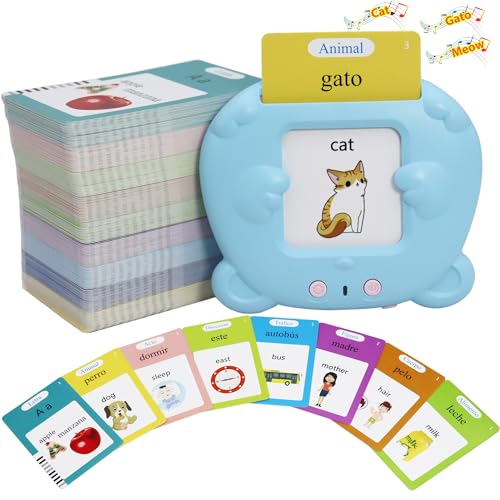
This set pairs 510 sight words with English and Spanish modes, making it the bilingual choice among the 510-word options. It has 255 double-sided cards across 31 themes, including alphabet, numbers, shapes, food, animals, and vehicles; the reader also imitates some animal and vehicle sounds. It fits families seeking exposure to two languages through picture-and-audio play. The limitation is that switching modes may be less suitable for a family seeking English-only practice.
Bottom line: Pick this set when English and Spanish audio are both useful.
Aullsaty 224-Word Flash Cards

The 4.2-by-3.5-inch reader has a smaller listed footprint than the 4-by-4-inch readers in this group. Its 112 double-sided cards cover 224 words in 12 everyday themes, including animals, vehicles, foods, colors, shapes, and daily objects. The set is English-language and designed for screen-free picture-and-sound play. It suits families who value a compact reader and a defined set of common words; buyers seeking hundreds of words or bilingual modes should choose another set.
Bottom line: Choose this one if a smaller reader matters more than maximum word count.
Airbition 224-Word English Flash Cards

This Airbition set keeps the word count to 224 and uses a five-level volume control, a repeat button, and a reader that plays animal sounds. Its cards cover animals, vehicles, food, fruits, and vegetables, so it suits short English practice sessions centered on familiar categories. The standard American accent may be useful for families seeking that pronunciation style. Unlike the 510-word option, this set offers a narrower vocabulary selection, so it is less suited to buyers wanting many themes.
Bottom line: Pick this set for a smaller English word set with adjustable volume.
AHJ 224-Word English-Spanish Flash Cards

This bilingual set brings English and Spanish audio modes to 112 double-sided cards covering 224 words, including animals, transportation, food, fruits, vegetables, people, and jobs. It offers a smaller bilingual vocabulary set than the 510-word bilingual reader, which may suit families who want to begin with fewer words. The reader requires a card barcode to be inserted correctly to play the corresponding audio, so careful card placement matters during use.
Bottom line: Choose it for bilingual practice with a 224-word set.
How to choose a pocket speech toy by word count
Start with the number of words your child can explore comfortably, not the largest number on the box. A 224-word set can keep practice focused, while a 510-word set offers a wider vocabulary range and, in some versions, more themes. Picture cards work best as prompts for naming, pointing, and taking turns rather than as a drill to finish. Pause after showing a picture and give your child time to respond; name the item naturally if they do not. A toddler who loses interest can benefit from a few cards at a time instead of cycling through a large deck. For children with limited spoken language or developmental concerns, ask a pediatrician or speech-language pathologist about individualized next steps rather than relying on a toy alone.
English or bilingual cards for toddler word practice
Choose English-only cards when the goal is practicing English words, and choose a bilingual reader when you want Spanish audio available as well. Bilingual exposure does not require separating languages into rigid blocks; families can use the language that feels natural during everyday routines. Make the cards meaningful by linking a picture to the real object, such as naming a fruit while preparing a snack. A reader that switches language modes can reinforce a word in both languages, but the child still benefits from a person responding and adding context. The product language modes indicate what audio the device can play, not whether the reader will match every family’s dialect or pronunciation preferences.
Using picture-and-audio cards safely and effectively
Use talking cards with an adult nearby, especially for children under 3, since small objects and pieces can pose a choking hazard. Stop using a card if it becomes torn or damaged, and keep loose cards out of reach when an adult cannot supervise. Keep sessions brief and responsive: show one picture, say the word, wait, and accept pointing, sounds, or an attempt to say it as participation. Do not pressure a toddler to repeat every word; conversation and shared attention are more useful than turning the cards into a quiz. Keep the reader at a comfortable volume and take a break if a child is bothered by the sounds or becomes frustrated.
Compare pocket speech toy formats by need
Use the word count and language choice as the main filters; reader size and controls matter after those needs are clear. A 224-word English set is a focused starting point, while 510 words add more breadth. For bilingual use, the 510-word option provides the larger set, and the 224-word bilingual option keeps the vocabulary count lower.
| Need | Useful choice | Tradeoff |
|---|---|---|
| Broad English vocabulary | 510-word English reader | No Spanish mode |
| Bilingual exposure | 510-word or 224-word bilingual reader | Word count differs |
| Compact reader | 4.2-by-3.5-inch reader | 224 words |
| Adjustable volume | Five-level control | 224 words |
Frequently Asked Questions
How many words should toddler flash cards have?
A set of 224 words offers a narrower selection, while 510 words provides more variety. Start with a few familiar cards and add more only when the child stays engaged.
Can talking flash cards help a late-talking toddler?
Talking cards can provide pictures and spoken-word prompts, but they do not diagnose or treat a speech delay. If you are concerned about a toddler’s communication, contact a pediatrician or speech-language pathologist for guidance.
How long should toddlers use talking flash cards?
Keep each session short enough that the child remains interested; a few minutes with a handful of cards is a practical starting point. Follow the toddler’s attention and stop if the activity becomes frustrating.
Are talking flash cards safe for one-year-olds?
Use them only with close adult supervision, because small cards can be a choking hazard for young children. Put the cards away when supervision is not available and discard any that become damaged.
Do bilingual flash cards confuse toddlers?
Bilingual cards can expose children to words in both languages, and families can use each language naturally in daily routines. Choose a reader with both language modes if you want Spanish as well as English audio.