
Butcher Buddy Burger Press: 5 Models Compared

The Butcher Buddy 4.5-inch press suits most home cooks who want round, quarter-pound patties; the combo set adds 1,000 wax-paper squares for separating patties. Choose a different style if you want a broad smash-burger tool, adjustable thickness or a stackable storage system.
We earn a commission if you buy through links on this page. As an Amazon Associate I earn from qualifying purchases. Products are compared on manufacturer specifications, not hands-on testing.
- Best overall: Butcher Buddy 4.5-in Burger Press – The 4.5-inch nonstick press makes quarter-pound patties up to 0.25 inch thick.
- Best for freezer prep: Butcher Buddy Press and Paper Set – The set pairs the 4.5-inch press with 1,000 wax-paper squares.
- Best for smash burgers: Sasquash 6-in Stainless Smash Press – Its smooth 6-inch stainless steel surface and flat handle are designed for pressing thinner patties.
| Product | Best for | Press diameter | Patty thickness | Included paper | Shop |
|---|---|---|---|---|---|
| Butcher Buddy 4.5-in Burger Press | Everyday patties | 4.5 in | Up to 0.25 in | — | Check Price on Amazon |
| Butcher Buddy Press and Paper Set | Batch freezer prep | 4.5 in | Up to 0.25 in | 1,000 squares | Check Price on Amazon |
| Sasquash 6-in Stainless Smash Press | Thin smash burgers | 6 in | — | — | Check Price on Amazon |
| Brigii 5.5-in Adjustable Press | Adjustable patty thickness | 5.55 in | Adjustable | — | Check Price on Amazon |
| Stackable Burger Patty Maker and Storage Set | Stacked batch storage | 5.08 in | — | Separator discs | Check Price on Amazon |
Butcher Buddy Burger Press Options
Compare the standard press and paper combo with larger or differently designed patty makers.
Butcher Buddy 4.5-in Burger Press
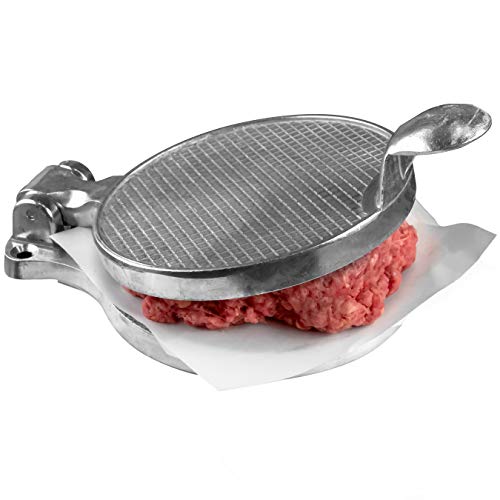
The standalone 4.5-inch press keeps the setup simple for cooks who already have a way to separate and store patties. Its nonstick cast-aluminum design forms round patties up to 0.25 inch thick and one-quarter pound, according to the maker. The maker also offers a lifetime satisfaction guarantee. This option suits routine burger prep and sausage patties without buying extra paper. Its fixed size and thickness are limiting if you want adjustable patties, larger portions or a thin smash-burger crust; a different press style is a better match for those jobs.
Bottom line: Choose this for uniform quarter-pound patties without extra paper.
Butcher Buddy Press and Paper Set

The combo set adds 1,000 wax-paper squares to the same 4.5-inch, nonstick cast-aluminum press format. The squares measure 4.75 by 5 inches, making this the convenient pick for cooks who want to separate patties during batch preparation or freezer storage. The press forms quarter-pound patties up to 0.25 inch thick, according to the maker. The extra paper is useful for planned batches, but unnecessary if you only shape a few burgers at a time or already keep separators on hand. Confirm the paper is suitable for your intended food-storage method.
Bottom line: Choose this when you want a press plus a large supply of patty separators.
Sasquash 6-in Stainless Smash Press

The 6-inch stainless-steel surface and broad flat handle distinguish this tool from the smaller patty-forming presses. Its one-piece welded construction uses 2 mm stainless steel, and the maker says the flat handle applies direct downward force for thinner patties and a thicker crust. It is designed for griddles, skillets and cast-iron pans, so it suits cooks pursuing smash burgers rather than pre-shaped quarter-pound rounds. The broad surface may be more than needed for compact patties, and the maker does not give a formed-patty thickness.
Bottom line: Pick this for pressing thin patties on a hot flat cooking surface.
Brigii 5.5-in Adjustable Press
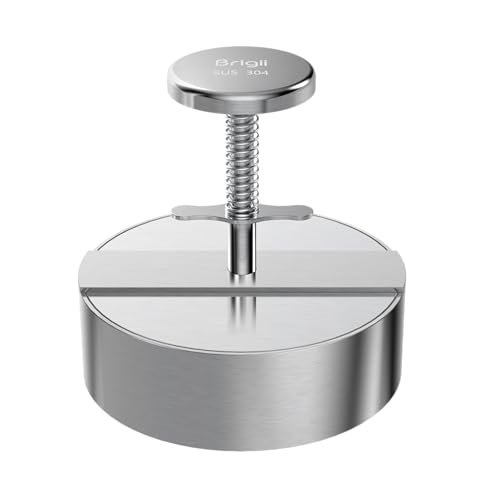
The 5.55-inch Brigii press stands out for adjustable pressing depth and a spring-back design, rather than a fixed quarter-pound patty format. The maker says it is 304 stainless steel and dishwasher safe, and reports lab testing for material composition and extractable lead. Its larger surface and adjustable thickness suit cooks making different patty styles, from thin portions to thicker burgers.
Bottom line: Choose this when adjustable thickness matters more than a fixed patty size.
Stackable Burger Patty Maker and Storage Set

The stackable multi-layer format is the main difference here: it is designed to shape multiple patties and store them in a clear airtight canister. Separator discs and a lifter stand are included, according to the maker, which can help keep stacked patties distinct and remove them without flattening their shape. This setup suits batch prep where built-in storage is more useful than a single metal press.
Bottom line: Pick this for shaping and stacking multiple patties in one storage system.
How to Choose a Burger Press
Choose a press by deciding whether you want formed patties or smashed burgers first. A fixed mold creates repeatable rounds; a flat press used on a hot griddle or skillet spreads a loose ball into a thin patty. For quarter-pound portions, four ounces of meat per patty gives a clear starting point, while a 0.25-inch target is notably thin and cooks differently from a thick pub-style burger. Press diameter alone does not guarantee the cooked patty’s final size because meat spreads and contracts as it cooks. If consistent portions matter, weigh each meat ball before pressing. Match handle shape and working surface to the cooking setup: a broad smash press needs a stable, heat-safe surface beneath it.
Patty Size and Thickness
For a consistent burger, portion meat by weight before comparing mold diameters. A quarter pound equals 4 ounces, but the diameter and thickness depend on how firmly the meat is pressed and how much it contracts during cooking. A 4.5-inch press is a compact round-patty format; a 5.5-inch or 6-inch surface covers more area, but does not by itself establish a finished patty size. Adjustable depth is useful when a single household makes both thin and thick patties. As a practical rule, choose a fixed press only when its target matches the patty you plan to make; otherwise, prioritize adjustable depth or a flat smash tool.
| Need | Press style | Key consideration |
|---|---|---|
| Repeatable rounds | Fixed mold | Match mold size and target portion |
| Variable thickness | Adjustable press | Check the actual adjustment range |
| Thin, crisp-edged burgers | Flat smash press | Use on a stable hot cooking surface |
| Batch storage | Stackable system or paper combo | Separate patties before chilling or freezing |
Smash Presses Versus Patty Molds
A patty mold shapes meat before cooking, while a smash press flattens meat on the cooking surface. That difference matters more than whether either tool is round: a mold is intended to produce consistent raw rounds, whereas smashing creates a broad, thin patty with more surface contact against the griddle. For smash burgers, place a portion on a hot, flat surface and press promptly; pressing later can squeeze out juices without improving the sear. Raw meat and ready-to-eat foods should use separate plates and utensils, and hands and tools need washing after contact with raw ground beef. Never rely on thickness or color alone to confirm doneness; use a food thermometer and cook ground beef to 160°F.
Separating and Storing Patties
Separate raw patties before stacking them for refrigeration or freezing, using food-safe separators or a storage system designed for that purpose. Keep raw ground beef refrigerated at 40°F or below and use or freeze it within 1 to 2 days; frozen ground beef keeps quality best for about 3 to 4 months. Airtight storage helps limit freezer exposure, but does not make food safe indefinitely. Wash hands, surfaces and reusable tools after handling raw meat, and keep uncooked patties below ready-to-eat foods in the refrigerator to prevent drips from contaminating them. For a large batch, portion and separate patties before they chill so they are easier to handle without reshaping.
Frequently Asked Questions
How much meat makes a quarter-pound burger?
A quarter-pound patty uses 4 ounces of ground meat before cooking. Weigh portions before pressing, since cooking changes the patty’s size and weight.
What temperature should ground beef burgers reach?
Ground beef should reach 160°F, measured with a food thermometer. Check the center of each patty rather than judging doneness by color.
How long can raw burger patties stay refrigerated?
Keep raw ground beef at 40°F or below and cook or freeze it within 1 to 2 days. Store sealed patties below ready-to-eat food to reduce cross-contamination risk.
Should burger meat be pressed before or during cooking?
Use a patty mold before cooking when you want uniform rounds, and a flat smash press on the cooking surface when you want thin patties. A smash press needs a stable, hot griddle or skillet.