
Nuclear Radiation Detector GQ GMC-800 Compared

Choose a different model if you prioritize second-by-second computer logging or isotope spectrum visualization.
Geiger counters detect ionizing radiation; their readings do not by themselves identify the radioactive material.
We earn a commission if you buy through links on this page. As an Amazon Associate I earn from qualifying purchases. Products are compared on manufacturer specifications, not hands-on testing.
- Best overall: GQ GMC-800 Geiger Counter – Detects beta, gamma and X-rays and offers four function screens, dosimeter functions and data saving.
- Best for frequent logging: GQ GMC-300S Geiger Counter – Records data every second in internal memory and supports computer downloads.
- Best for spectrum viewing: Radiacode-102 Smart Geiger Counter – Pairs radiation detection with spectrum visualization and app-based mapping.
| Product | Best for | Dimensions (in.) | Data feature | Detection or analysis | Shop |
|---|---|---|---|---|---|
| GQ GMC-800 Geiger Counter | Multi-function readings | 4.92 × 2.75 × 0.59 | Dosimeter, data save and sharing | Beta, gamma and X-rays | Check Price on Amazon |
| GQ GMC-300S Geiger Counter | Computer logging | 4.75 × 2.75 × 0.75 | Internal logging every second | Geiger count and dosimeter modes | Check Price on Amazon |
| GQ GMC-320 Plus Geiger Counter | Playback and protocols | 5.00 × 2.85 × 1.00 | Automatic recording and playback | Beta, gamma and X-rays | Check Price on Amazon |
| Radiacode-102 Smart Geiger Counter | Spectrum visualization | 5.71 × 4.13 × 1.38 | GPS-logged app mapping | Spectrum visualization | Check Price on Amazon |
GQ GMC-800 nuclear radiation detectors and alternatives
Compare the devices by what they detect and how they handle readings and recorded data.
GQ GMC-800 Geiger Counter

It detects beta, gamma and X-rays, and its four function screens are accessible with a shortcut key. The maker says the display is readable in sunlight, which may matter for outdoor use.
Choose this model if you want several measurement views in a portable device. A Geiger counter reading is not an isotope identification, so buyers who need source analysis should consider a spectrometer-style device instead.
Bottom line: Pick this if you want multiple measurement views and beta, gamma and X-ray detection.
GQ GMC-300S Geiger Counter

The GMC-300S stands out for recording data every second to internal memory and allowing history downloads to a computer. It also offers dosimeter, counts-per-minute and graph modes, plus rechargeable battery operation and PC viewer software.
This is a related Geiger counter alternative for buyers focused on keeping and reviewing a measurement history. Choose it when computer-based logging is the deciding feature.
Bottom line: Choose this if second-by-second logging and computer downloads matter most.
GQ GMC-320 Plus Geiger Counter
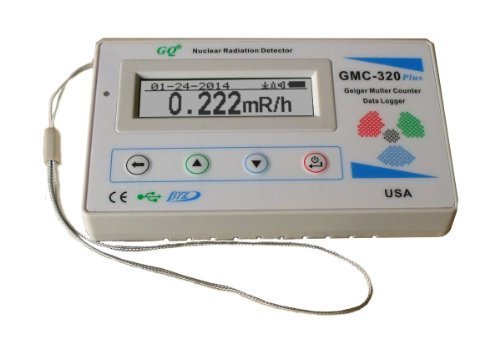
The GMC-320 Plus differentiates itself with automatic radiation data recording and playback, including later playback from a PC. Its open communication protocol is intended to support radiation network use, making it a related option for people interested in connecting recorded readings to a broader setup.
The product name identifies beta, gamma and X-ray detection, but the described features focus on recording, playback and communication.
Bottom line: Pick this for automatic recording, playback and open-protocol communication.
Radiacode-102 Smart Geiger Counter

The Radiacode-102 differs from the GQ counters by adding spectrum visualization and app-based radiation mapping with GPS-logged readings. The maker says it can help identify likely isotopes, and gives a spectral resolution of 9.5% ± 0.4% FWHM. The maker also claims detection speed up to 20 times faster than regular devices.
This is the alternative to consider when spectrum and mapping functions matter more than a conventional Geiger counter workflow. Its isotope display indicates likely sources; it should not be treated as definitive identification.
Bottom line: Choose this if spectrum visualization and GPS-linked mapping are priorities.
How to choose a nuclear radiation detector
Start with the job: spot checks, accumulated dose, recorded trends or source analysis call for different functions. A Geiger counter registers ionizing events; a spectrometer adds energy-spectrum information that can help distinguish likely sources. A count rate alone cannot identify an isotope, and a displayed dose rate is not a guarantee that every radiation type is measured equally well.
For recording, check whether the device retains data internally, exports to a computer or connects to an app. For field work, consider whether the screen is readable where you will use it and whether the device supports the measurement view you need. If you need to make a safety decision, use a properly calibrated instrument appropriate to the radiation and consult qualified radiation-safety guidance rather than relying on a consumer meter alone.
What Geiger counter readings can tell you
A Geiger counter detects ionizing radiation events, but a single reading does not say what isotope caused them. Counts per minute (CPM) are counts recorded over a minute; dose-rate units such as microsieverts per hour (µSv/h) express an estimated dose rate, and conversion between the two depends on the detector and radiation energy. Do not compare CPM values from different meters as if they were interchangeable.
Distance, shielding and measurement position can change a reading: doubling distance from a small point source often lowers exposure substantially, though the inverse-square rule is only an approximation and does not fit every source or geometry. Take repeat readings from a consistent position and allow the display to settle. For a potentially hazardous source, do not handle or move it to improve a measurement.
When spectrum analysis matters
Spectrum visualization can provide clues about the energies in a radiation signal and help suggest likely isotopes; a basic Geiger counter typically reports event counts or an estimated dose rate instead. Spectrum analysis is useful when source recognition is a goal, but it is not the same as laboratory identification: detector resolution, calibration, shielding and overlapping energy peaks affect interpretation.
Choose a spectrum-capable device when you need more than an alert or count trend, and treat isotope labels as leads rather than proof. For routine monitoring, logging and repeatable measurements may matter more than spectral analysis. Compare the available readout and export options against the task before choosing; a device that records a map or graph does not automatically establish that a source is safe.
| Need | Device type | Key consideration |
|---|---|---|
| Spot or dose readings | Geiger counter | Readout mode and detector suitability |
| Time history | Logging Geiger counter | Storage and export workflow |
| Likely source clues | Spectrometer-style detector | Resolution and interpretation limits |
Safe use and measurement habits
Use a detector without approaching or touching a suspected radioactive item; distance is a simple way to reduce exposure, and shielding may help only when it is appropriate to the radiation type. Beta particles, gamma rays and X-rays interact differently with shielding, so no single material or thin barrier is a universal solution. Keep people away and contact local radiation-safety authorities for a suspicious source.
For more useful comparisons, take readings from the same position, keep the detector orientation consistent, and record the time and location when the device supports logging. A sudden change should be checked with repeat measurements, not interpreted from one brief fluctuation. Do not use a personal detector as a substitute for workplace monitoring procedures, medical-device guidance or professional assessment.
Frequently Asked Questions
Can a Geiger counter identify an isotope?
A basic Geiger counter generally measures radiation events or an estimated dose rate rather than identifying an isotope. Spectrum-capable devices can show energy patterns that suggest likely sources, but detector resolution and overlapping peaks limit certainty.
What does CPM mean on a radiation detector?
CPM means counts per minute, the number of detected events in a minute. It is not interchangeable with a dose-rate value such as µSv/h because the conversion depends on detector response and radiation energy.
Why can two radiation meters show different readings?
Meters can differ in detector type, calibration, energy response and measurement position. Compare readings using the same units and conditions, and do not treat two meters’ CPM figures as directly equivalent.
How should I check a suspected radioactive object?
Do not touch or move the object; increase distance and keep others away. Take readings only from a safe position, and contact local radiation-safety authorities if the object appears suspicious or readings remain elevated.