
Martial Arts Kick Pads: 4 Options Compared by Fit

Juvale Taekwondo Kick Pad is the best fit for most buyers because it comes as a two-pad set with wrist straps and 15 x 7.5 x 2.5-inch targets. Choose a curved, single shield instead if your drills include heavier punches, knees and kicks; its shape and one-pad count suit a different training setup.
Flat kick pads are handheld targets for partner practice, not protective sparring gear.
We earn a commission if you buy through links on this page. As an Amazon Associate I earn from qualifying purchases. Products are compared on manufacturer specifications, not hands-on testing.
- Best overall: Juvale Taekwondo Kick Pad – Two 15 x 7.5 x 2.5-inch pads include wrist straps for partner drills.
- Best for audible feedback: Nicunom Double-Sided Kick Pads – The double-sided pads have internal boards that produce a striking sound.
| Product | Best for | Dimensions | Construction | Shop |
|---|---|---|---|---|
| Juvale Taekwondo Kick Pad | Two-person drills | 15 x 7.5 x 2.5 in | PU material; impact boards | Check Price on Amazon |
| Nicunom Double-Sided Kick Pads | Sound feedback | 15 x 7.5 x 2.5 in | PU leather; compression sponge | Check Price on Amazon |
| 2-Pack Taekwondo Kick Pads | Grip security | 15.35 x 7.48 x 1.97 in | PU leather | Check Price on Amazon |
| Upgraded Leather Taekwondo Kick Pads | Elastic hand fit | 14.56 x 9.84 x 2.75 in | Leather; elastic band | Check Price on Amazon |
Martial Arts Kick Pads Compared
Compare the pad count, target size and construction to match your partner drills and holder setup.
Juvale Taekwondo Kick Pad

Juvale gives you two 15 x 7.5 x 2.5-inch targets, a practical set for partner drills that alternate between high and low kicks. The pads have PU material and wrist straps, so a holder can keep a grip while presenting a target. The 2.5-inch thickness is useful to compare with thinner options when choosing a target for controlled practice. These are handheld targets rather than sparring protection; they suit students who want a pair for striking drills, but not buyers who need a single curved shield for punches and knees.
Bottom line: Choose this set for partner kick drills that need two strapped targets.
Nicunom Double-Sided Kick Pads

Nicunom calls out internal boards that make a loud sound on impact, giving a training partner an audible cue during kick practice. Each of the two blue pads measures 15 x 7.5 x 2.5 inches and has PU leather outside with compression sponge inside. Wrist straps help keep a pad from dropping as the holder changes targets. The sound is feedback, not a measure of force or a substitute for technique; choose these if an audible cue is useful, while buyers prioritizing a curved striking shield should consider a different style.
Bottom line: Pick these for two-sided targets with an audible strike cue.
2-Pack Taekwondo Kick Pads
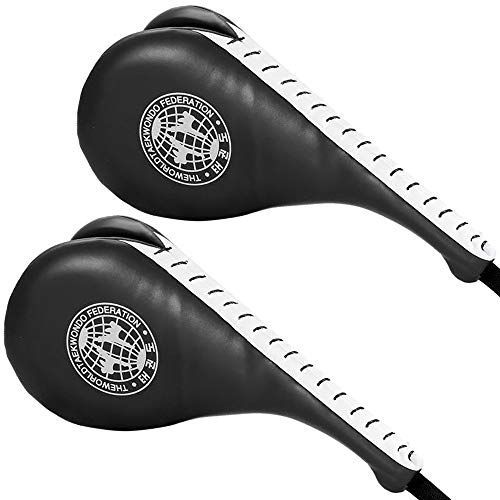
This black pair stands out for its non-slip wrist-grip design, which the maker says helps hold the target securely during energetic drills. The two pads measure 15.35 x 7.48 x 1.97 inches, giving them a thinner profile than the 2.5-inch options. The maker says the double-sided targets produce a snapping sound on kicks. That makes the set a fit for holders who value a wrist grip and a slimmer pad, but buyers wanting thicker targets should compare the dimensions before choosing.
Bottom line: Choose this pair when a non-slip wrist grip and thinner profile fit your drills.
Upgraded Leather Taekwondo Kick Pads

The elastic bottom band separates this red two-pad set from options that rely on a wrist strap. The maker says the pads use leather, high-elasticity sponge and reinforced patches in areas prone to unraveling. Dimensions are 14.56 x 9.84 x 2.75 inches, so the targets are wider and thicker than the 15 x 7.5 x 2.5-inch sets. The maker also claims the leather is thickened to improve service life. Check whether the elastic band suits the holder’s hand and grip preference; it is not the same attachment style as a wrist strap.
Bottom line: Pick these if the elastic band and wider target dimensions suit the holder.
How to Choose Martial Arts Kick Pads
Start with the drill: flat handheld targets are suited to partner kicks, while a curved shield can accommodate punches, knees and kicks. Compare target dimensions and pad thickness because a wider face gives the holder a larger aiming area, while a thicker pad changes how much material sits between the strike and the holder. Most options here are sold as pairs, but the curved shield is one pad, so verify count if you need a matched set. For repeated high- and low-kick practice, choose a pair with a grip style the holder can secure comfortably. Straps help retain the pad, but they do not make it protective sparring equipment.
Flat Targets and Curved Shields
Flat kick pads and curved shields serve different partner-training roles. Flat targets are easier to present as a defined left-or-right target for kick drills; a curved shield is a single, broader piece for varied strikes. Pad count also changes how a session is run: a pair lets a holder alternate targets without resetting, while one shield requires a single presentation at a time. Match the style to the strike mix, not just the word “kick” in a product name. Use a need-to-style comparison to narrow the choice:
| Training need | Pad style | What to compare |
|---|---|---|
| Alternating kick targets | Flat pair | Count, dimensions, grip |
| Punches, knees and kicks | Curved shield | Curve, handle, attachment |
Do not assume a handheld target protects a partner like a body shield or sparring gear.
Grip, Size and Holder Control
Choose a grip the holder can maintain without twisting the wrist; wrist straps and elastic bands attach differently and are not interchangeable preferences. A pad should be held firmly with the target presented at a comfortable angle, and beginners should start with controlled, lighter strikes before increasing speed. A target around 15 inches long is common among the flat options here, but width and thickness differ, so compare all three measurements rather than relying on length alone. If the holder cannot keep the target steady through a controlled drill, reduce force or change the setup. Stop if either partner feels pain, and keep the holder’s face and fingers out of the strike path.
Care and Common Training Mistakes
Wipe synthetic or coated surfaces with a damp cloth after practice and let pads dry fully before storing them; trapped sweat and moisture can shorten material life. Keep pads away from prolonged heat and direct sunlight, which can degrade synthetic coverings and foam. Inspect seams, straps, bands and handles before each session, and retire a pad if the cover splits, padding shifts or the grip attachment loosens. A common mistake is treating a loud impact sound as proof of correct technique: sound depends on contact and target construction, not just accuracy. Holders should communicate each target change, and kickers should use controlled contact rather than striking a partner’s unprotected hands or joints.
Frequently Asked Questions
Are kick pads the same as sparring pads?
No. Handheld kick pads are targets for partner drills, while sparring equipment is worn or positioned to protect participants during contact. A strap helps retain a target but does not turn it into protective gear.
How thick should a martial arts kick pad be?
The flat options here range from about 2 to 2.75 inches thick, so compare thickness alongside target size and drill intensity. Use controlled strikes and have the holder confirm the pad stays stable before increasing force.
Can one person use kick pads alone?
Most handheld kick pads are designed for a partner to hold, so solo practice needs a securely mounted target made for that purpose. Never wedge a handheld pad where it can slip or fall into the kicker’s path.
How do you hold a kick pad safely?
Start with lighter, controlled strikes and pause if the pad shifts or the holder feels pain.
How should kick pads be cleaned after training?
Wipe the exterior with a damp cloth and let the pad air-dry completely before storage. Avoid prolonged heat or direct sunlight, and inspect seams and grip attachments before the next session.