
Best Three-Hole Punches: 5 Models Compared by Capacity

Bostitch EZ Squeeze 20-Sheet Punch suits most people because its 20-sheet capacity and reduced-effort mechanism balance everyday volume with easier pressing. Choose Amazon Basics Semi-Adjustable 30-Sheet Punch instead if you need adjustable hole placement and capacity for up to 30 sheets, or AFMAT HPX2 40-Sheet Punch for batches up to 40 sheets.
A three-hole punch cuts holes positioned for standard three-ring binders; capacity, hole adjustment, and the force needed to operate the lever are the key differences here.
We earn a commission if you buy through links on this page. As an Amazon Associate I earn from qualifying purchases. Products are compared on manufacturer specifications, not hands-on testing.
- Best overall: Bostitch EZ Squeeze 20-Sheet Punch – Its 20-sheet capacity and maker-claimed 50% force reduction suit routine punching without moving to a larger-capacity model.
- Best for adjustable filing: Amazon Basics Semi-Adjustable 30-Sheet Punch – The semi-adjustable heads can change hole distance and the number of holes, with capacity for 30 sheets.
- Best for large batches: AFMAT HPX2 40-Sheet Punch – Its 40-sheet capacity is the highest among these options, and the maker claims 50% less effort.
| Product | Best for | Sheet capacity | Hole size | Construction | Shop |
|---|---|---|---|---|---|
| Bostitch EZ Squeeze 20-Sheet Punch | Everyday punching | 20 sheets | Standard three-hole | Metal | Check Price on Amazon |
| Bostitch Metal 12-Sheet Punch | Stable desk use | 12 sheets | 9/32 inch | All-metal | Check Price on Amazon |
| Amazon Basics Semi-Adjustable 30-Sheet Punch | Flexible filing | 30 sheets | Adjustable | — | Check Price on Amazon |
| Amazon Basics 10-Sheet Punch | Occasional use | 10 sheets | 9/32 inch | Metal | Check Price on Amazon |
| AFMAT HPX2 40-Sheet Punch | Large batches | 40 sheets | — | Metal | Check Price on Amazon |
Best Three-Hole Punches
Compare capacity, construction, and adjustability to match a punch to your typical stack size and filing needs.
Bostitch EZ Squeeze 20-Sheet Punch

Reduced-effort operation distinguishes this model from the simpler punches here. It holds up to 20 sheets, uses a standard three-hole configuration, and includes a ruler, paper guide, easy-clean chip tray, and handle lock for storage. The maker says its EZ Squeeze mechanism requires 50% less force; that can matter when you punch repeatedly through a workday. The capacity suits common office or classroom batches without the larger footprint of a heavy-duty option. Its fixed standard layout is less useful if you need to change hole spacing or switch between two- and three-hole filing.
Bottom line: Choose this for routine binder prep when easier lever operation matters more than adjustable hole placement.
Bostitch Metal 12-Sheet Punch

A non-slip base and all-metal construction make this a straightforward desk punch for smaller stacks. It punches up to 12 sheets and creates 9/32-inch holes, a diameter used for standard three-ring binder pages. The base helps keep the tool from shifting during use, and its chip tray opens for cleanup. This model favors stability and clean, standard-sized holes over extra capacity or adjustable punch heads. If your usual batch is larger than 12 sheets, choose a higher-capacity punch rather than forcing a thick stack through this one.
Bottom line: Pick this for modest stacks when a stable, all-metal desk tool is the priority.
Amazon Basics Semi-Adjustable 30-Sheet Punch

Adjustable heads set this punch apart: the design can change hole distance and the number of active holes for different filing needs. It handles up to 30 sheets of standard-weight paper, more than the everyday-capacity models in this group. The easy-access chip tray and locking handle support regular office use and compact storage. The maker describes it as semi-adjustable, so choose it for limited configuration changes rather than assuming every spacing is available. Its heavier 3.77-pound build also makes it less convenient to move around than lighter desk punches.
Bottom line: Choose this when you want higher capacity plus some flexibility in hole layout.
Amazon Basics 10-Sheet Punch
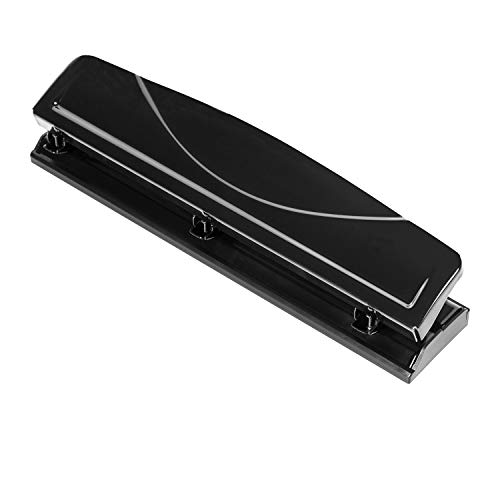
Simple, low-volume punching is the strength of this metal model, which handles up to 10 sheets and produces 9/32-inch holes. Its plastic base provides placement support, and an easy-clean tray collects paper chips. The modest capacity fits occasional forms or short document sets rather than repeated thick batches. A 20-pound sheet weight is a common reference for stated punch capacities, so keep stacks within the model’s limit and avoid mixing thick covers into a full paper stack. This fixed three-hole tool does not offer the adjustable layout of the 30-sheet option.
Bottom line: Pick this for occasional small batches that need standard-size binder holes.
AFMAT HPX2 40-Sheet Punch

The 40-sheet capacity makes this the batch-oriented choice in this group, and the maker says its lever structure requires 50% less effort than a regular punch. It is designed for 20-pound paper and includes a stainless-steel paper guide and a large chip tray. The higher capacity suits frequent processing of thick stacks, but a large lever punch is more tool than needed for a few pages at a time. The maker does not establish hole diameter or spacing, so verify binder compatibility before choosing it if exact placement is essential.
Bottom line: Choose this for frequent stacks near 40 sheets when the layout suits your binder.
How to Choose a Three-Hole Punch
Choose a capacity that clears your largest routine stack without requiring several passes: these models range from 10 to 40 sheets. Stated capacity commonly assumes standard 20-pound copy paper, so heavier stock, cardstock, or mixed media can reduce the practical stack size. For ordinary three-ring binders, standard US hole centers are 4.25 inches apart, with outer holes 4.25 inches from the center hole. Pick an adjustable punch only when you need a different pattern or hole count; otherwise a fixed three-hole tool is simpler. If your regular stack exceeds 20 sheets, compare the 30- and 40-sheet models instead of repeatedly punching smaller groups.
Three-Hole Punch Capacity and Paper Limits
Paper weight and stack alignment affect how cleanly a punch works, so treat capacity as a maximum rather than a target for every material. Standard US letter paper measures 8.5 by 11 inches, and three-hole binder punching is designed around that page format. A 20-pound sheet is the common copy-paper reference; thicker paper or covers add bulk quickly, so lower the sheet count for those jobs. Keep each stack square against the paper guide or edge stop before pressing, since skewed sheets can produce holes that do not line up across a document. For a stack over 40 sheets, split it into smaller, aligned batches.
Standard Hole Spacing and Binder Fit
Standard three-ring binder holes are centered 4.25 inches apart, and a common hole diameter is 9/32 inch. That spacing matches ordinary US letter pages, but compact or specialty binders can use a different pattern. Check the binder’s ring spacing and the punch’s adjustment range whenever the documents are not standard letter-size or must fit a nonstandard organizer. A semi-adjustable punch can vary hole count or distance, but it does not necessarily cover every binder format. This table summarizes which purchase need favors each capacity level.
| Typical need | Useful capacity range | Selection cue |
|---|---|---|
| Occasional short sets | 10–12 sheets | Choose a fixed standard pattern |
| Routine office stacks | 20 sheets | Consider reduced-effort operation |
| Thicker or frequent batches | 30–40 sheets | Check binder fit and paper weight |
Using and Maintaining a Paper Punch
Empty the chip tray before scraps reach the punch mechanism, because packed chads can obstruct the cutters and make cleanup harder. Punch on a firm, level surface and align pages against the guide before applying pressure; a stable base reduces movement while the lever is pressed. For thick stacks, use the capacity as a ceiling and reduce the count for heavier stock rather than forcing the handle. Keep fingers clear of the punch heads and never place a hand beneath the lever or cutters. If holes begin tearing rather than cutting cleanly, reduce stack thickness and clear the tray before continuing.
Frequently Asked Questions
What is the standard spacing for three-hole paper?
Standard US three-hole spacing places the hole centers 4.25 inches apart. Confirm the binder pattern before punching specialty pages or documents intended for a nonstandard organizer.
How many sheets should I punch at once?
Stay at or below the punch’s sheet capacity, and reduce the stack for heavier paper or covers. Capacity commonly refers to 20-pound copy paper, so thick stock can strain the mechanism sooner.
What size are standard three-hole punch holes?
A common standard hole diameter is 9/32 inch. Check the binder rings and punch specifications when a precise fit matters, since the diameter alone does not confirm compatible spacing.
Can a three-hole punch work with smaller paper?
Yes, if the punch’s guide or adjustment can position the page so all three holes remain aligned with the binder rings. For paper shorter than letter size, measure the ring positions before punching.
How do I prevent paper from shifting while punching?
Square the stack against the paper guide and keep it flat on a firm surface before pressing the lever. For stacks near the maximum capacity, punch fewer sheets if the pages do not stay aligned.