
ZYKR Nano Quick-Coat Restore: 3 Sprays Compared

For a ZYKR nano quick-coat restore spray, ZYKR Nano Quick-Coat Restore 350 ml is the closest match, with a 3-in-1 waterless wash, coat and shine formula in a 350 ml bottle. Choose a different option if you want a smaller bottle, a kit with accessories, or a product with a wash-cycle claim.
These spray coatings are applied to vehicle surfaces to add gloss and water repellency; they are not a substitute for paint correction when scratches or defects need removal.
We earn a commission if you buy through links on this page. As an Amazon Associate I earn from qualifying purchases. Products are compared on manufacturer specifications, not hands-on testing.
- Best overall: ZYKR Nano Quick-Coat Restore 350 ml – The closest match to the search, with a 3-in-1 waterless wash, coat and shine formula.
- Best for all finishes: ZYKR Nano-Quick Ceramic Coating Pro 300 ml – Its maker describes the 300 ml formula as safe on all finishes.
- Best for wash-cycle claim: ZYKR Nano Ceramic Liquid Wax 180 ml – The maker claims protection lasting up to 150 wash cycles.
| Product | Best for | Volume | Claimed use | Shop |
|---|---|---|---|---|
| ZYKR Nano Quick-Coat Restore 350 ml | Quick all-in-one care | 350 ml | Waterless wash, coat, shine | Check Price on Amazon |
| ZYKR Nano-Quick Ceramic Coating Pro 300 ml | All-finish compatibility | 300 ml | Dust-proof, water-repellent coating | Check Price on Amazon |
| ZYKR Nano Ceramic Liquid Wax 180 ml | Wash-count claim | 180 ml | Gloss, hydrophobic coating | Check Price on Amazon |
ZYKR Nano Quick-Coat Restore sprays
Compare these related sprays by formula, stated volume and the features that distinguish each option.
ZYKR Nano Quick-Coat Restore 350 ml

Unlike the other options, this spray combines a waterless wash, coating and shine step in one formula. The maker says its nano coating is intended to shield against UV rays, oxidation and environmental pollutants, and it highlights a hydrophobic, stain-resistant top coat. The 350 ml bottle suits someone looking for a quick gloss-focused maintenance step rather than a separate wash and wax routine. Its maker does not give a specific durability period, so buyers who need a defined service interval should choose based on that requirement instead.
Bottom line: Choose this for a single-step spray that combines wash, coating and shine.
ZYKR Nano-Quick Ceramic Coating Pro 300 ml
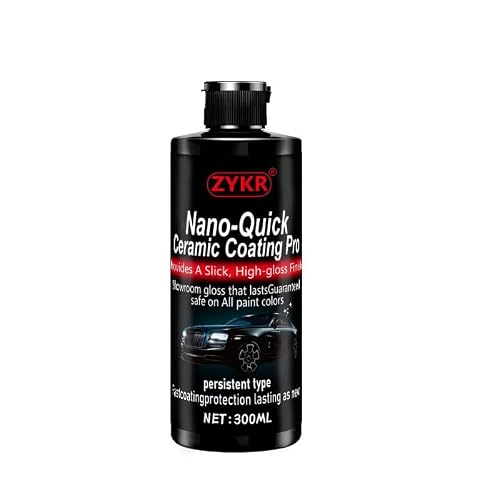
The 300 ml Pro is distinguished by its compatibility: the maker says it is safe on all paint colors and virtually any vehicle. It is positioned as a persistent-type nano-ceramic coating intended to add gloss while repelling water and dust. That makes it a reasonable fit for buyers prioritizing broad finish compatibility over an all-in-one wash step or included tools. The formula’s durability is described qualitatively, without a wash-count claim, so it is less useful for shoppers who need a specific longevity benchmark.
Bottom line: Pick this when broad paint-color compatibility is the priority.
ZYKR Nano Ceramic Liquid Wax 180 ml

This smaller liquid-wax option stands apart with the maker’s specific claim of protection up to 150 wash cycles and a gloss boost of up to 30%. The 180 ml pack includes a sponge and towel, unlike the spray-only options here. Its features also identify use on paint, plastic, rubber and tires, which may suit someone seeking one formula for multiple exterior surfaces. The wash-cycle and gloss figures are maker claims, not a guarantee for every vehicle or washing routine.
Bottom line: Choose it if the wash-cycle claim and included tools matter most.
How to choose a spray ceramic coating
Choose first by the job: a spray coating adds a surface layer and gloss, while a cleaner removes soil and a polish corrects some paint defects by abrasion. Spray sealants vary widely; many consumer products claim protection measured in weeks or months, but wash frequency, sun exposure and prep affect how long beading lasts. A specific wash-count claim is easier to compare than an unqualified promise of long-lasting protection, though it remains a maker claim. For routine care, wash and dry paint before applying a sealant unless its instructions explicitly combine cleaning and coating. Avoid applying over grit, which can drag across clear coat and cause fine swirls.
When spray coatings can address paint marks
Spray coatings are not a substitute for paint correction: they may temporarily mask very light marks, but they do not remove clear-coat scratches. Most automotive clear coat is only a small fraction of total paint thickness, so aggressive polishing can reduce its protective layer. If a fingernail catches in a scratch, a quick coating is unlikely to make it disappear; have the damage assessed rather than repeatedly polishing it. For minor wash marring, proper washing and a compatible sealant can improve the look without claiming repair. Wash with a clean microfiber mitt and plenty of rinse water, and keep separate towels for paint and wheels to avoid transferring abrasive grit.
How to apply a car coating spray
Apply sprays to cool paint in shade, working one small panel at a time; direct sun and hot panels can make a product flash or streak before it is buffed. Most spray sealants use a few sprays per panel, followed by an even spread and a clean microfiber buff, but the maker’s directions govern the amount and cure time. For a product that calls for clean, dry paint, wash first and remove remaining water from seams. Do not layer an additional coating until the prior layer has cured as directed, since incompatible layers can streak rather than bond. Keep the product off glass, trim or rubber unless its directions expressly allow those surfaces.
Spray coating claims and buyer needs
Use the claim that answers your actual need rather than treating all ceramic sprays as equivalent. The table separates a combined cleaning step, a broad compatibility statement, a wash-count figure and a multi-piece format; these are distinct benefits, not interchangeable measures of protection. No spray coating corrects deep paint damage, and protection claims do not establish scratch-proof performance. For a vehicle with frequent automated washes, a wash-cycle claim may help set expectations; for a quick maintenance wash, a combined formula may be more convenient. Always test an unfamiliar coating on a small, inconspicuous painted area first and use separate applicators for painted and unpainted surfaces.
Use this guide to match the feature emphasis to the maintenance task.
| Need | Look for |
|---|---|
| Combined maintenance step | Waterless wash and coating in one formula |
| Defined durability benchmark | A wash-count claim |
| More than one container | Pack quantity of two |
Frequently Asked Questions
Can a ceramic spray remove clear-coat scratches?
No, a spray coating does not remove clear-coat material or permanently correct scratches. If a fingernail catches in the mark, seek an assessment rather than relying on a spray to conceal it.
Should I apply a coating spray in direct sunlight?
No; use cool paint in shade because heat and sunlight can make sprays dry unevenly or streak. Work one small panel at a time and buff as directed.
How many sprays should I use on each panel?
There is no universal panel dose because spray concentration and directions differ. Start with the product’s amount, apply a thin even layer, and avoid excess that can streak.
Can I use the same coating on glass and paint?
Only if the product directions allow both surfaces; paint-safe wording alone does not establish glass compatibility. Keep the spray on approved surfaces and test an inconspicuous area first.
Does washing a car shorten spray coating life?
Yes, repeated washing can wear down a spray sealant, and harsh cleaners or frequent automated washes may shorten beading life faster than gentle hand washing. A wash-count claim is a maker benchmark, not a fixed interval for every vehicle.