
Best Outswing Murphy Door Hinges Compared by Fit

TamBee 6-Inch Outswing Concealed Hinges is the clearest fit for an outswing Murphy door because it is explicitly designed for outswing and opens 180 degrees. Choose MURPHY DOOR Hidden Hinge Kit if you want a pivot system that also supports in-swing, or consider a heavier-rated pivot when your door’s weight calls for it.
Concealed butt hinges and pivot hinges use different mounting layouts, so match the hinge type to the door construction and available swing clearance.
We earn a commission if you buy through links on this page. As an Amazon Associate I earn from qualifying purchases. Products are compared on manufacturer specifications, not hands-on testing.
- Best overall: TamBee 6-Inch Outswing Concealed Hinges – Explicitly supports outswing, opens 180 degrees and allows 3D adjustment.
- Best for versatile swing: MURPHY DOOR Hidden Hinge Kit – Supports in-swing or out-swing, left or right, with a 300-pound door capacity.
- Best for hold-open: TamBee 1,100-Pound Hold-Open Pivot – A pivot design with a stay-open feature and a 1,100-pound capacity.
| Product | Best for | Hinge style | Opening angle | Door capacity | Shop |
|---|---|---|---|---|---|
| TamBee 6-Inch Outswing Concealed Hinges | 180-degree outswing | Concealed butt | 180° | 88 lb per pair | Check Price on Amazon |
| MURPHY DOOR Hidden Hinge Kit | Flexible swing direction | Pivot pin | In- or outswing | 300 lb | Check Price on Amazon |
| 570-Pound Hidden Door Pivot Hinge | High-capacity pivot | Pivot | 360° | 570 lb | Check Price on Amazon |
| TamBee 1,100-Pound Hold-Open Pivot | Stay-open pivot | Pivot | Locks at 90° | 1,100 lb | Check Price on Amazon |
| 304 Stainless Steel 570-Pound Pivot | Stainless pivot | Pivot | 360° | 570 lb | Check Price on Amazon |
Outswing Murphy Door Hinges Compared
Compare the hinge style, swing range and stated load capacity against your door’s weight and installation layout.
TamBee 6-Inch Outswing Concealed Hinges

Unlike the pivot kits, these concealed butt hinges are specifically identified for outswing and a 180-degree opening. The pair has 3D adjustment without removing the door: ±3 mm vertical, ±2 mm horizontal and ±1 mm depth. The zinc and aluminum alloy construction is described as rust-resistant, and built-in spacers are intended to reduce friction. The load limit is 88 pounds per pair, so this is the most relevant choice for a lighter door that needs broad opening access. The limitation is capacity: choose another option if the door exceeds that stated limit.
Bottom line: Choose this pair for a lighter door when explicit outswing and 180-degree movement are priorities.
MURPHY DOOR Hidden Hinge Kit

This pin-style pivot kit offers more swing-direction flexibility than the dedicated outswing butt hinges: the maker says it works in- or out-swing and left- or right-hand layouts. It includes top and bottom hinge sets with pins, a pin-removal tool, screws and a catch with plate. The maker rates a single door up to 300 pounds and describes a ball-bearing lower pivot point rated at 1,160 torque pounds dynamic load and 540 pounds static. Confirm the door’s weight and layout before choosing it; this kit is aimed at experienced carpenters rather than a simple hinge swap.
Bottom line: Pick it when you need a pin pivot with multiple swing-direction options and a door within its limit.
570-Pound Hidden Door Pivot Hinge
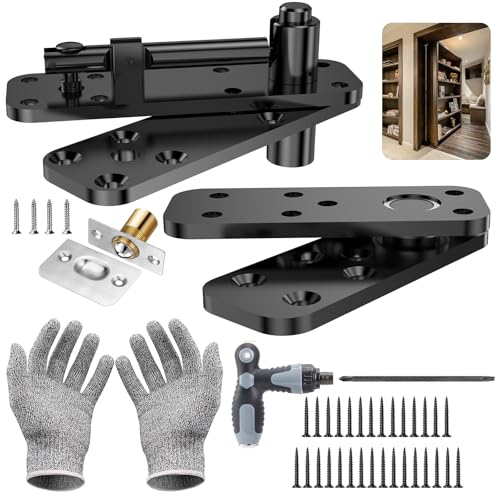
This pivot hinge is distinguished by its 360-degree rotation, rather than the 180-degree opening of the concealed butt-hinge pair. The kit includes a top-and-bottom pivot set, 30 screws, a ball catch with four screws and a screwdriver. Its maker gives a 570-pound load rating and describes the rotation as quiet and smooth. A pivot’s central-axis layout differs from a hinge mounted along the door edge, so check that the door and frame can accept this mounting arrangement. The 360-degree figure alone does not establish the clearance needed in your room.
Bottom line: Choose this pivot when its central-axis mounting suits the door and you need its capacity.
TamBee 1,100-Pound Hold-Open Pivot

This pivot system stands apart for its hold-open behavior: the maker says it keeps the door open when positioned at 90 degrees. It is made from 304 stainless steel and has a 1,100-pound capacity; the maker also describes movement as smooth and quiet under heavy loads. That large rating is not a substitute for checking the door, frame and mounting support as a complete assembly. The 90-degree hold-open position may not suit a layout that needs the wider opening offered by a 180-degree hinge.
Bottom line: Pick it when a 90-degree hold-open position matters and the pivot mounting fits your build.
304 Stainless Steel 570-Pound Pivot

This 304 stainless steel pivot is a distinct option for builders who want that material in a hidden-door hinge. Its maker rates it for 570 pounds and describes a ball-bearing lower set intended to support smooth, quiet rotation. The top and bottom hinge sets work together around a pivot axis, unlike the edge-mounted concealed butt pair. Verify that your door construction accommodates a pivot installation before selecting it; its material and capacity do not confirm compatibility with every Murphy door layout.
Bottom line: Choose this option when a 304 stainless pivot matches your door construction.
How to choose outswing Murphy door hinges
Choose by hinge layout, door weight and the opening angle your room needs. A concealed butt hinge mounts into the door and frame near the edge; a pivot hinge supports the door around a top-and-bottom axis. Those layouts require different preparation, so do not treat their load ratings as interchangeable. The 88-pound pair is the relevant stated limit for the dedicated outswing butt-hinge option here; the other capacities apply to their respective pivot kits. Measure the door’s weight and plan for its full swing arc before selecting hardware. With less than the door’s width of clear space outside the opening, check the actual swing path carefully, especially near walls or furniture.
| Need | Hinge type to consider |
|---|---|
| Explicit outswing and 180-degree opening | Concealed butt hinges |
| Pivot-axis mounting and broad rotation | Pivot hinge |
| Door held open at 90 degrees | Hold-open pivot |
Outswing clearance and hinge placement
Plan the open-door footprint before cutting hinge pockets or mounting pivot hardware. An outswing door needs room on the side it opens toward, and the usable clearance depends on the door width, hinge axis and nearby trim or walls. A 180-degree rating describes a hinge’s opening range, not a promise that every installation can reach that angle. Pivot hardware places its axis differently from edge-mounted concealed hinges, which changes the door’s path. Mark the opening arc on the floor or use a full-size door-width template; check for conflicts at both the leading edge and handle side. Also check the hinge maker’s required edge distances and mounting dimensions before drilling.
Load ratings and door support
Use the hinge’s load rating as a selection limit, not as a complete assessment of the installation. A door’s weight acts through the hinge and its attachment points, while door height and pivot placement affect leverage. Confirm the weight of the finished door, including attached panels or bookcase contents, and compare it with the rating for the exact hinge set or pair. The product capacities in this comparison use pounds, but their ratings come from different hinge designs and should not be ranked as if the mounting systems were identical. Strong screws and sound framing matter: hardware attached to weak material can fail even when the door is below a hinge’s capacity.
Common outswing hinge installation mistakes
The most common mistake is choosing by advertised capacity alone instead of confirming fit, clearance and mounting layout together. A pivot kit is not a direct substitute for an edge-mounted concealed hinge, and a 360-degree rotation claim does not guarantee the room has space for that movement. A second mistake is treating adjustment ranges as a fix for a misplaced pocket or pivot axis; the 3D adjustments are measured in millimeters and are intended for alignment, not major layout correction. Before installation, verify the finished door weight, swing direction, hinge cutout dimensions and frame support. Keep fingers clear of pivot and hinge gaps while moving a heavy door, and get help supporting it during installation.
Frequently Asked Questions
How much clearance does an outswing door need?
Allow a clear arc at least as wide as the door leaf, then account for the hinge axis, trim and nearby obstacles. A 180-degree hinge rating does not guarantee that the room permits a full 180-degree swing.
Can a pivot hinge work for an outswing door?
A pivot hinge can suit an outswing layout only when its mounting and swing path match the door and room. Check the hinge’s installation requirements and mark the pivot axis before preparing the door or frame.
How do I choose a hinge capacity for a bookcase door?
Weigh the finished door with its contents and stay within the capacity for the specific hinge set or pair. Leave room for contents that may be added later rather than sizing only for the empty door.
Are concealed butt hinges the same as pivot hinges?
No. Concealed butt hinges mount near the door edge, while pivot hinges support the door around an axis at the top and bottom. Their cutouts, mounting points and swing paths differ.
What should I check before cutting hinge pockets?
Confirm the hinge’s dimensions, required placement, door thickness and frame support before cutting. A few millimeters of alignment adjustment cannot compensate for a hinge pocket or pivot axis placed in the wrong location.