
WiFi Extender for Ring Cameras: 3 Options Compared

For most Ring cameras, choose a regular WiFi extender such as TP-Link RE315 AC1200 Extender or Mekupc AC1200 Dual-Band Extender, since those extend a home WiFi network; the Ring Alarm Range Extender only boosts the Ring Alarm system network.
We earn a commission if you buy through links on this page. As an Amazon Associate I earn from qualifying purchases. Products are compared on manufacturer specifications, not hands-on testing.
- Best overall: TP-Link RE315 AC1200 Extender – Dual-band WiFi includes 2.4 GHz, commonly used by Ring cameras, and includes an Ethernet port.
- Best for four antennas: Mekupc AC1200 Dual-Band Extender – Four external antennas and dual-band AC1200 support suit reaching a distant camera location.
| Product | Best for | Bands / speed | Coverage | Shop |
|---|---|---|---|---|
| TP-Link RE315 AC1200 Extender | Most home networks | 2.4/5 GHz; 300/867 Mbps | Up to 1,500 sq. ft. | Check Price on Amazon |
| Mekupc AC1200 Dual-Band Extender | Four-antenna reach | 2.4/5 GHz; AC1200 | Up to 15,999 sq. ft. claimed | Check Price on Amazon |
| Dual-Band 1200 Mbps WiFi Extender | Listed device limit | 2.4/5 GHz; 300/867 Mbps | Up to 5,000 sq. ft. | Check Price on Amazon |
WiFi Extenders for Ring Cameras
Match the extender to the network your camera uses and the distance between the router and camera.
TP-Link RE315 AC1200 Extender
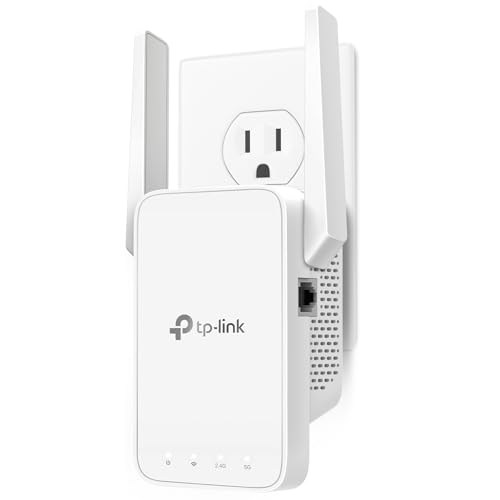
TP-Link RE315 AC1200 Extender is the most flexible fit here for a Ring camera on a standard home WiFi network, with 2.4 GHz and 5 GHz bands and one Ethernet port. TP-Link says it can cover up to 1,500 square feet and connect up to 32 devices; two adjustable external antennas and Adaptive Path Selection are part of the design. The 2.4 GHz band is the key detail for many cameras. The tradeoff is that advertised coverage is not a guarantee through walls or across a yard, so place it where it still receives a solid router signal.
Bottom line: Choose this if you want a dual-band WiFi extender with an Ethernet port.
Mekupc AC1200 Dual-Band Extender

Mekupc AC1200 Dual-Band Extender differentiates itself with four external antennas and a claimed coverage figure of up to 15,999 square feet, while supporting both 2.4 GHz and 5 GHz WiFi. It is intended to extend an existing home wireless network into hard-to-reach areas such as a garage or upstairs room, which can help if the camera location is beyond the router’s reliable range. The unusually large coverage claim should not be treated as a dependable real-world distance; walls, interference, and router placement affect the signal. Choose it for the antenna configuration, not as a guarantee of outdoor camera reception.
Bottom line: Choose this if you want four antennas for an area beyond the router’s reach.
Dual-Band 1200 Mbps WiFi Extender

Dual-Band 1200 Mbps WiFi Extender is a dual-band repeater with a total rate of 1,200 Mbps, split into up to 300 Mbps on 2.4 GHz and 867 Mbps on 5 GHz. Its name also gives a 35-device limit and up to 5,000-square-foot coverage, which distinguish it from the other standard-network options. The 2.4 GHz band can suit many smart-home devices, but the extender must be within reliable range of the router as well as the camera.
Bottom line: Choose this if the 35-device capacity is useful for your home.
How to choose a WiFi extender for a Ring camera
Ring cameras commonly connect over 2.4 GHz WiFi, while some newer models also support 5 GHz, so check your camera’s band compatibility before choosing. Place a WiFi extender roughly halfway between the router and the weak-signal area, but only where it still receives a usable signal. A repeater placed in a dead zone simply repeats a weak connection. If the camera is more than one exterior wall away, test signal at the intended mounting point before fixing the camera in place.
Ring Alarm extenders versus camera WiFi extenders
Those networks are not interchangeable. Use this distinction to avoid buying a device that matches the brand name but not the camera’s connection type. A mesh add-on has a similar compatibility rule: it extends only its own mesh ecosystem, not a separate router’s network.
| Device type | Network it extends | Use for a camera |
|---|---|---|
| WiFi extender | Home router WiFi | Yes, if compatible band and signal |
| Ring Alarm extender | Ring Alarm system | No, not camera WiFi |
| Mesh add-on | Matching mesh system | Yes, within that system |
Where to place an extender for an outdoor camera
Put the extender indoors between the router and the camera, not beside the camera after WiFi has already dropped out. The halfway point is a useful starting rule, but walls, metal siding, masonry, and neighboring WiFi can cut range sharply. A camera can connect reliably only if both the router-to-extender and extender-to-camera links work. Keep the extender in a dry indoor outlet unless its product is specifically rated for outdoor exposure; these options are plug-in indoor networking devices. Check the signal at the exact camera mounting point, since a strong signal in the room behind the wall does not establish reliable coverage outside.
Why advertised coverage numbers can mislead
Square-foot coverage figures describe broad manufacturer claims, not a guaranteed radius or outdoor reach. WiFi signal weakens with distance and obstacles, and 5 GHz generally loses usable range through walls more quickly than 2.4 GHz. Camera video also needs a stable connection, not just a WiFi network name appearing in setup. Start with the extender in a location where the router signal remains strong, then verify the camera connection at its intended location. If the camera is across several walls or detached-building space, a wired access point or a mesh node positioned nearer the exterior may be a better network design than adding a repeater farther into a weak signal area.
Frequently Asked Questions
Does a Ring camera need a 2.4 GHz extender?
Many Ring cameras use 2.4 GHz WiFi, though supported bands vary by camera model. Check the camera’s band requirements before selecting an extender.
Where should I put a WiFi extender for a Ring camera?
Start around halfway between the router and the camera location, where the extender still receives a reliable router signal. A dead-zone placement repeats a weak connection rather than restoring it.
Can I use an eero extender with a different router?
No. An eero 6 add-on extender requires an existing eero mesh network. For another router, choose an extender compatible with that home’s WiFi instead.