
FinalPress Coffee and Tea Maker: Models Compared

The FinalPress Original suits most people seeking a compact coffee and tea maker, with a 6.5-inch stainless steel body for brewing in a mug. Choose the V3 instead if its twist-off bottom lid and added capacity matter more; for multiple servings, consider a carafe press.
We earn a commission if you buy through links on this page. As an Amazon Associate I earn from qualifying purchases. Products are compared on manufacturer specifications, not hands-on testing.
- Best overall: FinalPress Original – Its 6.5-inch stainless steel body is the smaller of the two FinalPress options.
- Best for cleanup: FinalPress V3 – A twist-off bottom lid helps remove used grounds or tea leaves.
- Best for multiple servings: Veken 34 oz French Press – The 34-ounce carafe is sized for larger batches than the FinalPress makers.
| Product | Best for | Capacity | Height | Material | Shop |
|---|---|---|---|---|---|
| FinalPress Original | Compact brewing | — | 6.5 in | Stainless steel | Check Price on Amazon |
| FinalPress V3 | Easy grounds removal | — | 6.7 in | Stainless steel | Check Price on Amazon |
| Veken 34 oz French Press | Glass carafe brewing | 34 oz | 8.39 in | Glass, stainless steel | Check Price on Amazon |
| MuellerLiving 34 oz French Press | Insulated carafe | 34 oz | 8.25 in | Stainless steel | Check Price on Amazon |
| AeroPress Original | Fast manual brewing | — | 9.5 in | — | Check Price on Amazon |
FinalPress coffee and tea makers and alternatives
Choose between compact single-cup brewers and larger presses based on serving size, cleanup, and brewing style.
FinalPress Original

The FinalPress Original is the compact option in this group, measuring 6.5 inches tall and 1.3 inches wide and long. Its stainless steel micro French press brews directly in a mug, and its collapsible design is intended for pocket-friendly carrying. The maker says its spring-powered plunger can brew hot, iced, and cold-brew coffee or tea in about 2 minutes. The narrow format suits a single drink rather than a shared carafe. Choose another style if you want a batch capacity or a removable bottom lid for clearing grounds.
Bottom line: Pick this for a small, mug-based brewer that packs down for travel.
FinalPress V3

The FinalPress V3 adds a twist-off bottom lid, making grounds and tea leaves easier to remove than with the Original. Its stainless steel body stands 6.7 inches tall, and the maker says it holds 5 grams more coffee or tea than the prior model. Dishwasher-safe construction and the bottom opening suit buyers who prioritize cleanup after a compact brew. The specifications do not establish the resulting total capacity, so choose it for the increase rather than a specific serving yield. A 34-ounce carafe is a better fit for multiple cups.
Bottom line: Pick this when a removable bottom lid and extra ingredient capacity are priorities.
Veken 34 oz French Press
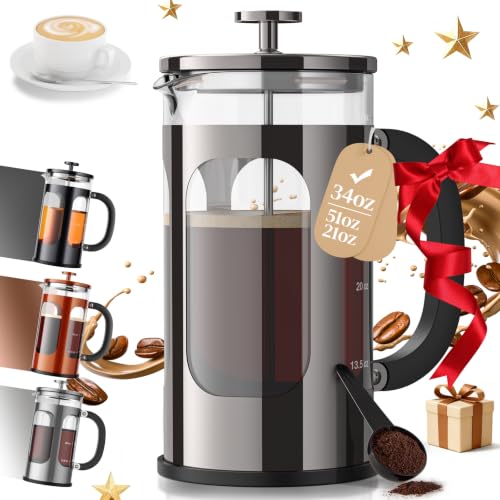
The Veken is a countertop-style 34-ounce carafe, unlike the narrow mug-brewing FinalPress models. It uses a thickened borosilicate glass vessel, 304 stainless steel, and food-grade silicone; its four-layer filter combines plates and fine mesh. The maker gives a glass temperature range of -40°F to 302°F, so it accommodates hot drinks and cold brew within that range. Its larger footprint suits kitchen batches or serving more than one person. Glass is less suited to pocket carry or rough travel than a compact stainless steel tube, so portability-focused buyers should choose a smaller press.
Bottom line: Pick this for a larger glass carafe with a multi-layer filter.
MuellerLiving 34 oz French Press
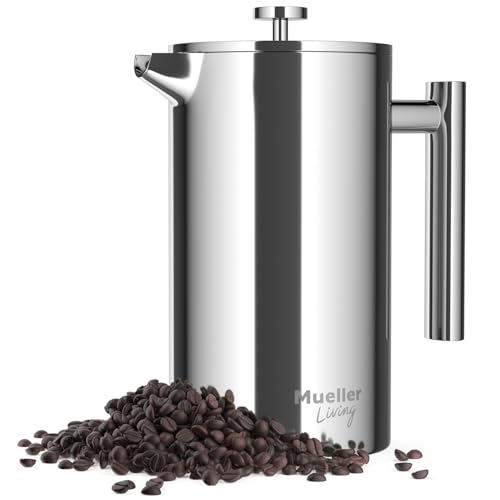
The MuellerLiving differs from the FinalPress brewers with a 34-ounce double-walled stainless steel carafe for batch brewing. Its four-filter construction and rust-free, food-grade stainless steel suit buyers who want a larger press without a glass vessel. The maker says the insulated carafe keeps coffee hot, and its brewing directions call for a 4-minute steep before pressing. At 2.1 pounds, it is substantially heavier than the FinalPress options, making it less convenient for pocket carry. The 34-ounce size also calls for more grounds and hot water than a single-mug micro press.
Bottom line: Pick this for batch brewing in a double-walled metal carafe.
AeroPress Original

The AeroPress Original offers a different manual brewing approach, combining French press, pour-over, and espresso-style methods in one portable device. It stands 9.5 inches tall and has a weight of 0.4 pounds, compared with the FinalPress models’ narrower, shorter bodies. The maker says it brews in under 2 minutes and is designed to limit bitterness and grit. Its method and dimensions make it a reasonable travel alternative, but the specifications do not establish its capacity or construction material. Choose the FinalPress if stainless steel and direct mug brewing are the deciding factors.
Bottom line: Pick this for a portable brewer with three manual brewing styles.
How to choose a compact coffee and tea maker
Choose by serving size first: compact immersion brewers are for mug-sized drinks, while the carafe presses hold 34 ounces. Immersion brewing steeps grounds in water before a filter separates them; a 4-minute steep is a common French press starting point, as shown by the MuellerLiving directions, while smaller devices may use shorter brew cycles. Grind size affects the cup: coarse grounds generally reduce sediment and are easier to press than fine grounds. For a one-person travel kit, prioritize a narrow body and a design that can be cleaned without carrying a large carafe. For more than one serving, use a carafe capacity rather than assuming a compact press will yield enough.
French press grind and steep time
Use a coarse, even grind and steep for about 4 minutes as a practical starting point for a standard French press. Finer particles pass through mesh more readily and can make a cup gritty, while a longer steep produces a stronger extraction. A micro press changes the ratio because its brewing chamber is much smaller than a 34-ounce carafe; use a small measured dose rather than scaling carafe directions by guesswork. Press slowly and steadily so the filter can separate grounds without forcing them through the mesh. For tea, steep time depends on tea type, so remove leaves when the desired strength is reached instead of treating coffee timing as universal.
Compact brewers versus carafe presses
A compact mug brewer favors portability, while a carafe press favors batch capacity and a larger brewing vessel. This comparison table separates the formats by the choice they support.
| Format | Typical use | Trade-off |
|---|---|---|
| Micro press | One mug and travel | Small brew volume |
| Glass carafe press | Kitchen batches, hot or cold drinks | Glass vessel needs careful handling |
| Insulated steel carafe | Batch coffee with heat retention | Bulkier than a micro press |
When capacity is the priority, choose a 34-ounce carafe; when packed size is the priority, the roughly 6.5-inch FinalPress format takes less room. Glass models need extra protection in a travel bag because hard impacts can break glass.
Cleaning and safe use of a manual press
Empty spent grounds promptly and rinse the filter and brewing chamber after each use; oils left on mesh can become stale and affect later cups. A twist-off base can simplify access to grounds, while a carafe press separates its filter from the vessel for rinsing. Hot water can cause burns, so keep fingers away from the spout and plunger outlet during brewing, and avoid filling a vessel beyond its working capacity. For coffee, a common water temperature target is about 195°F to 205°F, below a full boil; freshly boiled water can be allowed to cool briefly before pouring. Confirm the brewer’s handling limits before using it with very hot or cold liquid.
Frequently Asked Questions
How much coffee should I use in a French press?
Start near a 1:15 coffee-to-water ratio by weight, such as 20 grams of coffee for 300 grams of water. Adjust stronger or weaker in small steps, and measure for the brewer’s actual volume rather than its exterior size.
How long should French press coffee steep?
About 4 minutes is a useful starting point for standard French press coffee. Use a shorter steep for a lighter cup or longer for more strength, then press steadily to limit grounds passing the filter.
Can a French press make cold brew overnight?
Yes, immersion presses can steep coffee in cold water; a typical cold-brew steep is 12 to 18 hours in the refrigerator. Use coarse grounds and strain before serving, since a mesh filter may leave fine sediment.
What grind works best in a French press?
A coarse, even grind is the usual choice because larger particles are less likely to pass through the mesh filter. If the cup has excessive grit, grind coarser and avoid pressing too forcefully.
How do I keep a French press from tasting stale?
Rinse the filter and brewing vessel after each use and remove trapped grounds promptly. Coffee oils accumulate on mesh, so periodically disassemble the filter and clean all of its parts.