
Feeler Gauges for Valve Adjustment Compared by Fit

For most valve adjustments, choose Mutt Tools Dual Feeler Gauge Set because its straight and angled gauges offer access options and metric plus inch markings. Choose yourour A308 Offset Tappet Gauge instead if you need an offset tappet set with defined 0.004–0.014-inch blades; always match the blade to your engine’s specified clearance.
We earn a commission if you buy through links on this page. As an Amazon Associate I earn from qualifying purchases. Products are compared on manufacturer specifications, not hands-on testing.
- Best overall: Mutt Tools Dual Feeler Gauge Set – Includes straight and angled gauges with metric and inch markings for a range of access needs.
- Best for tappet lash: yourour A308 Offset Tappet Gauge – Its 11 offset blades cover 0.004–0.014 inch in 0.001-inch steps.
- Best for blade count: Hoiny Straight and Offset Gauge Set – Combines 32 straight blades with 16 angled blades and dual-unit markings.
| Product | Best for | Blade range | Blade count | Blade style | Shop |
|---|---|---|---|---|---|
| Mutt Tools Dual Feeler Gauge Set | Flexible access | 0.001–0.040 in | 32 blades | Straight and angled | Check Price on Amazon |
| Hoiny Straight and Offset Gauge Set | More blade choices | 0.0008–0.040 in | 48 blades | Straight and angled | Check Price on Amazon |
| yourour A308 Offset Tappet Gauge | Tappet adjustments | 0.004–0.014 in | 11 blades | Offset | Check Price on Amazon |
| 32-Blade Stainless Offset Gauge | Compact offset use | 0.0008–0.040 in | 32 blades | Offset | Check Price on Amazon |
Feeler Gauges for Valve Adjustment
Compare blade ranges, counts and shapes to find a gauge suited to your engine’s specified valve clearance.
Mutt Tools Dual Feeler Gauge Set

Straight and angled gauges make this set more adaptable to different access angles than a single-profile gauge. The set has 32 blades, metric and inch markings, and a range of 0.001–0.040 inch; its laser-etched markings are intended to stay readable. That broad span suits buyers who work across more than one engine or measurement task. The limitation is that the set’s blade count is given for the set as a whole, so it does not establish how many blades are in each gauge or which specific sizes are included.
Bottom line: Choose this set when you want both straight and angled access in one kit.
Hoiny Straight and Offset Gauge Set
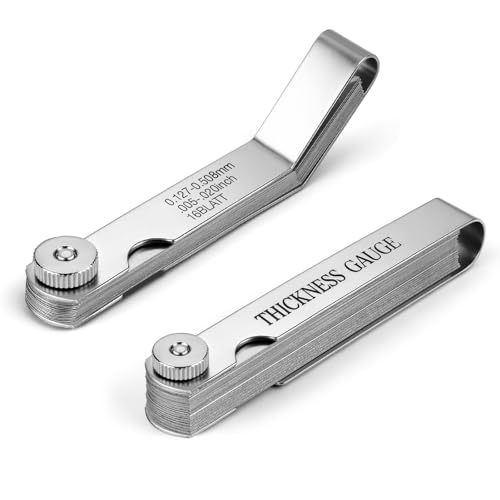
With 48 blades across straight and angled gauges, this set offers more blades than the other sets, which can help when you need closer measurement increments. The straight gauge spans 0.0008–0.040 inch, while the angled gauge covers 0.005–0.020 inch; both use metric and inch markings. Stainless steel construction is specified. The angled gauge’s narrower range matters if your target clearance falls outside that interval, so check the straight gauge range against the engine’s required intake or exhaust measurement before choosing.
Bottom line: Pick this set if the higher blade count and separate straight and angled ranges suit your measurements.
yourour A308 Offset Tappet Gauge

This offset tappet set is purpose-built for valve lash adjustment and gives a clearly defined run of 11 sizes from 0.004 to 0.014 inch in 0.001-inch increments. Its two handles have steel and rubber construction, and the blades are steel. That focused range can make it a direct choice when the engine’s required clearance falls within those sizes and an offset blade improves access. Its limitation is the narrower span: it does not cover clearances below 0.004 or above 0.014 inch, so confirm the engine specification first.
Bottom line: Choose this set when your specified valve lash falls within its 0.004–0.014-inch range.
32-Blade Stainless Offset Gauge

This 32-blade offset gauge combines a broad 0.0008–0.040-inch range with a foldable design, unlike the dedicated tappet set’s narrower size run. Its blades are stainless steel, with metric and inch sizes laser-etched on them; an oil coating is specified to help protect against corrosion. The offset shape is useful where a straight blade is awkward, but the specifications do not define specific blade increments. Check that the included sizes match the clearance your engine requires rather than assuming every value in the range is available.
Bottom line: Choose this gauge if you want a foldable offset tool with a broad stated range.
How to Choose Feeler Gauges for Valve Adjustment
Choose a gauge by matching its blade size and access angle to the engine’s specified valve clearance. Valve lash is the gap between valve-train components measured at the position and temperature specified for that engine; intake and exhaust clearances can differ. Many small-engine and automotive clearances fall in the thousandths of an inch, so a gauge with fine increments matters more than a wide maximum range alone. A blade should slide through the gap with slight, even drag, not force. Start with the service specification, then check that the set includes the required value and offers a profile that can reach the adjustment point.
For a practical choice, select an offset blade when a straight blade cannot sit squarely in the gap; choose a straight blade when access is open and alignment is easy. Never substitute a nearby size just because it is included.
Valve Clearance Size and Temperature
Use the engine maker’s intake and exhaust clearance values and its specified measurement temperature; cold and hot specifications are not interchangeable. A cold clearance is commonly measured with the engine at room temperature, while a hot specification requires measurement under the maker’s warm condition. Small errors matter: a difference of 0.001 inch is one thousandth of an inch and can change whether a blade feels snug or loose. Measure each valve at the prescribed crankshaft position, since camshaft position affects whether the valve is fully closed.
Compare a set’s actual blade sizes with the specification, not just its minimum and maximum. A range does not guarantee that every intermediate increment is included. Keep intake and exhaust measurements separate, and record them before making adjustments so the correct gap is restored.
Straight and Offset Feeler Gauges Compared
Straight blades are easiest to align when the valve gap is open and unobstructed; offset blades bend away from the handle to reach tighter spaces. The blade needs to enter squarely, because an angle across the gap can make a correct thickness feel too tight. Use this comparison to choose by access and target clearance.
| Need | Gauge choice | Decision rule |
|---|---|---|
| Open access | Straight blade | Choose when the blade can sit square in the gap. |
| Restricted access | Angled or offset blade | Choose when a straight blade cannot align squarely. |
| Known lash value | Set containing that size | Verify the exact blade size is included. |
A combined set can cover different access conditions, but blade shape does not replace correct measurement technique. If access forces the blade to bend or scrape against nearby parts, reposition it rather than accepting a misleading drag.
Using and Caring for Feeler Gauges
Measure with the engine off, and follow the engine’s specified cold or hot condition; moving valve-train parts can pinch fingers, and a hot engine can burn skin. Clean oil and grit from the blade and contact surfaces before measuring, since debris changes the effective gap. Insert one blade gently and feel for slight resistance across the measurement area. A loose fit suggests the blade is thinner than the gap, while a blade that must be forced is too thick or misaligned.
After use, wipe the blades clean and dry, then store a folding set closed to limit corrosion and damage. A light protective oil film can help steel blades resist rust, but wipe excess oil before the next measurement. Avoid bending or levering with a blade; a distorted gauge can no longer measure reliably.
Frequently Asked Questions
Should valve lash be measured hot or cold?
Use the condition specified for the engine: some clearances are checked cold, while others require a warmed engine. Cold and hot gaps are not interchangeable because engine components expand with heat.
How tight should a feeler gauge feel?
The correct blade should slide through with slight, even drag and without force. A blade that moves freely is likely too thin for the gap, while a blade that sticks may be too thick or misaligned.
Can one feeler gauge work for intake and exhaust valves?
One set can measure both, but intake and exhaust clearances may have different specified values. Check each valve’s required size and confirm the set includes both measurements.
Do offset feeler gauges help with tight valve access?
Yes, an offset blade can reach a gap that a straight blade cannot approach squarely. If the blade still contacts nearby parts or sits at an angle, reposition it rather than trusting the reading.
How should I store steel feeler gauge blades?
Wipe blades clean and dry before storage, then keep a folding set closed. A light oil film can help resist corrosion, but remove excess oil before measuring.