
Laser Timer for Sprints: 4 Systems Compared

For most coaches, YZ Laser Sprint Timer is a practical laser timer for sprints because its kit includes reflectors and stands for setting up start and finish points. Choose a different system if you need an explicit wireless range, a built-in display on the laser unit, or a longer stated runtime.
A laser sprint timer records when an athlete crosses a beam at a timing point, so beam alignment and consistent start and finish placement matter as much as the display.
We earn a commission if you buy through links on this page. As an Amazon Associate I earn from qualifying purchases. Products are compared on manufacturer specifications, not hands-on testing.
- Best overall: YZ Laser Sprint Timer – The kit includes two reflectors and four stands, with a 10-hour runtime.
- Best for bright conditions: Ousmile Wireless Laser Timer – The maker says the sensors reject visible-light interference and the LED is visible day or night.
- Best for longer wireless setups: GAN XIN 40/60-Yard Sprint Timer – It gives a wireless communication range of 0–400 meters, though its effective laser distance is under 13 meters.
- Best for battery monitoring: Wireless Laser Sprint Timer with Battery Indicator – Its battery indicator uses red, yellow and white to signal approximate charge levels.
| Product | Best for | Runtime | Display precision | Shop |
|---|---|---|---|---|
| YZ Laser Sprint Timer | Coach-ready kit | 10 hours | 0.001 seconds | Check Price on Amazon |
| Ousmile Wireless Laser Timer | Bright practice fields | Up to 10 hours | — | Check Price on Amazon |
| GAN XIN 40/60-Yard Sprint Timer | Long wireless links | 8 hours | 0.001 seconds | Check Price on Amazon |
| Wireless Laser Sprint Timer with Battery Indicator | Battery monitoring | 8–10 hours | 0.001 seconds | Check Price on Amazon |
Laser Timers for Sprints
Compare the included setup equipment, timing precision and stated operating limits before choosing a sprint-timing system.
YZ Laser Sprint Timer

Unlike the other options, this kit explicitly includes two reflectors and four stands, giving coaches components for setting up separate timing points. The five-digit display reads to 0.001 seconds, and the maker says timing error is under 0.001 seconds in one hour. It runs for a 10 hours after a four-hour charge and comes in a toolbox-style package. This suits coaches who want the basic alignment hardware together. The wireless operating range is not given, so confirm the distance between the timer and sensors before ordering if your setup needs a long separation.
Bottom line: Choose this if you want stands and reflectors included in the kit.
Ousmile Wireless Laser Timer

This system emphasizes visibility and operation in bright surroundings: the maker says its LED numbers remain clear indoors or outdoors, day or night, and that the sensors reject visible-light interference. It is a wireless unit with an aluminum carrying case and up to 10 hours of standby time, so it may suit coaches moving between training grounds. The size option is dual lasers with a built-in display and low stand.
Bottom line: Pick this for practice where clear display visibility is a priority.
GAN XIN 40/60-Yard Sprint Timer
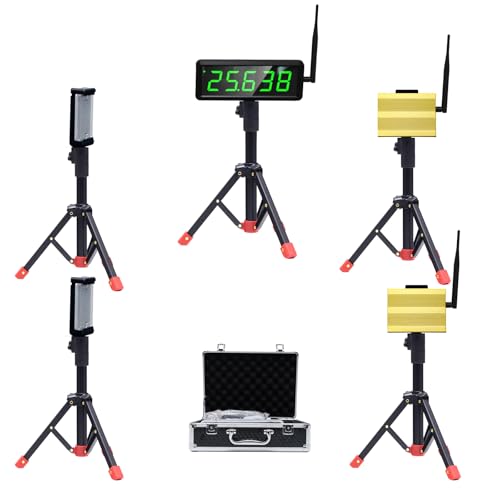
This timer is the one here with a wireless communication range: 0–400 meters, while its effective laser distance is under 13 meters. Keep those separate when planning a course, since wireless communication distance does not extend the laser beam’s effective span. It has a five-digit display with 0.001-second precision, a built-in battery rated for eight hours after a five-hour charge, and a reset button on the side. Its smaller tripod and stated laser limit suit compact timing points better than setups that need a wider beam span.
Bottom line: Choose this when the communication range fits your course layout.
Wireless Laser Sprint Timer with Battery Indicator

This option adds a three-color battery indicator to a five-digit display with 0.001-second precision. The maker says its rechargeable battery supports 8–10 hours of continuous timing and that infrared sensors reject visible-light interference; the indicator colors correspond approximately to 30%, 60% and 100% charge. It may suit a coach who wants a quick visual cue before a session and a precision figure.
Bottom line: Choose this if a visible battery-status indicator matters to your routine.
How to Choose a Laser Timer for Sprints
Choose by timing method, alignment requirements and the precision you need to record. A beam-break setup records a crossing at the sensor; it does not measure an athlete’s reaction to a starting signal unless the system has a separate start input. For repeatable comparisons, place the start and finish beams at the same course marks every session and record the measured distance between them. A display reading to 0.001 seconds is a resolution claim, not proof that every run is accurate to that tolerance. If you need to compare times closely, keep the course, start procedure and sensor positions consistent; changing any of those can affect the result more than the last displayed digit.
Setting Up the Start and Finish Beams
Set each beam across the athlete’s path at a clear, consistent crossing point, and check that the reflector and sensor stay aligned before timing. A misaligned or obstructed beam can fail to register a crossing or register one at the wrong moment, so test the trigger several times before a session. Keep runners and equipment from crossing the beam during resets, and secure stands where athletes will not clip them. Measure the course between the two trigger lines, not between the timer boxes or stands. For multi-lane drills, use a separate clear path for each timed run unless the system explicitly supports multiple lanes.
Wireless Range and Laser Distance
Wireless communication range and effective laser distance describe different limits. Communication carries a signal between components; laser distance describes how far the sensing beam can effectively span. For GAN XIN 40/60-Yard Sprint Timer, the communication range is 0–400 meters, while the effective laser distance is under 13 meters. That means it can communicate over a longer separation than its beam can cover. Choose based on the actual distance between the beam and reflector first, then check the component-to-timer distance against the wireless range. Never treat a long wireless figure as proof that a beam will span a wide track or field.
Timing Precision and Sprint Comparisons
Use the same course marks and start convention when comparing sprint times across sessions. A five-digit display or 0.001-second resolution shows fine increments, but a consistent setup is necessary for meaningful comparisons. Beam-break timing usually begins when an athlete crosses the start beam, so it excludes time spent reacting before that crossing; hand-timed starts and beam starts are not directly interchangeable. Record whether the start is a stationary beam break or a moving start, and keep that procedure consistent. For short dashes, even a small change in where the athlete crosses can alter the measured distance, so mark the beam lines clearly before repeating a test.
Frequently Asked Questions
How far apart should sprint timing gates be?
Set the gates at the exact course distance you want to measure, with one beam defining each endpoint. Measure between the beam lines rather than between the equipment stands, because those positions may not match.
Does a laser timer measure reaction time?
A beam-break timer starts when the runner crosses the start beam, so it does not include reaction time before that crossing. A separate start input or signal is needed to time from a starting cue.
Why can a laser timer miss a runner?
A missed trigger can result from a blocked or misaligned beam, or from the runner crossing outside the sensor path. Test each timing point with several crossings before a session and keep the beam clear during resets.
Is 0.001-second precision enough for sprint drills?
A 0.001-second display increment is useful for recording fine differences, but it does not by itself guarantee accuracy at that level. Consistent course measurement and the same start procedure matter when comparing runs.
Can laser sprint timers work outdoors in sunlight?
Outdoor suitability depends on the sensor and display design. One maker specifically says its sensors reject visible-light interference, but beam alignment and a clear view of the display still matter in field conditions.