
Fine Point Whiteboard Markers: 5 Options Compared

For fine point whiteboard markers, EXPO Ultra Fine, 8 Colors is the best match for most people because it combines an ultra fine tip with assorted colors and broad non-porous-surface use. Choose a 0.7 mm set instead if a measured tip width and compact-board writing are your priorities.
We earn a commission if you buy through links on this page. As an Amazon Associate I earn from qualifying purchases. Products are compared on manufacturer specifications, not hands-on testing.
- Best overall: EXPO Ultra Fine, 8 Colors – Ultra fine tip and assorted colors, with use on whiteboards and other non-porous surfaces.
- Best for magnetic planners: YISAN 0.7 mm Magnetic, 12 Count – 0.7 mm tip, magnetic barrel end and an integrated eraser.
- Best for color coding: SFAIH Magnetic Ultra Fine, 15 Colors – 15 colors for separating notes and calendar entries.
- Best for whiteboard calendars: maxtek 0.7 mm, 12 Colors – 0.7 mm acrylic tips and 12 colors; maker recommends standard porous whiteboards for richer color.
| Product | Best for | Tip width | Color count | Magnet | Shop |
|---|---|---|---|---|---|
| EXPO Ultra Fine, 8 Colors | Versatile surfaces | Ultra fine | 8 | No | Check Price on Amazon |
| YISAN 0.7 mm Magnetic, 12 Count | Magnetic planners | 0.7 mm | 10 | Yes | Check Price on Amazon |
| SFAIH Magnetic Ultra Fine, 15 Colors | Color-coded grids | 0.7 mm | 15 | Yes | Check Price on Amazon |
| maxtek 0.7 mm, 12 Colors | Whiteboard calendars | 0.7 mm | 12 | No | Check Price on Amazon |
| TWOHANDS Magnetic 0.7 mm, 12 Count | Board-side storage | 0.7 mm | 11 | Yes | Check Price on Amazon |
Fine Point Whiteboard Markers Compared
Compare tip specifications, color selection and practical differences for small writing tasks.
EXPO Ultra Fine, 8 Colors

EXPO Ultra Fine, 8 Colors stands apart by combining an ultra fine tip with use beyond whiteboards, including glass, acrylic and most non-porous surfaces. The eight assorted colors suit color-coded notes, and the ink is designed to erase with an EXPO eraser or dry cloth. The maker says the ink is vibrant and easier to read from a distance. This is a useful choice when one set needs to cover several surface types; the set has fewer colors than the 12- and 15-color alternatives, which matters for detailed color systems.
Bottom line: Choose this set if you want ultra fine writing that can also be used on several non-porous surfaces.
YISAN 0.7 mm Magnetic, 12 Count

YISAN 0.7 mm Magnetic, 12 Count is a 0.7 mm option built around compact planning surfaces, including small-grid calendars, fridge planners and dry-erase pockets. The 12-marker count contains 10 colors, with black repeated three times; a barrel-end magnet and eraser add practical features for a shared planning board. The maker describes the magnet as helping draw ink toward the tip when stored. Its intended use emphasizes close-up clarity rather than long-distance viewing, so it is a better fit for nearby calendar entries than presentation-room notes.
Bottom line: Pick this set for small-grid planners where a magnetic barrel and 0.7 mm point are useful.
SFAIH Magnetic Ultra Fine, 15 Colors

SFAIH Magnetic Ultra Fine, 15 Colors distinguishes itself with 15 colors, giving a planner user more choices for separating categories across detailed grids. The maker cautions that colors may appear lighter on glass or acrylic than on a whiteboard. That surface difference matters if you plan to move between board types; choose another set if consistent color on glass or acrylic is central to your setup.
Bottom line: Choose it when a 15-color palette is more useful than a set with an eraser or tip material.
maxtek 0.7 mm, 12 Colors

maxtek 0.7 mm, 12 Colors offers 12 colors and an acrylic 0.7 mm tip, plus maker-described low-odor ink. Its maker says the ink meets ASTM D-4236 and recommends a standard porous whiteboard for the richest color; glass or acrylic can make the marks look lighter. The maker also says the marks erase cleanly without residue. This distinction makes it a sensible match for a calendar that stays on a standard board, but less suited to someone who expects bold marks on glass or acrylic.
Bottom line: Choose this set for a standard whiteboard calendar and a 12-color palette.
TWOHANDS Magnetic 0.7 mm, 12 Count
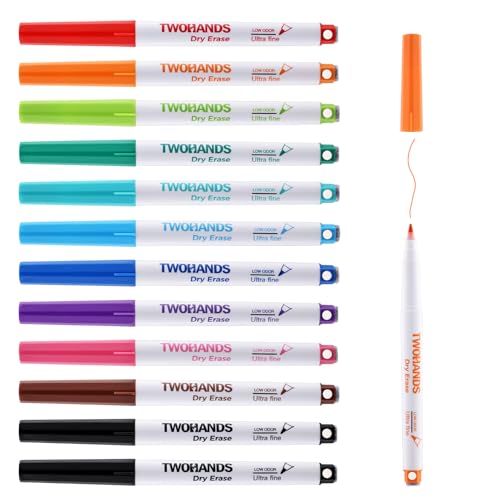
TWOHANDS Magnetic 0.7 mm, 12 Count combines a 0.7 mm tip with a barrel-end magnet and eraser, and its 12-marker pack contains 11 colors because black is included twice. The maker recommends using it on dry-erase boards rather than glass or acrylic, where colors may appear light. Its 0.7 mm point is intended for detailed marks, and the integrated magnet can keep the pens near a metal board. The surface restriction is important for users who need one set to write on glass or acrylic as well.
Bottom line: Pick it for detailed board writing when keeping a magnet and eraser on each marker is convenient.
How to choose a fine point whiteboard marker
Choose a fine point by matching its line width to the space available: 0.7 mm tips are suited to compact calendar cells and small grids. A thinner line can fit more characters into a cell, but tiny handwriting still becomes hard to read at a distance. For a board used across a room, prioritize legibility over maximum detail. Also check the writing surface: some dry-erase inks look lighter on glass or acrylic than on a standard whiteboard. If your notes must be readable from more than 6 feet away, use larger lettering or a broader tip rather than trying to compress text into fine lines.
Which marker features matter for planners
For a calendar or planning board, color count and storage features affect daily use more than a broad claim of precision. A 12-marker pack may contain fewer than 12 distinct colors when a color is repeated, so count the color list when building a color code. Barrel-end magnets attach to metal boards, but they do not make a marker suitable for every surface. Integrated erasers are convenient for small corrections; a separate cloth or board eraser is better for clearing larger areas. The table distinguishes compact-grid-focused options from those with a specified broader surface range.
| Need | Choose | Tradeoff |
|---|---|---|
| Several non-porous surfaces | EXPO Ultra Fine, 8 Colors | 8 assorted colors |
| Small grids with magnetic storage | YISAN 0.7 mm Magnetic, 12 Count or TWOHANDS Magnetic 0.7 mm, 12 Count | Surface use differs |
| More color categories | SFAIH Magnetic Ultra Fine, 15 Colors | Glass and acrylic colors may look lighter |
| Standard whiteboard calendar | maxtek 0.7 mm, 12 Colors | Glass and acrylic can mute color |
Whiteboard, glass and acrylic surface fit
Dry-erase markers work best on surfaces made for dry-erase ink, and surface finish changes how marks look and erase. The maker guidance for several options here warns that glass or acrylic can produce lighter-looking color; TWOHANDS Magnetic 0.7 mm, 12 Count is specifically not recommended for those surfaces. For a board that switches between materials, choose a set whose use covers those materials, then test a small mark in an inconspicuous spot before filling a planner. Avoid using a permanent marker by mistake: label the marker type clearly and keep it separate from permanent pens to prevent accidental marks that do not wipe away like dry-erase ink.
Keep fine tip markers writing clearly
Fine tips need careful storage because a damaged or ink-starved point can make narrow marks uneven. Store caps firmly closed between uses, and avoid pressing down hard on the tip; pressure can deform fine-point nibs and widen the line. A marker that looks faint can sometimes recover after being stored tip-down for a day, a remedy suggested by the maker of SFAIH Magnetic Ultra Fine, 15 Colors. Use a dry-erase cloth or board eraser for ordinary cleanup, and clear old marks before they build up. Never use a cleaning chemical on a board unless its manufacturer permits it, since harsh solvents can damage the writing surface.
Frequently Asked Questions
What tip width works for small whiteboard calendars?
A 0.7 mm tip is a practical choice for small calendar cells and compact grids. Keep letters large enough to read at the distance where the board will be used.
Do fine point markers work on glass whiteboards?
Some dry-erase markers can write on glass, but color may look lighter than on a standard whiteboard. Choose a set whose maker specifies glass use if that surface is essential.
How many colors should a planner marker set have?
A set with 8 to 15 colors can separate multiple categories, but check whether the pack repeats any colors. Repeated black markers, for example, reduce the number of distinct color choices.
How should fine tip dry erase markers be stored?
Close each cap firmly after use to limit drying, and avoid storing uncapped markers. If a marker appears faint, one maker recommends leaving it tip-down for 24 hours to help restore ink flow.