
Best Adhesive Hooks for Concrete: 5 Options Compared

For concrete, MintifyCo Concrete Wall Hooks is the only option here explicitly made for rough surfaces such as concrete, stucco, and brick, with a 15-pound capacity per hook. Choose a different set only if your wall is smooth and its surface suits the adhesive; the other hooks warn against rough or textured surfaces or describe smooth-surface use.
We earn a commission if you buy through links on this page. As an Amazon Associate I earn from qualifying purchases. Products are compared on manufacturer specifications, not hands-on testing.
- Best overall: MintifyCo Concrete Wall Hooks – Designed for rough concrete and other masonry, with a 15-pound capacity per hook.
- Best for smooth walls: Large Clear Adhesive Hooks, 10 Pack – The maker specifies smooth surfaces and gives a 22–44-pound capacity range depending on surface smoothness.
- Best for larger loads on smooth surfaces: DDMY Clear Adhesive Hooks, 10 Pack – The maker claims up to 50 pounds per hook on smooth surfaces.
| Product | Best for | Surface fit | Capacity per hook | Pack size | Shop |
|---|---|---|---|---|---|
| MintifyCo Concrete Wall Hooks | Rough masonry | Concrete, stucco, brick | 15 lb | 4 hooks | Check Price on Amazon |
| Large Clear Adhesive Hooks, 10 Pack | Smooth surfaces | Smooth surfaces | 22–44 lb | 10 hooks | Check Price on Amazon |
| DDMY Clear Adhesive Hooks, 10 Pack | Smooth-surface loads | Smooth surfaces | Up to 50 lb | 10 hooks | Check Price on Amazon |
| DKHDBD Clear Adhesive Hooks, 16 Pack | Larger pack count | Wall surface | Up to 33 lb | 16 hooks | Check Price on Amazon |
| DDMY Clear Adhesive Hooks, 24 Pack | High hook count | Wall surface | Up to 50 lb | 24 hooks | Check Price on Amazon |
Adhesive Hooks for Concrete
Wall texture is the deciding factor: only one set here says it bonds to rough concrete and masonry.
MintifyCo Concrete Wall Hooks
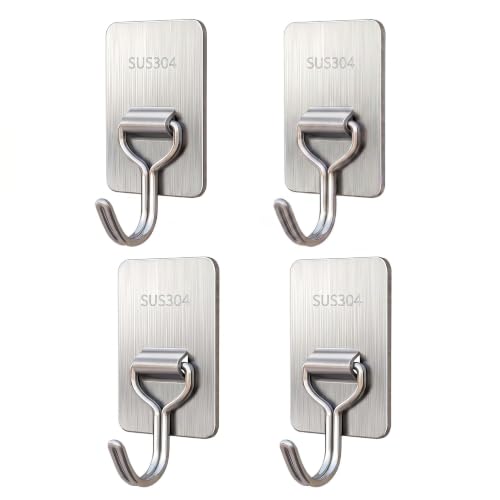
Unlike the other options, this set is specifically described for rough concrete, stucco, brick, textured ceilings, and uneven surfaces. Each hook has a 15-pound capacity, and the pack contains four stainless-steel hooks. That makes it the relevant choice when the wall is masonry rather than a smooth tile or glass surface. The tradeoff is the lower per-hook capacity compared with the smooth-surface claims on other options, so it is better suited to lighter hanging needs than heavy loads.
Bottom line: Choose these for rough concrete or masonry when a 15-pound per-hook rating meets your need.
Large Clear Adhesive Hooks, 10 Pack
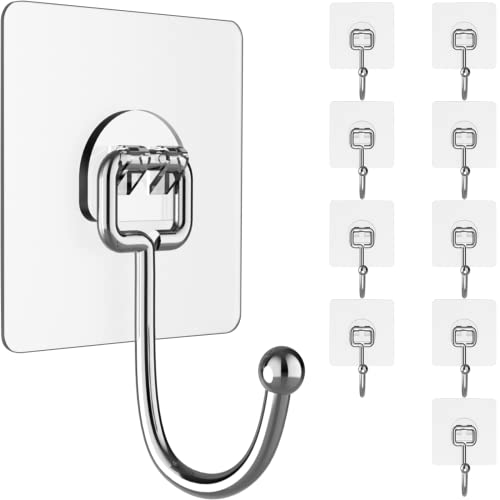
This set is a smooth-surface alternative, not a concrete-wall option: its instructions exclude rough surfaces such as brick. The maker gives a capacity range of 22 to 44 pounds based on surface smoothness, and the pack includes 10 clear stainless-steel hooks. The range matters more than the maximum when deciding what to hang, because even small differences in smoothness change the claimed capacity. This set does not suit porous or textured concrete; use it only where the mounting area is smooth and compatible.
Bottom line: Choose this only for a smooth surface, not for rough or porous concrete.
DDMY Clear Adhesive Hooks, 10 Pack

The DDMY 10-pack differs from the masonry-specific set by targeting smooth surfaces and giving a higher maximum claim of 50 pounds per hook. The hooks use stainless steel and PVC and have a 180-degree rotatable design. The maker notes restrictions on painted walls, and smooth-surface compatibility does not establish suitability for rough concrete. Choose this set for an appropriate smooth mounting area when rotation is useful, but not as a substitute for a hook explicitly intended for masonry.
Bottom line: Pick this for a compatible smooth surface when the rotating hook design is useful.
DKHDBD Clear Adhesive Hooks, 16 Pack
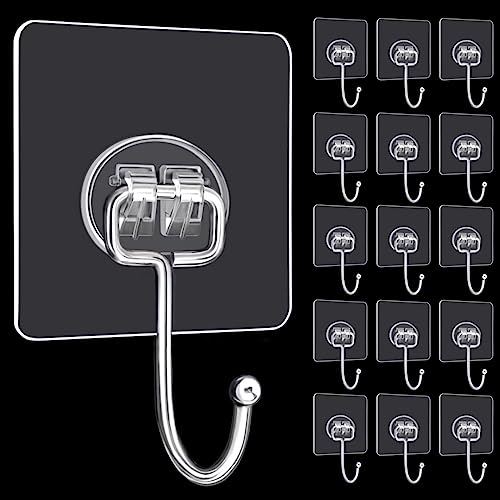
This option supplies 16 hooks, more than the other sets, and gives a maximum load claim of 33 pounds per hook. The pads are described as nano acrylic gel with stainless-steel hooks, and each hook measures 2.75 by 2.75 inches. Its features do not establish rough-concrete compatibility, so the higher pack count should not be mistaken for a masonry fit. It may suit a buyer who needs many hooks for an appropriate wall surface, but not someone relying on adhesion to textured concrete.
Bottom line: Choose this for quantity when your wall surface is suitable for its adhesive.
DDMY Clear Adhesive Hooks, 24 Pack

The 24-pack is the largest set here and uses stainless steel and PVC in a small, transparent design. Its maker claims a maximum 50-pound capacity, but the features do not connect that figure to rough concrete. The set is presented for general indoor and outdoor use, with tile backsplash as an example, which is a very different mounting surface from porous masonry. Consider it when you need many hooks for smooth compatible areas; do not infer that its maximum load applies to a concrete wall.
Bottom line: Choose this for a high hook count on a compatible surface, not rough concrete.
How to choose adhesive hooks for concrete
Choose hooks explicitly intended for rough masonry when the wall is porous or textured; smooth-wall adhesive claims do not transfer to concrete. This set includes one such option, rated by its maker at 15 pounds per hook. Surface texture, dust, and moisture affect adhesive contact, so a maximum claim should not be treated as a universal working load. For a smooth concrete finish, verify that the hook maker permits that surface before mounting. As a practical decision rule, if the wall has visible pits or aggregate, choose a masonry-rated product rather than a general clear hook.
Separate wall type from load
First match the adhesive to the wall, then compare capacities. A larger maximum rating cannot compensate for poor contact on a rough surface.
Concrete, stucco, and brick surface fit
Concrete, stucco, and brick are porous masonry, while tile and glass are smooth nonporous surfaces; adhesives formulated for one group may not bond reliably to the other. A masonry hook’s 15-pound per-hook claim is the only capacity here tied directly to rough concrete-type surfaces. Clear adhesive hooks elsewhere are described for smooth surfaces, and one maker specifically rules out brick. Clean, dry, sound surfaces provide the best opportunity for contact; loose paint, dust, efflorescence, and crumbling mortar are poor mounting bases. If the concrete is painted or sealed, confirm the coating’s adhesion and surface compatibility before relying on a hook.
Adhesive hook capacities and safe loading
Per-hook maximums are not interchangeable: the figures here range from 15 pounds for rough masonry to claimed maxima of 50 pounds for smooth surfaces. Adhesive strength depends on substrate, contact area, installation, and how force is applied. A hanging planter or swinging item creates more pull and movement than a still, lightweight towel, so avoid treating a static maximum as a safe allowance for dynamic loads. Use a fastener designed for the load when failure could injure someone or damage property. Keep hooks away from overhead areas where a falling object could strike a person, and never use adhesive hooks to support people, pets, or valuable fragile items.
Installing and removing adhesive hooks
Adhesive hooks need firm, full contact, so start with a clean, dry mounting spot and press the pad evenly rather than attaching over dust or moisture. For rough concrete, a hook intended for masonry is essential because small high points can leave gaps beneath a flat adhesive pad. Do not hang a load until the adhesive has had the cure time specified by its maker; cure times vary by adhesive, and no single wait period applies to all these sets. One set’s instructions recommend warming its pad with a hair dryer for removal, but that method should not be assumed for other adhesives. Test removal in an inconspicuous area where wall finish matters.
Frequently Asked Questions
Can regular adhesive hooks stick to rough concrete?
Most general adhesive hooks in this group are described for smooth surfaces, and one explicitly excludes brick and rough surfaces. For visibly pitted or textured concrete, use a hook specifically intended for masonry.
How much weight can adhesive concrete hooks hold?
The masonry-specific option here has a maker-stated maximum of 15 pounds per hook. Treat that as surface-dependent rather than a universal working load, especially for items that swing or pull outward.
Do adhesive hooks work on painted concrete?
Paint creates a second bond to consider: the adhesive may hold the paint while the paint separates from the concrete. Use a sound, well-bonded coating and confirm compatibility, particularly before hanging anything that could cause injury if it falls.
How should concrete be cleaned before hanging a hook?
Remove loose dust and grit and let the spot dry fully before attaching the pad. Adhesive cannot make reliable contact with crumbling concrete, loose paint, or dusty mortar.
Can adhesive hooks be used outdoors on concrete?
Outdoor exposure adds moisture and temperature changes that can weaken adhesive contact. Choose a hook whose maker permits both masonry and the intended outdoor conditions, and avoid loads that could fall onto people or property.