
Persian Carpet Mouse Pads Compared by Size and Style

Persian Carpet Style Mouse Pad is the closest match for most buyers seeking a compact Persian carpet mouse pad, with a 10-by-7-inch surface and a 3mm rubber base. Choose Paitianle Oriental Carpet Mouse Pad for fringed edges or kotoyas Persian Style Mouse Pads, 4-Pack if you want four mats; those differences matter more than the shared rug-inspired look.
A carpet-style mouse pad is a small fabric-covered mat with a rubber backing, combining a mouse surface with a decorative textile look.
We earn a commission if you buy through links on this page. As an Amazon Associate I earn from qualifying purchases. Products are compared on manufacturer specifications, not hands-on testing.
- Best overall: Persian Carpet Style Mouse Pad – Its 10-by-7-inch footprint pairs a microfiber polyester surface with a 3mm non-slip rubber base.
- Best for fringed style: Paitianle Oriental Carpet Mouse Pad – Two fringed ends and an 11.02-by-7.09-inch surface give it a distinct carpet-like finish.
- Best for multiples: kotoyas Persian Style Mouse Pads, 4-Pack – The four-pack provides several 10-by-7-inch mats for separate desks or coaster use.
| Product | Best for | Size | Surface | Pack or edge detail | Shop |
|---|---|---|---|---|---|
| Persian Carpet Style Mouse Pad | Compact desk use | 10 × 7 in | Microfiber polyester | Single mat | Check Price on Amazon |
| Paitianle Oriental Carpet Mouse Pad | Fringed edges | 11.02 × 7.09 in | Yarn-dyed nylon fiber | Fringe on two sides | Check Price on Amazon |
| kotoyas Persian Style Mouse Pads, 4-Pack | Multiple workspaces | 10 × 7 in each | Smooth surface | Four mats with fringe | Check Price on Amazon |
| Persian Rug Mouse Pad, French Grey | Grey-toned décor | 10 × 7 in | Soft smooth fabric | Fringed edges | Check Price on Amazon |
Persian Carpet Mouse Pads
Compare footprint, surface construction and decorative details to find a mat that suits your desk.
Persian Carpet Style Mouse Pad

Persian Carpet Style Mouse Pad stands out for its microfiber polyester top and 3mm rubber base, making its construction more specifically described than the other compact mats. The 10-by-7-inch footprint is suited to a small desk area, and the product also presents the mat as a coaster. The maker says the base grips wood, glass, leather, metal and marble surfaces. This is a sensible choice if you want the compact size and soft fabric feel, but the 10-inch length leaves less room for broad mouse sweeps than a larger desk mat.
Bottom line: Pick it for a compact setup where a soft top and 3mm base are priorities.
Paitianle Oriental Carpet Mouse Pad

Paitianle Oriental Carpet Mouse Pad is the largest of these single mats by surface dimensions and adds fringe along two sides. Its yarn-dyed nylon fiber surface uses a printing process described by the maker as ink-free, while the thin rubber base is intended to limit slipping. The product says it works with optical and ball mice, which makes it a practical pick for mixed older and newer devices. The fringe creates a more rug-like appearance, but buyers who prefer a clean-edged pad may find it less suited to their desk style.
Bottom line: Choose it for a longer surface and fringed carpet-like edges.
kotoyas Persian Style Mouse Pads, 4-Pack

kotoyas Persian Style Mouse Pads, 4-Pack is the only option here sold as a four-pack, so it suits buyers setting up multiple work areas or wanting matching small mats for desk décor. Each mat measures 10 by 7 inches and has white fringe on each side, with a smooth surface intended for mouse movement and a non-skid rubber base. That combination also makes the mats usable as decorative coasters.
Bottom line: Pick the four-pack when you need several small fringed mats.
Persian Rug Mouse Pad, French Grey
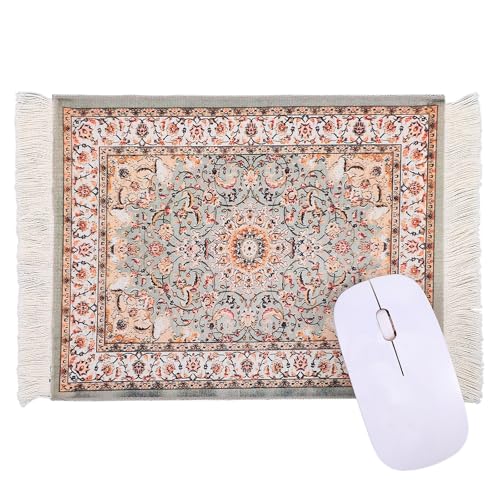
Persian Rug Mouse Pad, French Grey pairs a French Grey color with a vintage Bohemian floral motif and fringed edges, a decorative combination that separates it from the plainer compact choices. Its 10-by-7-inch surface is described as soft and smooth, and its 3mm non-slip rubber base is designed for stability on wood, glass, metal and marble. The maker says the surface is optimized for all mouse types. This suits a small home or office desk with grey-toned décor, though the compact footprint may constrain users who make wide mouse movements.
Bottom line: Choose it for a grey-toned look with fringe and a 3mm base.
How to Choose a Persian Carpet Mouse Pad
Start with the usable mouse area, then choose the textile look and backing. These options measure about 10 to 11 inches long and about 7 inches wide, which fits a compact work area but offers less travel space than a full desk mat. A practical rule is to reserve at least 2 inches beyond your normal mouse movement on every side; if your hand often reaches the mat’s edge, move to a larger format. Surface and edge construction also change the feel: microfiber polyester, yarn-dyed nylon fiber, or an unspecified smooth fabric are not interchangeable materials. Fringe adds a rug-like accent, while an edge without fringe is easier to align closely with other desk items.
Mouse Pad Size and Desk Fit
A 10-by-7-inch mouse pad occupies about 70 square inches, while the 11.02-by-7.09-inch option provides roughly 78 square inches. Measure the clear desk area before choosing, especially if a keyboard, laptop stand or notebook shares the space. A pad should lie flat with its rubber side against the desk; curled corners can reduce usable movement area. Mouse sensitivity affects how much physical room you need: a higher pointer-speed setting generally allows a shorter hand movement, while broad, low-sensitivity movements call for more space. These carpet-style mats are compact accessories, not substitutes for large gaming or full-desk surfaces.
Fabric Surfaces and Rubber Bases
Fabric-covered pads provide a soft contact surface, while rubber backing helps keep the mat positioned during mouse movement. Product materials differ: microfiber polyester, yarn-dyed nylon fiber and generic smooth fabric each describe a different level of material specificity. A thicker base may change cushioning and desk feel, but thickness alone does not establish tracking precision. Keep the pad on a flat, dry surface, and make sure the rubber side is not folded underneath. Optical and laser mice are designed to read surface changes; highly reflective or transparent surfaces can be less reliable than a matte, opaque fabric surface, so a fabric mat can be useful when a bare desk gives inconsistent tracking.
Carpet-Style Mat Care
Keep a mouse pad’s tracking area clear of grit and dust, since debris can interfere with smooth mouse movement and abrade the fabric over time. Brush away loose particles with a clean, soft cloth or brush; avoid soaking the rubber backing unless its care directions allow it, because trapped moisture can affect the bond between layers. Let a damp-cleaned mat dry flat and fully before putting it back under a mouse. Fringe needs extra care: pull or brush it gently rather than tugging individual threads. A four-pack can help keep a spare mat available, but store unused pads flat so edges do not develop a curl.
Frequently Asked Questions
Will these Persian carpet mouse pads fit a small desk?
Each mat is about 10 to 11 inches long and about 7 inches wide, so it can fit beside a compact keyboard or laptop. Measure the clear desk area and leave room for your usual mouse movement; a broad low-sensitivity sweep needs more space than a short high-sensitivity movement.
Can an optical mouse work on a fabric mouse pad?
Yes, fabric mouse pads are commonly used with optical mice, and the Paitianle option specifically says it works with optical and ball mice. If a mouse skips, clean dust from the sensor and use the pad on a flat, matte surface.
What is the difference between fringed and plain edges?
Fringe adds a decorative textile border, and the Paitianle mat has fringe on two sides while the kotoyas mats have fringe on each side. Plain edges are easier to position flush beside a keyboard or other desk accessory.
How should I clean a carpet-style mouse pad?
Brush off dry dust and crumbs with a soft cloth or brush, then use only light damp cleaning unless the care directions permit more. Dry the mat flat and completely before use, and avoid pulling on fringe threads.
Does a thicker rubber base always improve mouse tracking?
No; base thickness mainly changes cushioning and stability rather than guaranteeing tracking accuracy. A 3mm base is specified for two mats here, while mouse tracking also depends on a clean sensor and a surface suited to the device.