
Battery Turn Off Switches Compared by Fit and Rating

For a general-purpose battery turn off switch, Nilight 90015A 275A On/Off Switch is the clearest choice because it specifies a 275-amp continuous rating at 12 volts DC and supports 12–48-volt systems. Choose a terminal-mounted option instead if a direct fit on a negative top post is your priority.
A battery disconnect switch manually isolates the battery from a vehicle’s electrical system, which can help prevent drain during storage.
We earn a commission if you buy through links on this page. As an Amazon Associate I earn from qualifying purchases. Products are compared on manufacturer specifications, not hands-on testing.
- Best overall: Nilight 90015A 275A On/Off Switch – Lists 275 amps continuous at 12 volts DC and supports 12–48-volt systems.
- Best for simple rotary control: 2-Pack Manual Rotary Disconnect Switch – Uses a manual rotary action to switch power off and on.
| Product | Best for | Voltage range | Mounting or operation | Shop |
|---|---|---|---|---|
| Nilight 90015A 275A On/Off Switch | Broad system range | 12–48 V DC | Standalone or linked switches | Check Price on Amazon |
| BURMONG 275A Disconnect Switch | Negative-terminal mounting | 12–48 V | Bolt-on; 90° rotation | Check Price on Amazon |
| 2-Pack Manual Rotary Disconnect Switch | Basic rotary control | 12 V or 24 V | Manual rotary; 90° turn | Check Price on Amazon |
Battery Turn Off Switches
Compare system voltage, current ratings and mounting style before choosing a battery disconnect.
Nilight 90015A 275A On/Off Switch

Nilight 90015A 275A On/Off Switch stands apart with specified continuous, intermittent and momentary current ratings, plus support for 12–48-volt DC systems. Its ABS housing has a rear cover that insulates the terminals, and the two-position switch is designed to isolate a vehicle or boat electrical system. The maker gives ratings of 275 amps continuous, 455 amps intermittent and 1,250 amps momentary at 12 volts DC. It suits buyers who need documented current ratings across a broad system range. Its 275-amp continuous figure is specified at 12 volts, so buyers using another voltage should confirm the required rating before choosing.
Bottom line: Choose this if you want specified current ratings and a 12–48-volt system range.
BURMONG 275A Disconnect Switch
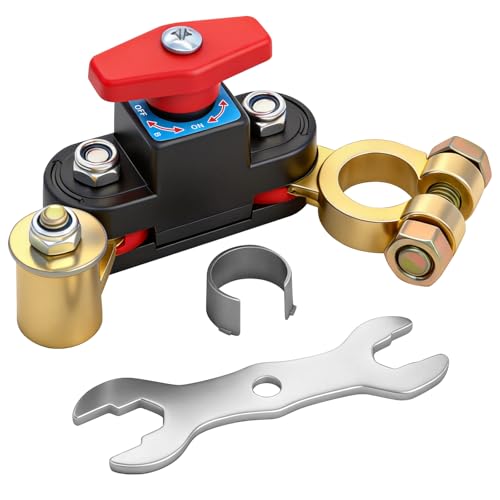
BURMONG 275A Disconnect Switch is a bolt-on disconnect with a 275-amp rating and a 12–48-volt range, with clear on/off positions operated by a 90-degree turn. The maker describes it as typically mounted on the negative battery terminal and intended to reduce parasitic drain while a vehicle, RV or boat is stored. This option suits buyers who want a rotary control at the battery rather than a top-post adapter. The current rating is not broken out by continuous, intermittent or starting use in the product name, so check the intended load and required rating before installation.
Bottom line: Pick this for a bolt-on rotary switch with a 12–48-volt range.
2-Pack Manual Rotary Disconnect Switch

2-Pack Manual Rotary Disconnect Switch is sold as a two-piece set and uses a manual 90-degree rotary action to cut battery power or restore it. Its voltage compatibility is 12 or 24 volts, making it a fit for buyers who want simple mechanical control on those systems. The switch has a copper contact structure, and its compact dimensions are 3.3 by 3.1 by 2.2 inches.
Bottom line: Choose this for a two-piece set and straightforward rotary operation on 12- or 24-volt systems.
How to Choose a Battery Turn Off Switch
Match the switch’s voltage and current rating to the battery system and the load it must interrupt. A 12-volt vehicle system and a 24-volt system are not interchangeable just because a switch is marketed for automotive use; verify the marked range. Current ratings can distinguish continuous duty from intermittent or momentary starting loads, so compare the right rating category rather than treating all amp figures as equivalent. A decision rule: if the switch does not give a current rating appropriate to the load, verify that rating before buying. Also choose the mounting style: a cable-mounted rotary switch needs space and suitable cable connections, while a top-post disconnect must match the terminal’s size and polarity.
Battery Disconnect Mounting and Terminal Fit
Top-post disconnects fit directly at a battery terminal, while bolt-on switches generally connect through battery cables and need a secure mounting point. Negative terminals are commonly disconnected first when servicing a conventional negative-ground vehicle; reconnect the negative terminal last. Confirm the battery polarity and terminal type before installation, because a negative top-post model will not fit every battery arrangement. Leave enough clearance for the switch, cables and cover, and keep conductive tools from bridging the positive terminal to the vehicle body. Switches with removable knobs add a physical control feature, but the fit still depends on post diameter and surrounding space. If the installation requires cable changes or the correct connection is unclear, have a qualified technician handle it.
Current Ratings and Safe Switching
Continuous, intermittent and momentary amp ratings describe different operating conditions, so compare like with like. A starting circuit can draw a brief high current, while accessories may draw a lower current for longer; a momentary rating alone does not establish a suitable continuous rating. Turn the ignition and accessories off before isolating a battery, and do not use a disconnect as a substitute for proper electrical protection. A loose or undersized connection can heat under load, so terminals and cable connections must be secure and sized for the circuit. Never let a metal tool contact both a battery terminal and grounded metal at once. Check the vehicle manual for model-specific battery procedures, especially where electronics may require a particular shutdown or reset sequence.
Battery Switch Types at a Glance
Rotary and top-post disconnects solve different installation needs: choose based on terminal fit, operating access and electrical rating. A rotary switch may be mounted away from the battery if the cable layout supports it, while a top-post switch puts control directly at the negative terminal. The table separates the main trade-offs; use the vehicle’s terminal type and load rating to narrow the choice.
| Type | Best fit | Check before choosing |
|---|---|---|
| Manual rotary | Accessible on/off control | Voltage and current rating |
| Bolt-on rotary | Cable-mounted installation | Mounting location and duty rating |
| Negative top-post | Compatible battery post | Post diameter and polarity |
Frequently Asked Questions
Should a battery disconnect go on the positive or negative terminal?
For a conventional negative-ground vehicle, disconnecting the negative terminal is the usual approach because the chassis is connected to battery negative. Confirm the vehicle’s polarity and manual before installation; reconnect the negative terminal last.
Can I turn off a battery switch while the engine is running?
No; shut off the engine and electrical accessories before operating a disconnect. Interrupting a running vehicle’s electrical system can cause electrical problems, and a battery switch should not be treated as an engine-kill control.
What does a 275-amp continuous rating mean?
A 275-amp continuous rating identifies a load the switch is rated to carry continuously under its specified conditions. Do not substitute an intermittent or momentary rating for continuous duty, and match the switch rating to the circuit.
How do I know whether a top-post disconnect will fit?
Match the disconnect to the battery’s terminal type, polarity and post diameter. A model intended for a 15–17 mm negative top post will not fit a different post size or a positive terminal.
Will a battery disconnect stop every vehicle drain?
A disconnect isolates the battery from circuits on the disconnected side, but it will not correct a faulty battery or every possible wiring issue. After isolation, a battery can still lose charge naturally during storage.