
12 Volt Water Pump: 5 RV Models Compared

For most RV fresh-water systems, Gidrox 4.0 GPM 45 PSI Pump is the strongest fit because its 4.0 GPM flow and 45 PSI setting balance useful flow with typical RV pressure. Choose VEVOR 5.5 GPM 70 PSI Pump instead when you need a higher 5.5 GPM open flow and an adjustable 40–100 PSI range.
A 12-volt water pump moves water from a tank through a pressurized plumbing system; the right choice depends on fixture demand, priming lift and electrical capacity.
We earn a commission if you buy through links on this page. As an Amazon Associate I earn from qualifying purchases. Products are compared on manufacturer specifications, not hands-on testing.
- Best overall: Gidrox 4.0 GPM 45 PSI Pump – 4.0 GPM flow, 45 PSI pressure and 10-foot self-priming capacity suit a broad range of RV needs.
- Best for higher flow: VEVOR 5.5 GPM 70 PSI Pump – Its 5.5 GPM open flow and adjustable 40–100 PSI range provide more capacity and pressure flexibility.
- Best for a compact footprint: SEAFLO 33 Series 3.0 GPM Pump – At 7.87 inches long and 4.72 inches high, it is the smallest model by length and height.
| Product | Best for | Flow | Pressure | Self-priming lift | Shop |
|---|---|---|---|---|---|
| Gidrox 4.0 GPM 45 PSI Pump | RV fresh water | 4.0 GPM | 45 PSI | 10 ft | Check Price on Amazon |
| SEAFLO 33 Series 3.0 GPM Pump | Compact installation | 3.0 GPM | 45 PSI | 6 ft | Check Price on Amazon |
| WASSERMANN 4.0 GPM 45 PSI Pump | Included fittings | 4.0 GPM | 45 PSI | — | Check Price on Amazon |
| ECO-WORTHY 3.5 GPM Pump | Adjustable pressure | 3.5 GPM | 45 PSI; 35–80 adjustable | 9.8 ft | Check Price on Amazon |
| VEVOR 5.5 GPM 70 PSI Pump | High flow demand | 5.5 GPM | 70 PSI; 40–100 adjustable | 6 ft | Check Price on Amazon |
12 Volt Water Pumps Compared
Compare flow, pressure and priming lift against the demands of your plumbing system before choosing.
Gidrox 4.0 GPM 45 PSI Pump

Gidrox 4.0 GPM 45 PSI Pump pairs a 4.0 GPM flow with a 45 PSI pressure setting and a 10-foot self-prime, a balanced combination for RV and marine fresh-water systems. Its maker says the pump has a 100-foot head pressure and 40 dB operating noise, with a rubber vibration-damping base and 158°F overheating protection. The 8.58-inch-long housing suits buyers with room for a mid-size pump. The pressure setting is fixed in the specifications, so buyers who need pressure adjustment should consider a model with an adjustable range instead.
Bottom line: Choose this for a balanced 4.0 GPM RV setup with a 45 PSI target.
SEAFLO 33 Series 3.0 GPM Pump

SEAFLO 33 Series 3.0 GPM Pump is the smallest option by length and height, at 7.87 inches long and 4.72 inches high, while delivering 3.0 GPM at 45 PSI. Its three-chamber diaphragm design is intended for moderate-pressure water systems, and the package includes a filter and two straight pump fittings. The pump uses EPDM valves and a Santoprene diaphragm, with a 6-foot suction lift and a 140°F maximum recommended temperature. Its lower flow and shorter priming lift matter if multiple fixtures draw water together or the tank sits farther below the pump.
Bottom line: Choose this where installation space is tight and 3.0 GPM meets demand.
WASSERMANN 4.0 GPM 45 PSI Pump
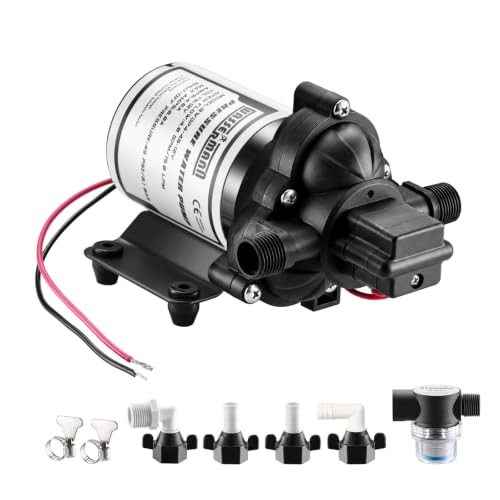
WASSERMANN 4.0 GPM 45 PSI Pump matches the 4.0 GPM, 45 PSI combination of Gidrox 4.0 GPM 45 PSI Pump, but distinguishes itself with a filter, two 1/2-inch barbed hose adaptors and a 1/2-inch male-thread hose adaptor. Its maker describes automatic pressure-switch operation that starts the pump when a tap opens, and says it can run from a 12-volt battery or an RV cigarette-lighter socket. The housing measures 8.15 inches long. No priming-lift figure is provided in the specifications, so verify that the intended tank-to-pump lift is compatible before selecting it.
Bottom line: Choose this when the included hose adaptors match your plumbing connections.
ECO-WORTHY 3.5 GPM Pump

ECO-WORTHY 3.5 GPM Pump offers a 3.5 GPM flow with a pressure switch adjustable from 35 to 80 PSI, making its pressure flexibility the key difference from fixed-setting alternatives. Its maker says the pump self-primes up to 9.8 feet, can lift water up to 98 feet, draws a maximum of 6.0 amps and can run dry without damage. The 11.38-inch length is greater than the other housings, so measure the installation space before choosing it. The maker’s pressure range is broad; set pressure to suit the plumbing and connected fixtures rather than assuming every system can use the maximum.
Bottom line: Choose this when adjustable pressure and a long priming lift are priorities.
VEVOR 5.5 GPM 70 PSI Pump

VEVOR 5.5 GPM 70 PSI Pump has the highest open flow in this group at 5.5 GPM and a 70 PSI rated setting adjustable from 40 to 100 PSI. Its maker says it self-primes up to 6 feet, has a 17-amp motor and supports short periods of dry running. That larger flow and pressure range can suit a higher-demand setup, but the 17-amp motor is a meaningful electrical requirement compared with the 6.0-amp maximum stated for ECO-WORTHY 3.5 GPM Pump. Check that the 12-volt supply and wiring can support the motor’s demand before choosing this higher-capacity pump.
Bottom line: Choose this for high flow demand when the electrical system can support 17 amps.
How to Choose a 12 Volt Water Pump
Choose by open flow, pressure and the pump’s electrical demand, not by flow alone. RV diaphragm pumps in this set range from 3.0 to 5.5 GPM and 45 to 70 PSI rated pressure; adjustable models span 35–80 PSI or 40–100 PSI. Higher flow can serve more simultaneous demand, but it also needs adequate wiring and power. For example, a 17-amp motor is a substantially larger electrical load than a 6.0-amp maximum. Match pressure to the plumbing and fixtures, and confirm the system’s pressure rating before using an adjustable pump at its upper end. A practical rule: choose a 3.0–4.0 GPM model for modest fixture use; consider higher flow only when the plumbing and power source support it.
Self-Priming Lift and Pump Placement
Self-priming lift is the vertical distance a pump can draw water from below its inlet, and the figures here range from 6 to 10 feet. Measure the height from the water surface in the lowest tank condition to the pump inlet; a longer suction run and air leaks can make priming more difficult. Keep the pump close to the tank and use a suction line sized and sealed for the pump connections. The comparison below shows why lift and flow should be considered together, rather than treating GPM as the only fit measure.
Use the priming lift as an upper boundary, not a target installation distance.
| Need | Selection cue | Models in this group |
|---|---|---|
| Lower flow | 3.0 GPM; 6-foot lift | SEAFLO 33 Series 3.0 GPM Pump |
| Middle flow | 3.5–4.0 GPM; up to 10-foot lift | Gidrox 4.0 GPM 45 PSI Pump, ECO-WORTHY 3.5 GPM Pump |
| Higher flow | 5.5 GPM; 6-foot lift | VEVOR 5.5 GPM 70 PSI Pump |
Pressure Switches and RV Plumbing Fit
An on-demand pressure switch starts a pump as pressure falls when a fixture opens, then stops the pump as pressure recovers. Fixed 45 PSI settings suit buyers whose system is designed around that target; adjustable pressure gives more control, but does not raise the pressure rating of hoses, filters, faucets or other components. A 1/2-inch connection does not guarantee a direct fit: thread style and hose-barb size must match the installed plumbing. Measure available mounting room as well, since these housings range from 7.87 to 11.38 inches long. Confirm thread type, port adapter size and electrical connections before ordering if an existing pump is being replaced.
Electrical and Dry-Run Safety
A 12-volt pump still draws enough current to make wire sizing and circuit protection important; one pump here specifies a 17-amp motor and another states a 6.0-amp maximum. Use a fused circuit and wiring sized for the pump’s current and the full circuit length, since voltage drop can impair motor operation. Dry-running claims are product-specific: ECO-WORTHY 3.5 GPM Pump says it can run dry without damage, while VEVOR 5.5 GPM 70 PSI Pump supports only short periods of dry running. Do not treat those claims as permission to operate other pumps without water. Shut off power before servicing plumbing, and avoid exceeding the pressure rating of any connected component.
Frequently Asked Questions
How much flow does an RV water pump need?
A modest RV setup may be served by a 3.0–4.0 GPM pump, while higher simultaneous fixture demand can call for more. Compare the pump’s open-flow rating with the plumbing and power supply rather than choosing the largest figure automatically.
How high can a 12 volt pump lift water?
The self-priming capacities here range from 6 to 10 feet. Measure vertical distance from the lowest tank water level to the pump inlet, and leave margin for suction-line losses and air leaks.
Can I adjust the pressure on an RV water pump?
Only if the pump has an adjustable pressure switch. The adjustable models here specify ranges of 35–80 PSI and 40–100 PSI; keep the setting within the pressure rating of every connected plumbing component.
What size fuse does a 12 volt water pump need?
Use the pump maker’s required fuse size and match wiring to the rated current and circuit length; a pump in this group specifies a 17-amp motor. Do not select a fuse solely from the pump voltage, because the correct protection depends on the pump’s electrical specifications.
Can a 12 volt RV pump run dry?
Dry-running tolerance varies by pump: one model claims it can run dry without damage, and another allows short dry-running periods. Keep the pump supplied with water unless its specific maker claim covers the planned condition.