
Car Antenna Amplifier Radio: 4 Signal Boosters Compared

For a universal 12V car antenna amplifier, Bingfu 12V DIN Booster is the straightforward pick because it specifies switched 12V power and a DIN plug connector. Choose another model if you need bundled installation parts, a 25 dB rating, or use in a boat or RV.
An antenna amplifier is an inline device that raises the radio signal received by the vehicle antenna; it cannot restore stations absent from the coverage area.
We earn a commission if you buy through links on this page. As an Amazon Associate I earn from qualifying purchases. Products are compared on manufacturer specifications, not hands-on testing.
- Best overall: Bingfu 12V DIN Booster – Specifies switched 12V power and a DIN plug connector for a universal vehicle setup.
- Best for installation kit: TTLCFP 12V Antenna Booster – Includes double-sided tape, a quick connector, and two cable clamps.
- Best for stated gain: 12V 25 dB Antenna Booster – Its name gives a 25 dB signal-amplifier rating.
- Best for marine use: Mr.Ho AM/FM Booster – The fit includes marine, boat, truck, and RV use.
| Product | Best for | Power | Radio bands | Installation detail | Shop |
|---|---|---|---|---|---|
| Bingfu 12V DIN Booster | Universal vehicle use | 12V switched | FM | DIN plug connector | Check Price on Amazon |
| TTLCFP 12V Antenna Booster | DIY installation kit | 12V | AM/FM | Tape, connector, clamps | Check Price on Amazon |
| 12V 25 dB Antenna Booster | Specified signal gain | 12V | AM/FM | Inline; fuse cap | Check Price on Amazon |
| Mr.Ho AM/FM Booster | Boat and RV radios | 12V | AM/FM | Inline antenna connection | Check Price on Amazon |
Car Antenna Amplifiers for Radio
Compare the power, band support, and installation features that distinguish these inline car radio boosters.
Bingfu 12V DIN Booster

Bingfu 12V DIN Booster is the only option here that explicitly pairs a switched 12V power supply with a DIN plug connector. It is intended for car, truck, and SUV head units and uses copper signal wire; the maker says it enhances the radio signal and reduces noise. That combination suits a vehicle with a compatible DIN antenna connection and a switched 12V source.
The band support is FM, so buyers who rely on AM should choose a model that explicitly names AM/FM instead. Confirm connector compatibility before ordering if the head unit or antenna uses a different plug.
Bottom line: Choose it for a vehicle setup that matches its DIN connector and switched 12V power.
TTLCFP 12V Antenna Booster

TTLCFP 12V Antenna Booster stands out for its included installation pieces: double-sided tape, a quick connector, and two cable clamps accompany the amplifier. It supports AM and FM, has an ABS housing, and the maker says its shielded metal housing helps limit outside interference while improving sensitivity and receiving distance.
The package is useful when those mounting and connection accessories match the vehicle’s wiring approach. Unlike Bingfu 12V DIN Booster, a particular antenna plug type is not identified here, so verify the connection before choosing it; an inline amplifier cannot compensate for an incompatible antenna connector.
Bottom line: Pick it when the included mounting tape and wiring accessories suit your install.
12V 25 dB Antenna Booster

12V 25 dB Antenna Booster is the only option with a named 25 dB amplifier rating, making that specification the key point of comparison. It is a 12V AM/FM booster with copper conductors, a metal shield, and an ABS shell; the maker says the shield reduces electrical interference and the capped fuse holder guards the connection against dust and water.
Choose it when the gain and protected fuse connection matter to your setup.
Bottom line: Choose it if a 25 dB rating is your deciding specification.
Mr.Ho AM/FM Booster
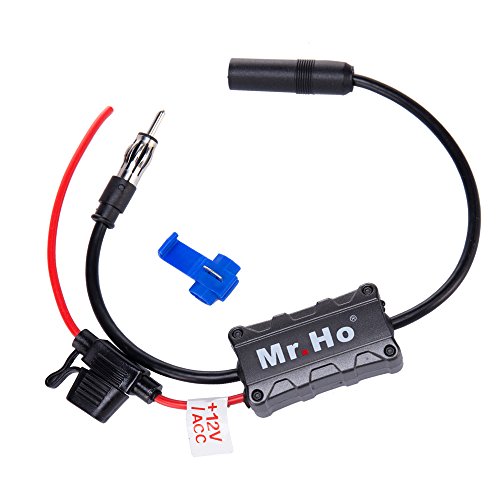
Mr.Ho AM/FM Booster is the model explicitly presented for marine, boat, truck, and RV use as well as cars. It supports AM and FM, uses copper signal wire, and has a thickened tinplate metal shielding cover. The maker says the amplifier enhances signal sensitivity and reduces noise when installed in line with the antenna and connected to 12V power.
This wider stated vehicle range makes it a natural fit for someone wiring a boat or RV radio. The connection is described as inline, but a specific connector style is not named, so check that the antenna cable and available 12V supply match your installation.
Bottom line: Pick it for an AM/FM radio in a boat, RV, truck, or car.
How to choose a car antenna amplifier
Match the amplifier to the antenna cable, radio bands, and power source before comparing gain. Inline boosters sit between the antenna and receiver, then use vehicle power; the wrong plug or a missing power lead can leave the radio without reception. AM/FM support matters if you listen to both bands, because an FM-only specification does not establish AM compatibility.
Use this quick decision table to narrow the type of fit you need.
| Need | Choose a model that specifies |
|---|---|
| DIN-connected head unit | Matching DIN plug |
| AM and FM listening | AM/FM band support |
| Boat or RV installation | That vehicle use and 12V power |
If a plug does not match the cable, stop and confirm the connector type rather than forcing the fit. An amplifier boosts the signal reaching the receiver; it does not create a broadcast signal where coverage is absent.
When a radio signal booster helps
A car antenna amplifier is most useful when a working antenna receives a weak broadcast signal, not when the antenna cable is disconnected or damaged. FM reception is generally line-of-sight, so hills, buildings, and distance from a transmitter can cause stations to fade; AM can travel farther but is susceptible to electrical noise. A booster may raise a weak received signal and noise together, so it cannot guarantee cleaner audio in every location.
Check the antenna base, cable connections, and ground before adding amplification if reception changed suddenly. If reception is poor on every station, inspect the antenna path first; if only distant stations fade, the broadcast coverage may be the limiting factor rather than the receiver.
Power and connector fit for car amplifiers
Most vehicle inline antenna amplifiers are designed around the vehicle’s 12V electrical system, but their power leads differ. A switched 12V feed powers the booster only while the ignition circuit is on, reducing the chance of leaving an accessory energized; connect only to a circuit appropriate for the vehicle and protect wiring with a suitable fuse.
Connector fit is equally important: DIN, Motorola-style, and other antenna plugs are not interchangeable without a compatible adapter. Match both sides of the inline path—the antenna lead and receiver input—and avoid routing bare wiring near moving parts or hot surfaces. Disconnect vehicle power before making electrical connections.
Common causes of poor reception after installation
Loose antenna plugs, poor grounds, and incorrect power connections are common reasons a booster does not improve reception. A shielded housing can reduce interference entering the amplifier, but it cannot repair a broken coax cable or a corroded antenna base. Keep the antenna lead seated firmly and route power wiring away from ignition and charging components where practical.
For a useful check, compare reception with the amplifier powered and with the original antenna path intact; a sudden increase in hiss or distortion can indicate interference or a wiring problem rather than insufficient gain. Do not treat a larger gain number as a guarantee of more usable stations: amplification also raises unwanted noise when the incoming signal is poor.
Frequently Asked Questions
Will a car antenna amplifier add more radio stations?
A booster can make a weak received signal easier for the radio to use, but it cannot add stations outside the broadcast coverage area. FM reception usually fades with distance or obstructions because it is largely line-of-sight.
Does an antenna booster work for AM and FM?
Only choose a booster that explicitly supports both bands if you listen to AM and FM. An FM-only specification does not confirm AM operation.
Should a 12V antenna amplifier use switched power?
Switched 12V power turns the amplifier off with the vehicle’s ignition circuit, helping avoid an accessory drawing power while parked. Use an appropriate fused circuit and secure the wiring away from hot or moving components.
Can an amplifier fix a damaged car antenna cable?
No, amplification does not repair a disconnected or damaged coax cable or antenna ground. Check the antenna base and cable continuity first if reception suddenly fails on many stations.
What connector should I check before installing a booster?
Check the antenna plug at both the receiver and antenna lead, since DIN and other common automotive antenna connectors are not interchangeable. If the booster connector does not match, use only a compatible adapter rather than forcing the connection.