
Electric Wagon Conversion Kit Options Compared by Fit

For Current Big Kahuna owners, Current Big Kahuna Electric Conversion Kit is the direct electric wagon conversion kit match because it is made for that wagon. The other options are general-purpose motor or axle kits, or a complete powered wagon rather than a conversion kit, so buyers should choose them only when their cart’s layout and electrical system can be matched.
We earn a commission if you buy through links on this page. As an Amazon Associate I earn from qualifying purchases. Products are compared on manufacturer specifications, not hands-on testing.
- Best overall: Current Big Kahuna Electric Conversion Kit – Designed specifically for Current Big Kahuna owners and includes a 48-volt battery and controls.
- Best for 24V wheel builds: 24V 250W Two-Wheel Motor Kit – Includes two 10-inch motor wheels, controller and thumb throttle.
- Best for axle-drive projects: 24V 350W Differential Transaxle Kit – Combines a differential transaxle with a 17.1-inch wheel spacing.
| Product | Best for | Voltage | Drive components | Load capacity | Shop |
|---|---|---|---|---|---|
| Current Big Kahuna Electric Conversion Kit | Big Kahuna owners | 48V | Enclosed gear drive, differential | — | Check Price on Amazon |
| 24V 250W Two-Wheel Motor Kit | DIY wheel builds | 24V | Two 10-inch motor wheels | 330–440 lb | Check Price on Amazon |
| 24V 350W Differential Transaxle Kit | Axle-drive projects | 24V | Differential rear axle | — | Check Price on Amazon |
| Sushar Electric Wagon Cart | Ready-made powered wagon | — | Built-in power assist | 210 lb standard; 340 lb max | Check Price on Amazon |
| 36V 350W Motor Wheel Kit | 36V DIY builds | 36V | 10-inch motor wheels | — | Check Price on Amazon |
Electric wagon conversion kits and alternatives
Compare direct wagon compatibility first, then match voltage and drive parts to the cart you plan to convert.
Current Big Kahuna Electric Conversion Kit

For owners of a Current Big Kahuna, this is the only option here built as a conversion kit for that specific wagon. Its 48-volt lithium-ion battery is included with a charger, and the enclosed direct gear drive has a differential, three speed settings, and forward and reverse operation. A digital control panel shows speed setting and battery life. The pull handle uses a safety lever together with the throttle; both must be engaged to activate assist. The maker says the battery runs over five miles per charge. Buyers with another wagon should not assume the mounting or controls will fit.
Bottom line: Choose this for a Current Big Kahuna; other wagon owners need a kit confirmed for their frame.
24V 250W Two-Wheel Motor Kit

Unlike the wagon-specific kit, this set centers on two 10-inch wheels with integrated brush gear motors, a controller, and thumb throttle. The maker gives a 24-volt, 250-watt system, a rated speed of 330 rpm, and a claimed load capacity range of 330 to 440 pounds. Those figures do not establish that the wheel spacing, mounting points, or electrical connections match a particular wagon. This kit suits a DIY builder who can adapt the chassis and confirm those dimensions before purchase; it is not presented as a bolt-on fit for the Big Kahuna.
Bottom line: Pick this if your DIY build can accommodate its two 10-inch motor wheels.
24V 350W Differential Transaxle Kit

This kit is a preassembled rear axle and differential drive, rather than a pair of separately fitted powered wheels. It has 17.1 inches of center-to-center wheel spacing, a 0.75-inch bore, and 9-by-3.5-by-4-inch pneumatic wheels. Its 24-volt, 350-watt brushed motor uses a 21.67:1 gear ratio, intended to reduce motor speed for low-speed drive applications. The defined axle dimensions make it useful for a builder designing around that geometry, but it may require substantial frame or mounting changes on an existing wagon. Confirm axle fit and the electrical match before committing.
Bottom line: Choose this when your frame can use the specified transaxle spacing and bore.
Sushar Electric Wagon Cart

This is a complete powered wagon, not a conversion kit, so it suits someone who wants a finished cart rather than parts for an existing one. Its standard load capacity is 210 pounds and expands to a 340-pound maximum with the rear tailgate open. The wagon has forward and reverse controls, manual mode, a removable 5,000mAh battery, and wide tires intended for varied terrain. Its foldable design and included assist may make it a practical alternative to a DIY build, but it cannot convert a wagon the buyer already owns.
Bottom line: Select this if you want a powered wagon rather than a retrofit kit.
36V 350W Motor Wheel Kit
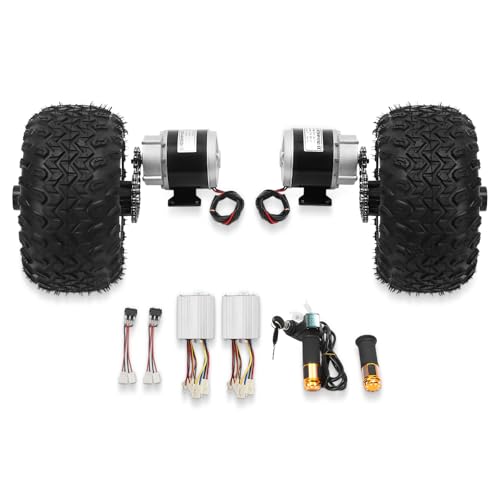
This 36-volt, 350-watt kit differs from the 24-volt wheel set by its system voltage and rated torque: the figures are 1.1 N·m and 330 rpm. It also includes a digital display throttle, while its 10-inch wheels and brush gear motor format point toward a wheel-based conversion rather than a complete wagon-specific assembly. Its features call out use across several vehicle types, but that broad range does not guarantee fit on a particular cart. Check wheel mounting, available space, and battery/controller voltage compatibility as part of the build plan.
Bottom line: Consider this for a 36V wheel-based project with compatible mounts and controls.
How to choose an electric wagon conversion kit
Start with the wagon, then match the kit’s drive layout and electrical system. A kit made for a named wagon is a more direct fit than a general motor set, but builders still need to confirm mounting points, wheel spacing, and control placement. Motor wheel sets and differential axles solve different mechanical problems: the former puts drive at the wheels, while a transaxle integrates drive across a rear axle. Voltage must match between battery, motor, and controller; never connect components with mismatched voltage ratings. Make a simple checklist before choosing: wagon model, axle or wheel arrangement, mount dimensions, voltage, and control style.
A conversion also changes how a loaded cart moves. Keep loads within the cart’s rated capacity and maintain control on slopes or uneven ground.
Voltage and drive layouts for wagon conversions
Voltage and mechanical layout are the two main differences among these choices: the systems range from 24 volts through 48 volts, and they use either wheel motors, an axle drive, or a wagon-specific enclosed gear drive. Higher voltage by itself does not prove that a kit is more powerful or a better fit; wattage, gearing, controller, and battery all matter. The options with 250-watt and 350-watt motors give motor power, while the Big Kahuna-specific kit gives battery voltage and drive type.
Use this comparison to narrow the type of build, not as a substitute for checking fit.
| Build need | Drive approach | What to match |
|---|---|---|
| Existing Big Kahuna | Wagon-specific enclosed gear drive | Named wagon compatibility |
| DIY wheel conversion | Motor wheels | Wheel size, mounts, voltage |
| DIY rear axle conversion | Differential transaxle | Axle spacing, bore, frame clearance |
| Want a complete cart | Integrated power assist | Capacity and cargo dimensions |
Measure wagon fit before ordering
Measure the wheel or axle area before selecting a general-purpose conversion kit. For the transaxle option, the key stated fit dimensions are 17.1 inches between wheel centers and a 0.75-inch bore; compare those measurements with the frame, hubs, and available mounting space. For wheel-motor kits, measure wheel diameter and the mounting area, then confirm the controller and battery can connect to the motor set. A kit with a suitable voltage can still fail to fit mechanically.
Use a measurable go/no-go rule: if your frame cannot accommodate the kit’s spacing and bore without interference, do not choose that axle kit. For an existing named wagon, confirm compatibility rather than assuming generic conversion parts will bolt on. Allow space for the battery and controls, and route wiring away from moving wheels and pinch points.
Safe operation and battery care
Electric assist adds moving force to a cart, so test controls with the wagon unloaded in a clear, level area before hauling cargo. Keep hands and loose straps away from wheels, axles, and exposed moving parts. A dead-man lever, such as the one included with the wagon-specific kit, is a control safeguard; use the controls as designed and do not bypass an engagement mechanism.
Charge lithium-ion batteries with the charger intended for that battery and voltage, and keep the battery dry unless its maker specifies otherwise. Store and charge batteries away from heat and flammable materials, and stop using a battery that is swollen, damaged, or unusually hot. Capacity claims are not a substitute for observing the wagon’s load rating or checking stability on slopes.
Frequently Asked Questions
How do I know if a conversion kit fits my wagon?
Compare the wagon’s mounting points, wheel or axle spacing, and available clearance with the kit’s dimensions. If the kit is made for a named wagon, verify your wagon model is included; generic motor kits should not be assumed to fit.
Can I use a 24V kit with a 48V battery?
No, do not pair components with different voltage ratings unless the manufacturer explicitly specifies compatibility. Match the battery, controller, and motor voltage, and use the charger intended for that battery.
What does a differential do on an electric wagon?
A differential allows the two driven wheels to turn at different speeds while cornering. That matters because the outer wheel follows a longer path than the inner wheel; axle spacing and frame clearance still need to fit the cart.
How much weight can an electric wagon conversion carry?
Use the lowest applicable rating among the wagon, frame, and conversion components. The complete Sushar wagon gives a 210-pound standard load and 340-pound maximum with its tailgate open, but the conversion kits’ figures do not establish a universal wagon capacity.
Is a motor wheel kit the same as an axle kit?
No. A motor wheel kit integrates motors at the wheels, while a transaxle kit combines drive with a rear axle and differential. Choose by the cart’s mounting layout and the components you can safely install.