
Wet N Fix Drywall Anchor Repair Options Compared

WRAPNLOCK Drywall Anchor Repair Kit is the closest match for Wet N Fix drywall anchor repair because its dampen-wrap-insert method is described for loose anchors and oversized holes. Wet N Fix itself is not among these options; choose a different repair approach if the drywall is crushed or the hole is too damaged to hold an anchor.
These are moisture-activated patches or patch material wrapped around an existing anchor, rather than conventional wall filler. For heavy fixtures or uncertain wall condition, inspect the wall and anchor type before relying on a patch.
We earn a commission if you buy through links on this page. As an Amazon Associate I earn from qualifying purchases. Products are compared on manufacturer specifications, not hands-on testing.
- Best overall: WRAPNLOCK Drywall Anchor Repair Kit – Includes 22 patches plus screws, anchors, screwdriver and gloves, and describes the dampen-wrap-insert method.
- Best for two patch sizes: X-Protector Anchor Patches, 2 Sizes – The set includes 10 big and 10 standard patches.
- Best for cut-to-fit material: Kenbry Drywall Anchor Repair Roll – The patch material comes as a 1.96-foot-wide, 39.37-foot-long roll.
| Product | Best for | Patch quantity or format | Included extras | Dimensions | Shop |
|---|---|---|---|---|---|
| WRAPNLOCK Drywall Anchor Repair Kit | Complete repair kit | 22 patches | Screws, anchors, screwdriver, gloves | — | Check Price on Amazon |
| X-Protector Anchor Patches, 2 Sizes | Two patch sizes | 20 patches; 10 each size | — | 2.4 in. long and wide | Check Price on Amazon |
| 20-Pack Drywall Masonry Anchor Repair Kit | Trim-to-fit discs | 20 discs | — | 1.97 in. diameter; 0.59 in. high | Check Price on Amazon |
| Kenbry Drywall Anchor Repair Roll | Long repair roll | Roll format | Gloves | 23.52 in. wide × 472.44 in. long | Check Price on Amazon |
Wet N Fix Drywall Anchor Repair Alternatives
These options use dampened patch material around a loose anchor, but differ in format, size and kit contents.
WRAPNLOCK Drywall Anchor Repair Kit
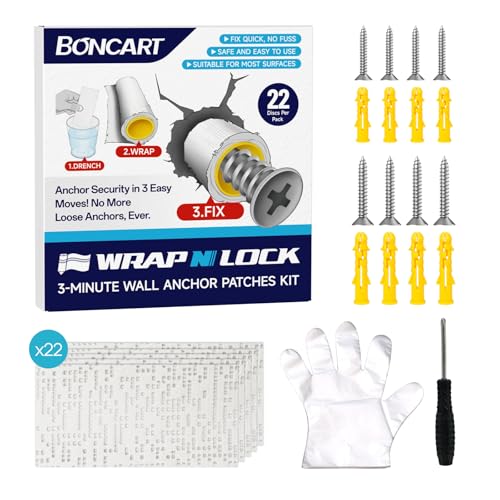
WRAPNLOCK Drywall Anchor Repair Kit stands out for its included hardware: the kit has 22 patches, screws, anchors, a screwdriver and gloves. The maker describes a three-step process: dampen a patch, wrap it around an anchor, and insert it into the hole. That approach suits a loose plug or an oversized hole when the surrounding wall remains sound enough to support an anchor. The maker says the patches are intended for fixtures including shelves and curtain rods, but gives no load rating; do not treat the kit as a rated support for a heavy fixture. Match the anchor to the wall and expected load.
Bottom line: Choose it if you want patch material and basic hardware in one kit.
X-Protector Anchor Patches, 2 Sizes

X-Protector Anchor Patches, 2 Sizes is the only set here that explicitly divides its patches between two sizes: 10 big and 10 standard. The maker’s method is to soak a patch in water, wrap it around the anchor, and insert it into the hole. The square patches measure 2.4 inches on each side, giving buyers a size to compare with the anchor and damaged area. This format suits repairs where one patch size may not fit every plug. The maker does not give a load rating or dimensions for each size category, so avoid assuming that the larger patches support more weight.
Bottom line: Choose it when having two patch sizes matters more than included hardware.
20-Pack Drywall Masonry Anchor Repair Kit

20-Pack Drywall Masonry Anchor Repair Kit differs by using round discs that can be trimmed, rather than an assortment of patch sizes or a roll. Each white disc is 1.97 inches in diameter and 0.59 inch high. The maker says to soak the required number, shake off excess water and wrap the material around the anchor; the instructions end before describing the final insertion step. The cut-to-fit format may suit a repair where a full disc needs adjustment around a particular plug.
Bottom line: Choose it if adjustable round discs suit the anchor repair.
Kenbry Drywall Anchor Repair Roll
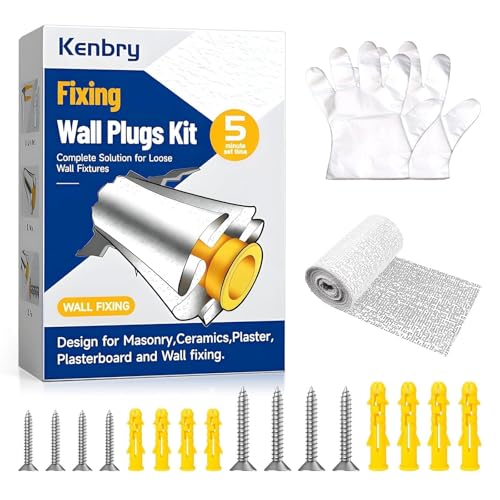
Kenbry Drywall Anchor Repair Roll is supplied as a long, easy-cut roll rather than separate patches: its size converts to 23.52 inches wide by 472.44 inches long. The maker describes dampening the patch, wrapping it tightly around a loose anchor and reinserting it, and says gloves are included. A roll suits someone who wants to cut material to the needed size across multiple repairs. Its width and length do not establish how much material each anchor requires, and the maker gives no load rating, so this is not a basis for sizing a support for a heavy object.
Bottom line: Choose it when roll material is more useful than pre-cut patches.
How to choose a drywall anchor repair patch
Choose by the damaged hole, the anchor, and the load—not by patch count alone. A patch wrapped around an existing plug is intended to restore grip in a loose or oversized hole; it does not replace a suitable anchor or sound wall material. Standard drywall commonly comes in 1/2-inch and 5/8-inch thicknesses, so confirm the wall thickness and anchor compatibility before reusing a plug. For a small, light item, a repaired anchor may be adequate if it seats firmly; for a heavy shelf, cabinet or grab bar, use a mounting method suited to the load and wall structure instead. A measurable rule: if the hole’s edge crumbles when lightly pressed or the plug spins after installation, stop and assess a different anchor location or repair rather than adding more patch material.
Patch sizes and formats for loose anchors
Patch format affects how much material you can shape around a plug, but the product dimensions do not establish a safe load. Separate discs or patches offer ready-to-use pieces; a roll can be cut to size, while two-size sets give a choice between pre-cut formats. Measure the hole and anchor before wetting material, since damp patches can be harder to trim neatly. Keep the repair area close-fitting: a loose wrap or a patch folded into a lump can prevent the anchor from seating straight. The table compares the formats and contents that distinguish these options; use wall thickness and anchor size as separate fit checks.
| Format | What to compare | Useful when |
|---|---|---|
| Pre-cut patch or disc | Piece count and dimensions | You want ready pieces |
| Two-size patch set | Count in each size | Hole repairs differ |
| Roll | Width and total length | You want cut-to-size material |
Anchor loads and wall safety
Drywall anchors have different load limits based on anchor design, drywall thickness, installation quality and load direction; a patch kit without a load rating cannot answer those questions. A screw pulling straight down from a shelf bracket can stress a hole differently from a light picture hook. For substantial or dynamic loads, fasten into a stud or use a properly selected anchor with a published rating, and keep the fixture’s total load within that rating. Never use a repaired drywall anchor to support a person or other life-safety load. Before drilling or enlarging a hole, check for wiring and plumbing routes, especially around outlets, switches and sinks.
Common mistakes when fixing a loose wall plug
The most common mistake is trying to reuse a hole after the surrounding drywall has broken away; patch material cannot restore missing board strength. Another is using too much water or leaving a wet patch folded unevenly, which can obstruct the plug instead of tightening its fit. Dampen only as the maker directs, wrap snugly, and keep the anchor aligned as it goes in. Do not force a screw that binds or spin an anchor in the hole, since either can enlarge the damage. If the fixture still moves after the material sets, remove the load and switch to a sound mounting point or a repair suited to damaged drywall.
Frequently Asked Questions
Can a drywall anchor repair patch hold a heavy shelf?
A patch without a published load rating cannot establish a safe shelf capacity. For a heavy shelf, attach the bracket to a stud or use an anchor rated for the wall thickness and expected load.
Should the anchor patch be wet before wrapping?
The patch methods described for these kits call for dampening or soaking the material before wrapping it around the anchor. Use only enough water for the material to be workable, and avoid inserting a bulky or uneven wrap.
Can I reuse the same hole after the anchor loosens?
Reuse is only sensible when the hole edges and surrounding drywall remain intact enough to support an anchor. If the plug spins or the board crumbles, move to a sound mounting point or repair the damaged wall before remounting.
How thick is standard drywall for anchor selection?
Common drywall thicknesses are 1/2 inch and 5/8 inch. Check the wall thickness because an anchor must be compatible with the board and its own specified installation range.
When should I anchor a fixture into a wall stud?
Use a stud for substantial or dynamic loads, or whenever the anchor’s capacity is uncertain.