
Military Smart Watches for Men: 5 Models Compared

For men who want outdoor navigation plus calls, Tiwain 1.43-inch AMOLED GPS Watch stands out with built-in GPS, support for six satellite systems, and a compass, altimeter, and barometer. Choose Soudorv S50 1.53-inch Watch instead if longer standby time matters more than onboard navigation, or Jet Black 1.95-inch Call Watch for Bluetooth 5.4 calls and a larger screen.
These rugged-style smartwatches combine fitness tracking with features such as GPS, calls, or flashlight functions; “military-grade” alone does not identify a specific durability test.
We earn a commission if you buy through links on this page. As an Amazon Associate I earn from qualifying purchases. Products are compared on manufacturer specifications, not hands-on testing.
- Best overall: Tiwain 1.43-inch AMOLED GPS Watch – Built-in GPS supports six satellite systems, with compass, altimeter, and barometer for outdoor use.
- Best for standby time: Soudorv S50 1.53-inch Watch – The maker claims up to 50 days of standby and 18 days of daily use.
- Best for calls: Jet Black 1.95-inch Call Watch – Bluetooth 5.4 supports wrist calls, and the watch has a 1.95-inch screen.
| Product | Best for | Screen size | Built-in GPS | Battery claim | Shop |
|---|---|---|---|---|---|
| Tiwain 1.43-inch AMOLED GPS Watch | Outdoor navigation | 1.43 in. AMOLED | Yes; 6 satellite systems | 30-day standby | Check Price on Amazon |
| Soudorv S50 1.53-inch Watch | Long standby | 1.53 in. | — | Up to 50 days standby; 18 days daily use | Check Price on Amazon |
| Jet Black 1.95-inch Call Watch | Wrist calls | 1.95 in. HD | — | 30+ days (maker claim) | Check Price on Amazon |
| 2.02-inch GPS Compass Watch | Outdoor instruments | 2.02 in. | Yes | — | Check Price on Amazon |
| 2.02-inch Calls and Fitness Watch | Large-screen fitness | 2.02 in. | — | — | Check Price on Amazon |
Military Smart Watches for Men
Compare these rugged-style watches by screen size, navigation features, and the battery claims that matter to your routine.
Tiwain 1.43-inch AMOLED GPS Watch

Unlike the other models, this Tiwain watch names six satellite systems for built-in location tracking: GPS, GLONASS, BeiDou, Galileo, NAVIC, and QZSS. It also pairs a compass, altimeter, and barometer with a 1.43-inch AMOLED screen, 170+ sport modes, and Bluetooth calling. The maker claims 30 days of standby time. This option suits hikers and runners who want positioning without relying on a phone; satellite reception can still be limited by terrain, buildings, and tree cover. Its screen is smaller than the 1.95- and 2.02-inch options.
Bottom line: Choose this if onboard navigation and multiple satellite systems matter most.
Soudorv S50 1.53-inch Watch
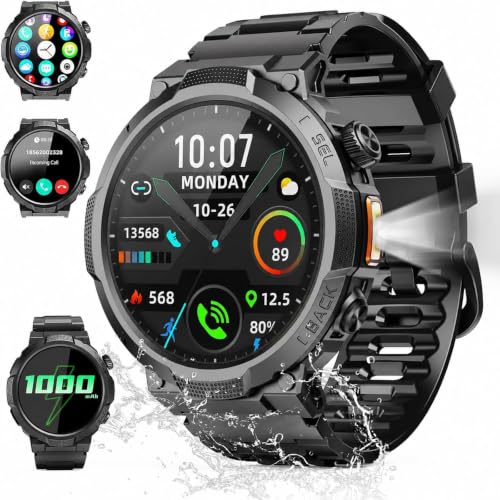
The Soudorv S50 prioritizes battery endurance over the built-in navigation features offered by some alternatives. It has a 1.53-inch display, a 1,000mAh battery, magnetic charging, 110+ sports modes, an LED flashlight, and an IP68 rating. The maker claims up to 18 days of daily use or 50 days on standby, with a full charge taking about two hours. That makes it a fit for trips when charging access is limited. Those daily-use and standby figures describe different usage conditions, so frequent calls, GPS, or screen use may reduce runtime.
Bottom line: Pick this for the maker’s extended standby claim and a mid-size screen.
Jet Black 1.95-inch Call Watch

The Jet Black model stands out for Bluetooth 5.4 calling and its 1.95-inch HD screen, larger than the 1.43- and 1.53-inch options. It supports making, answering, and rejecting calls from the wrist, contact syncing, message notifications, 120+ sports modes, and an LED flashlight. The maker claims 30+ days of battery life. It suits users who want a larger display and call controls during workouts or daily routines. Message replies are not supported, so choose a different setup if responding to texts from the watch is essential.
Bottom line: Choose this for a larger display and Bluetooth calling controls.
2.02-inch GPS Compass Watch

The 2.02-inch GPS model combines a large screen with outdoor instruments: built-in GPS, compass, altimeter, and barometer. Its feature set also includes sleep monitoring, heart-rate monitoring, sport modes, water resistance, and calls, making it a broad fitness-and-outdoors option. GPS tracking without a phone is useful for route recording, while the compass and altitude and pressure readings provide additional context. The tradeoff is its larger screen, which may feel less convenient on a smaller wrist or under a snug sleeve.
Bottom line: Pick this if you want a large screen with GPS and outdoor instruments.
2.02-inch Calls and Fitness Watch

The Black 2.02-inch model emphasizes calls and fitness tracking rather than naming built-in GPS. It has an aluminum-alloy bezel and special composite material; the maker claims resistance to heat up to 187.96°F, cold down to -82.78°F, low pressure, and dust. It also supports calls, 100+ sport modes, sleep monitoring, and heart-rate monitoring. This is a fit for buyers who want the large display and rugged design claims but do not need onboard route tracking.
Bottom line: Choose this for a large fitness display and the maker’s temperature-resistance claims.
How to choose a military smart watch for men
Start with the feature that changes your use most: independent navigation, call controls, or fewer charging stops. Built-in GPS can record a route without a phone, while a connected watch may rely on a phone for location; GPS also uses more power than basic timekeeping. Satellite signals can be blocked or weakened by dense buildings, steep terrain, and heavy tree cover. If you routinely hike beyond phone coverage, favor a model explicitly naming built-in GPS; if you mainly want wrist calls and workouts, prioritize call support and display size instead. “Military-grade” is not a single universal consumer-watch rating, so confirm which named test standard and test methods support any durability claim you plan to rely on.
GPS, compass, and outdoor tracking
Built-in GPS is the deciding feature when you want route tracking without carrying a phone, but it does not guarantee a usable signal in every setting. Satellite reception is usually strongest with a clear view of the sky and weaker indoors, in urban canyons, or under dense canopy. A compass indicates direction, while an altimeter estimates elevation and a barometer measures air pressure; these instruments complement GPS rather than replacing route maps. Multi-system support can use signals from more than one satellite network, but actual accuracy depends on reception and device implementation. For regular hikes, compare whether the watch names onboard GPS and which instruments it includes, then plan navigation that does not depend on a wrist device alone.
Water resistance and rugged-watch claims
Water resistance ratings are not the same as a promise that every water activity is safe. IP ratings use standardized dust and water ingress tests, but the exact conditions and limits matter; IP68 does not by itself say how deep or how long a watch can be submerged. Water resistance can also decline with wear, impacts, or damaged seals. Avoid operating buttons underwater unless the manufacturer explicitly permits it, and rinse off salt or chlorinated water after exposure. Temperature-resistance figures and general “military-grade” language describe different claims from an IP rating. For swimming, diving, or exposure to hot water, confirm the watch’s precise activity limits rather than relying on a broad waterproof label.
Screen size, battery, and daily use
Screen size affects readability and wear comfort: these models range from 1.43 to 2.02 inches, and a larger display may be easier to read but take up more wrist space. Compare battery claims by mode, because standby time and active daily use are not interchangeable measures. GPS tracking, calls, notifications, and frequent screen wake-ups can all increase power use, so a quoted standby figure is a poor estimate for a trip with continuous tracking. Match the watch to your routine: if you expect several days of GPS use, prioritize an active-use figure and charging plan; if your main need is everyday notifications, screen fit and call functions may matter more.
Frequently Asked Questions
Can a military smartwatch track a route without a phone?
Only models with built-in GPS can record location without depending on a phone’s GPS. Satellite reception can be weak indoors, between tall buildings, or under dense tree cover.
Does IP68 mean a watch is safe for swimming?
Not automatically: IP68 test depth and duration are set by the manufacturer, and the rating does not spell out every swimming limit. Check the specific water-use limits, and do not press buttons underwater unless permitted.
What does a smartwatch altimeter measure?
An altimeter estimates elevation, often using air-pressure changes, while a barometer measures air pressure. Weather shifts can affect pressure-based elevation readings, so treat them as estimates rather than surveyed altitude.
Why does GPS reduce smartwatch battery life?
GPS actively receives satellite signals to calculate position, so route tracking typically draws more power than standby or basic timekeeping. Calls, frequent screen use, and notifications can also shorten runtime.
What does military-grade mean on a smartwatch?
Look for a named test standard and the specific methods or limits that were tested.