
Welbilt Bread Machine: Models Compared by Fit

The Welbilt ABM-100 is the named bread machine; choose it if you want that specific model, while the alternatives offer stated capacity and program choices that help compare functions.
Bread machines automate mixing, kneading, rising, and baking; if you need a programmable cycle or a particular loaf size, compare the alternatives’ stated settings and capacity first.
We earn a commission if you buy through links on this page. As an Amazon Associate I earn from qualifying purchases. Products are compared on manufacturer specifications, not hands-on testing.
- Best overall: Welbilt ABM-100 Bread Machine – It is the exact Welbilt ABM-100 model named in the search.
- Best for program variety: KITCHENARM 29-in-1 SMART – It lists 29 programs, three loaf sizes, and three crust colors.
- Best for quick baking: Amazon Basics Programmable Bread Maker – Its ExpressBake setting is described as baking bread in under 90 minutes.
| Product | Best for | Loaf capacity | Programs | Color | Shop |
|---|---|---|---|---|---|
| Welbilt ABM-100 Bread Machine | Welbilt model | — | — | White | Check Price on Amazon |
| 2LB 17-Program Bread Maker | Beginner controls | 2 lb | 17 | Silver | Check Price on Amazon |
| KITCHENARM 29-in-1 SMART | Cycle flexibility | 1, 1.5, or 2 lb | 29 | Stainless steel | Check Price on Amazon |
| Amazon Basics Programmable Bread Maker | Express baking | Up to 2 lb | 14 | White | Check Price on Amazon |
Welbilt bread machine and alternatives
Compare the named Welbilt model with other bread makers by their functions and size options.
Welbilt ABM-100 Bread Machine

The Welbilt ABM-100 is the specific bread machine named in the search, making it the direct match for someone seeking that model rather than a newer machine with a different feature set. For a replacement purchase, confirm that the machine matches the model you need before ordering, especially if you are trying to replace or match an existing appliance. Buyers prioritizing a loaf capacity or a menu count can compare the other machines here instead.
Bottom line: Choose this if the Welbilt ABM-100 model itself is your priority.
2LB 17-Program Bread Maker

This silver bread maker stands apart with a 2-pound capacity and 17 automatic programs, including options for whole wheat, jam, yogurt, and gluten-free bread. Its controls are presented as beginner-friendly, and the machine has a 15-hour timer and LCD display. The maker says it handles the process from kneading through baking; that broad program mix may suit a household that wants more than a basic loaf. It is a different brand and model from the Welbilt ABM-100, so it is an alternative rather than a match for buyers who specifically need Welbilt.
Bottom line: Choose this for a 2-pound machine with 17 automatic programs.
KITCHENARM 29-in-1 SMART
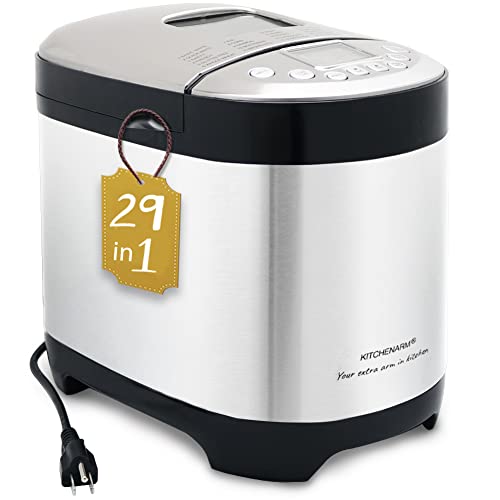
The KITCHENARM is distinguished by three selectable loaf sizes—1, 1.5, or 2 pounds—and a customizable Homemade cycle, rather than a single stated capacity. It also has 29 automatic menus, including bread and non-bread choices, and three crust colors. The maker says the machine saves settings for the next use and includes a recipe book with 77 recipes. This range of controls may suit bakers who want to adjust loaf size or settings; buyers who only need the Welbilt model should treat it as a separate alternative.
Bottom line: Choose this when adjustable loaf size and a customizable cycle matter.
Amazon Basics Programmable Bread Maker

The Amazon Basics machine is the alternative with a specifically named ExpressBake setting, which the maker says bakes bread in less than 90 minutes. It has a capacity of up to 2 pounds, 14 settings for breads, doughs, gluten-free options, and jams, plus three crust colors and an LCD display. Its 550-watt rating and white finish distinguish its specification set from the Welbilt model. The quick-bake option may suit someone short on time, but it is not the named Welbilt machine.
Bottom line: Choose this if a specifically stated quick-bake cycle is useful.
How to choose a bread machine
Choose a bread machine by matching loaf capacity and cycle controls to the bread you plan to make. Home machines commonly offer 1-, 1.5-, or 2-pound loaf settings; a larger setting is not automatically better if you usually bake small batches. Program counts also need context: a menu may cover dough or jam as well as finished bread, so compare the named cycles you will actually use. For a household that wants more than one loaf size, select a model that explicitly offers multiple sizes. If you need the Welbilt model itself, prioritize the ABM-100 name over a similar-looking alternative.
Loaf size and ingredient measuring
Match recipe quantities to the selected loaf size, because filling a pan beyond its intended capacity can cause dough to rise over the pan and bake unevenly. A 2-pound loaf is 32 ounces of finished bread; that does not mean 32 ounces of flour, since water and other ingredients contribute to the loaf weight. Weighing flour is more repeatable than scooping: 1 cup of all-purpose flour is commonly about 4.25 ounces, though packing changes the amount. Use a bread machine recipe sized for the chosen setting rather than scaling ingredients by guesswork, and leave room for dough expansion.
What bread machine programs do
Bread machine cycles coordinate mixing, kneading, rising, and baking, while dough programs generally stop before baking so the dough can be shaped and baked separately. Gluten-free dough behaves differently from wheat dough because it lacks gluten’s elastic network; use a cycle and recipe intended for gluten-free baking rather than swapping flour cup for cup. Whole-wheat flour absorbs water differently from white flour, so recipes often need different liquid proportions. A higher program count can include non-bread functions such as jam or cake, so check the actual cycle names against your baking plans rather than treating the count alone as a measure of suitability.
Using a bread machine safely
Keep the machine on a stable, heat-resistant surface with clearance around its vents, and do not touch the pan or heating area during or immediately after baking. Bread machine pans and kneading paddles can be hot enough to burn; use oven mitts when removing the pan. Add ingredients in the order given by a recipe designed for your machine, since recipes differ in whether liquid or dry ingredients go in first. Keep yeast separate from salt and liquid until mixing begins when using a delayed timer, so fermentation does not start prematurely. Unplug the machine and let it cool before cleaning or handling the paddle.
Frequently Asked Questions
How large is a 2-pound bread machine loaf?
A 2-pound loaf means about 32 ounces of finished bread, not 32 ounces of flour. Flour, water, and other ingredients all contribute to that total weight.
Can I use regular bread recipes in a bread machine?
Use recipes scaled for a bread machine and its loaf capacity. A standard 1-pound loaf is 16 ounces finished, so a recipe for a larger loaf may overflow a smaller pan.
Why does bread machine dough rise too high?
Too much yeast, excess liquid, or a recipe that exceeds the selected loaf size can make dough rise over the pan. Use a recipe matched to the machine’s capacity and measure ingredients consistently.
When should I add yeast to a bread machine?
For a delayed-start cycle, keep yeast from touching liquid and salt before mixing begins. Many recipes place yeast on top of the dry ingredients, but the order should match that recipe’s machine instructions.
Can bread machines make gluten-free bread?
Some machines include a gluten-free program, but a gluten-free recipe is still important because those doughs do not develop wheat gluten’s elastic structure. Use a recipe made for the selected machine capacity and cycle.