
Best Adhesive for Car Spoiler: 4 Tapes Compared

3M PT1500 Exterior Attachment Tape is the best adhesive for a car spoiler when the part has a broad or uneven mounting surface: its 1.52 mm acrylic foam core is made to conform to curves and fill gaps. Choose a different tape if you need more length, a narrower strip or an included adhesion promoter.
Automotive attachment tape is double-sided foam tape designed to bond trim and accessories to painted or prepared vehicle surfaces. For a spoiler carrying substantial aerodynamic load, confirm the vehicle and spoiler maker allow tape-only attachment.
We earn a commission if you buy through links on this page. As an Amazon Associate I earn from qualifying purchases. Products are compared on manufacturer specifications, not hands-on testing.
- Best overall: 3M PT1500 Exterior Attachment Tape – Its 1.52 mm foam core conforms to curves and gaps, and its dual adhesives target paint and trim.
- Best with promoter: PHIXBEAR Tape with Promoter – It includes an adhesion promoter and measures 3/4 inch wide by 19.7 feet long.
- Best for longer rolls: PHIXBEAR Heavy-Duty Automotive Tape – The 20-foot roll is the longest among the tape options.
| Product | Best for | Width | Length | Core thickness | Shop |
|---|---|---|---|---|---|
| 3M PT1500 Exterior Attachment Tape | Curved or uneven flanges | 3/8 in | 10.8 ft | 1.52 mm | Check Price on Amazon |
| PHIXBEAR Tape with Promoter | Promoter included | 3/4 in | 19.7 ft | — | Check Price on Amazon |
| PHIXBEAR Heavy-Duty Automotive Tape | Longer installations | 3/5 in | 20 ft | — | Check Price on Amazon |
| Surosha Automotive Acrylic Foam Tape | Thicker foam strip | 0.59 in | 16.4 ft | 2 mm | Check Price on Amazon |
Car Spoiler Adhesive Tapes Compared
Match tape width and foam construction to the spoiler flange, then prepare the surfaces for a clean bond.
3M PT1500 Exterior Attachment Tape
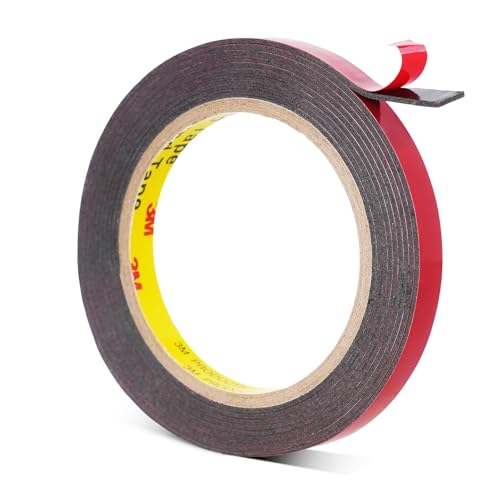
For a spoiler with a curved or slightly uneven flange, this tape has a 1.52 mm acrylic foam core that conforms to curves and fills gaps. The maker says its liner-side adhesive bonds to rigid and flexible clear-coat paint systems, while the other side is for metal, trim and primed plastic. That makes it the most purpose-built choice here for larger parts and irregular surfaces. Its 3/8-inch width and 10.8-foot length may be limiting for a wide flange or a long installation; measure the full contact path before choosing it.
Bottom line: Choose this when the flange is curved or uneven and the narrower roll covers the full contact path.
PHIXBEAR Tape with Promoter

The included adhesion promoter distinguishes this 3/4-inch tape from the other rolls, particularly when the bonding surface is hard to stick to. The maker describes the product as acrylic foam tape for automotive accessories and says it conforms to curves and holds under vibration; the promoter is intended to boost bonding on hard-to-stick surfaces. It also comes with a liner-lift tool for starting the backing.
Bottom line: Choose this when an included promoter and a wide roll suit your installation.
PHIXBEAR Heavy-Duty Automotive Tape

The 20-foot roll gives this tape the most length among these tape options, which can help when the spoiler flange requires a long continuous strip. The maker describes it as high-temperature resistant and intended for exterior automotive accessories including rear spoiler wings; its peel-and-stick format is also described as removable without residue. The 3/5-inch width is narrower than the 3/4-inch option, and the specifications do not give a foam-core thickness. That makes it less suitable when a known gap-filling profile is essential.
Bottom line: Choose this when you need the longest roll and do not require a specified core thickness.
Surosha Automotive Acrylic Foam Tape

This tape has a 2 mm foam thickness, the only specified thickness here besides the 1.52 mm core in 3M PT1500 Exterior Attachment Tape, making its profile easy to compare for a flange with a small gap. The roll measures 15 mm wide and 5 m long, equivalent to about 0.59 inch by 16.4 feet. The maker describes it as weather resistant and intended for automotive trim and emblems. It is not as wide or long as the 3/4-inch, 19.7-foot tape, so measure the flange and required tape path first.
Bottom line: Choose this when a specified 2 mm foam profile matches the flange.
How to Choose Spoiler Adhesive Tape
Start with the spoiler flange: tape width should fit the flat bonding land without protruding, and the foam must accommodate the surface shape. Automotive acrylic foam tape bonds through pressure-sensitive adhesive and a compressible core; a thicker core can conform to more irregularities, but thickness alone does not establish load capacity. Compare the core thicknesses and measure the usable flange width before cutting. Clean, dry surfaces matter because wax, polish, dust and moisture interfere with contact. Use a compatible surface cleaner and let the surfaces dry fully. Apply steady pressure along the entire bond line, rather than pressing only at the ends. Tape-only mounting is appropriate only when the vehicle and spoiler manufacturers specify it for that application.
Fit Tape Width and Length to the Spoiler
Measure the complete bonding path on the spoiler, including each segment that will receive tape; do not estimate from the spoiler’s outside dimensions. A 3/4-inch strip covers more flange width per pass than a 3/8-inch strip, but it will not fit a narrow bonding land without overhang. Leave no unsupported breaks at corners unless the installation instructions call for them, and avoid stretching foam tape around bends. Check both the spoiler and painted panel for a continuous, flat contact surface. A spoiler with less than 3/8 inch of usable flat land cannot fully support even the narrowest tape here, so confirm the maker’s mounting approach before proceeding. Cold surfaces and rushed handling can reduce initial adhesion; install within the tape maker’s specified temperature range.
Prepare Surfaces and Allow the Bond to Set
Surface preparation and curing time affect the bond as much as tape choice. Remove old adhesive without scratching the paint, then clean and dry both bonding surfaces; fingerprints and oily residue can create weak spots. An adhesion promoter can help on compatible hard-to-bond materials, but use it only where the tape and promoter manufacturers permit, since primers may affect paint or plastics. Apply tape evenly without trapping dust, position the spoiler once, and press along the full contact area. Pressure-sensitive acrylic adhesives generally build strength over time rather than reaching their ultimate bond immediately; avoid washing, loading or driving at speed until the installation instructions allow it. Never use tape as a substitute for specified screws, clips or other mechanical fasteners.
Frequently Asked Questions
Can double-sided tape hold a car spoiler at highway speed?
Only use tape-only mounting when the vehicle and spoiler manufacturers approve it for that spoiler and vehicle. Aerodynamic loads rise with speed, and a peel-prone edge or inadequate bonding land can lead to detachment.
How wide should spoiler mounting tape be?
Choose tape no wider than the flat bonding land, so the strip stays supported without hanging over an edge. Measure the flange first; if it offers less than 3/8 inch of usable width, confirm the required mounting method.
Does thicker foam tape fill gaps better?
A thicker foam core can conform to a larger surface irregularity, but it does not by itself prove that the bond can carry a spoiler’s load. Compare the flange shape and follow the spoiler maker’s mounting requirements.
How long should automotive tape cure before driving?
Acrylic foam tape typically continues building bond strength for about 72 hours, with temperature and surface preparation affecting the rate. Use the tape and spoiler makers’ specified wait time, and avoid stressing the joint during that period.