
Power Adapter US to France: 4 Options Compared

For a power adapter from the US to France, HANYCONY 5-in-1 EU Adapter suits travelers charging several devices because it combines two AC outlets with three USB ports, including two USB-C ports. Choose a simpler plug-only adapter if you want a compact set for multiple outlets; none of these adapters converts voltage, so your appliance must support France’s 230V supply.
We earn a commission if you buy through links on this page. As an Amazon Associate I earn from qualifying purchases. Products are compared on manufacturer specifications, not hands-on testing.
- Best overall: HANYCONY 5-in-1 EU Adapter – Two AC outlets and three USB ports let you connect up to five devices at once.
- Best for spares: Unidapt Type C Adapter, 4-Pack – The four-pack provides a separate Type C adapter for multiple outlets or travelers.
- Best for a desk: European Extension Cord, 3 ft – A 3-foot cord separates the adapter from its three AC outlets and four USB ports.
- Best for compact travel: Amazon Basics Type E/F Adapter, 3-Pack – Three Type E/F plugs provide a basic plug-adapter set without added USB ports.
| Product | Best for | Outlets and USB ports | Pack or cord | Shop |
|---|---|---|---|---|
| HANYCONY 5-in-1 EU Adapter | Multi-device charging | 2 outlets, 3 USB | 1 adapter | Check Price on Amazon |
| Unidapt Type C Adapter, 4-Pack | Multiple outlets | 1 plug adapter | 4 adapters | Check Price on Amazon |
| European Extension Cord, 3 ft | Shared charging spot | 3 outlets, 4 USB | 3 ft cord | Check Price on Amazon |
| Amazon Basics Type E/F Adapter, 3-Pack | Basic plug conversion | 1 plug adapter | 3 adapters | Check Price on Amazon |
Power adapters from the US to France
Compare outlet formats, charging connections, and ratings before choosing an adapter for your devices.
HANYCONY 5-in-1 EU Adapter

With two AC outlets and three USB ports, including two USB-C ports, this adapter is the most versatile pick here for charging several devices from one wall socket. The maker says its USB output is up to 3.1A total and its AC capacity is up to 2,500W at 250V and 10A. It is intended for dual-voltage appliances only, not single-voltage heating appliances such as hair dryers or coffee makers. Its multiport design suits phones, tablets, and chargers, but travelers needing only a small plug should consider a simpler adapter.
Bottom line: Pick this when you want multiple AC and USB connections from one adapter.
Unidapt Type C Adapter, 4-Pack

This four-pack prioritizes having a separate plug adapter for several outlets or travelers, rather than adding USB charging ports. Its Type C plug is designed for many European outlets, and the maker says it also fits Schuko Type E/F sockets; it is not for UK or Ireland Type G outlets. The adapter has solid copper pins and conductors in a flame-retardant PC shell, with a 6A rating and a 1,380W maximum at 230V. It suits travelers carrying their own chargers, but it does not provide the built-in USB ports found on other options.
Bottom line: Choose this if having four simple plug adapters matters more than integrated charging ports.
European Extension Cord, 3 ft

The 3-foot cord makes this adapter a better fit for a shared charging spot than a compact wall plug, with three US outlets and four USB ports gathered at the cord end. The maker says it accepts standard US two- or three-prong plugs and has an AC capacity up to 2,500W at 250V and 10A. It is designed for use in France and other European countries. Its larger corded form can serve several devices together, but travelers who want a pocketable adapter or just one connection may prefer a smaller plug.
Bottom line: Pick this for a group charging area where several devices need to connect together.
Amazon Basics Type E/F Adapter, 3-Pack
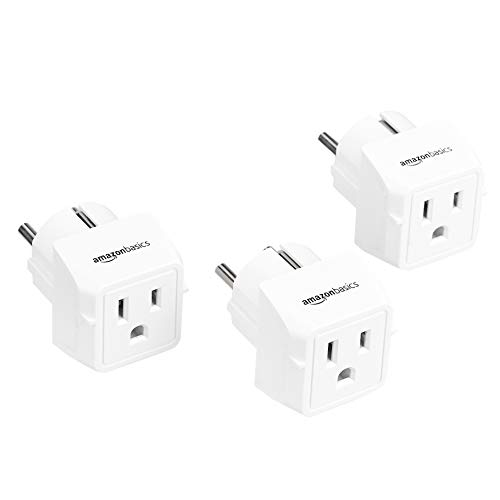
This three-pack is the straightforward choice for travelers who need Type E/F plug adapters and already have suitable chargers. It accepts North American two- or three-prong flat-pin plugs, including polarized plugs, and has a 5-15R socket. The maker says it is not a voltage converter and is for dual-voltage devices; its rating is 250V and 10A. Its compact, plug-only format avoids extra charging features, but it has no built-in USB ports or cord for separating connected devices from the wall socket.
Bottom line: Choose this for a basic three-plug set when your devices already support 230V.
How to choose a US-to-France adapter
Start with the device label: a plug adapter changes the plug shape, while France’s mains supply is 230V at 50Hz. Devices marked 100–240V can generally accept that voltage, but a device marked only 110V cannot be made compatible by a travel adapter. A charger with a range printed on its label is usually the simplest travel case. For multiple devices, count the AC outlets and USB ports you actually need, and compare the adapter’s current and wattage ratings with the devices connected. With more than two devices to charge at one spot, a multiport or corded model may be more practical than carrying several single-plug adapters.
France plug shape and grounding
French wall outlets commonly use Type E sockets, while many European travel adapters use Type C or combined Type E/F designs. Type C plugs are two-pin and ungrounded; a three-prong US plug requires an adapter that supports grounding if the appliance depends on it. Check both the appliance plug and adapter design before connecting grounded equipment. A plug fitting into a socket does not establish voltage compatibility or guarantee grounding. France uses 230V, 50Hz mains power, compared with the nominal 120V, 60Hz supply in the United States, so the device label—not the adapter’s physical fit—determines whether the appliance can operate safely.
Adapter types compared by charging need
Simple plug adapters change the plug interface, while multiport adapters and corded units add charging connections. Choose by the number and type of devices you will use together; extra ports do not increase the capacity of the wall circuit or convert voltage. This guide maps common travel needs to the adapter style and a practical check.
| Need | Adapter style | Check before travel |
|---|---|---|
| One or two device chargers | Plug-only adapter | Plug shape and device voltage range |
| Several USB devices | Multiport adapter | Shared USB output rating |
| Several devices at a distance | Corded adapter | Total load and grounded connection |
Safe use with French mains power
Use an adapter only when the appliance label supports 230V; a plug adapter alone does not step voltage down to 120V. Heating appliances often draw substantial power, so do not connect a single-voltage US hair dryer, straightener, curling iron, or coffee maker through a plug adapter. Compare the device’s wattage with the adapter’s rating and avoid exceeding the lowest applicable rating among the adapter and connected devices. If a device is dual-voltage but has a three-prong plug, confirm that the adapter preserves the required grounding. Disconnect equipment if the plug or adapter becomes unusually hot, smells of burning, or shows physical damage.
Frequently Asked Questions
Will a US plug fit a French wall outlet?
A US plug generally needs a travel adapter to fit a French Type E outlet. Check that the adapter accepts the plug’s prong arrangement, especially for polarized or grounded plugs.
Does a travel adapter convert 230 volts to 120 volts?
No, a plug adapter changes the physical connection but does not convert voltage. Use only appliances whose label supports 230V, such as a charger marked 100–240V.
Can I use a US hair dryer in France?
Only if the hair dryer is designed for 230V or has a dual-voltage setting that supports it. A plug adapter alone cannot convert France’s 230V supply for a 120V-only dryer.
What does 50Hz mean for US electronics in France?
France’s mains supply is 50Hz, while US mains power is typically 60Hz. Many electronic chargers accept 50/60Hz, but check the device label; some motorized or timing appliances may require the correct frequency.
Can I charge several devices from one adapter?
Yes, if the adapter has enough ports and the combined load stays within its rating. USB ports may share a total output limit, so check that rating when charging several devices simultaneously.