
Best Deer Salt Block Holder: 3 Mounting Options Compared

For most deer setups, Teenyyou Galvanized Block Holders, 4-Pack is the practical pick because its galvanized metal frame is sized for standard blocks and comes four to a pack. Choose a different holder if you need a single mounting bracket, a plated wire frame, or a ground-level pan for feed and water.
We earn a commission if you buy through links on this page. As an Amazon Associate I earn from qualifying purchases. Products are compared on manufacturer specifications, not hands-on testing.
- Best overall: Teenyyou Galvanized Block Holders, 4-Pack – Four galvanized holders fit standard-size blocks and include mounting screws.
- Best for wire-frame mounting: QWORK Nickel-Plated Wire Holder, 2-Pack – Nickel-plated metal wire frame is sold as a two-pack for standard 4 lb blocks.
| Product | Best for | Capacity or fit | Material | Pack size | Shop |
|---|---|---|---|---|---|
| Teenyyou Galvanized Block Holders, 4-Pack | Multiple stations | Standard-size blocks | Galvanized metal | 4 holders | Check Price on Amazon |
| Youven Standard 4 lb Holder, 1-Pack | Single station | Standard 4 lb blocks | — | 1 holder | Check Price on Amazon |
| QWORK Nickel-Plated Wire Holder, 2-Pack | Wire frame | Standard 4 lb blocks | Nickel-plated metal wire | 2 holders | Check Price on Amazon |
Deer Salt Block Holders
Compare the mounting format, block fit and material before choosing a holder for your feeding setup.
Teenyyou Galvanized Block Holders, 4-Pack
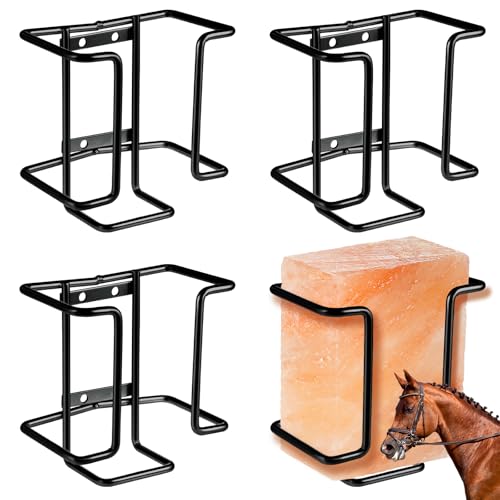
For setting up several wall-mounted mineral stations, this four-pack offers more holders than the single-bracket option and the two-pack wire frame. Each galvanized metal rack measures about 5.3 × 3.3 × 5.5 inches and includes screws for installation. The maker says the galvanized, non-corrosive construction resists rust for outdoor use. It suits a property that needs multiple stations for deer or other livestock. The package count is the main limitation for a small setup; a single holder avoids extra brackets if you only need one location.
Bottom line: Choose this set when you want several galvanized mounting points.
Youven Standard 4 lb Holder, 1-Pack

For one mineral station, this is the simplest choice: the package contains one holder for standard 4 lb blocks rather than a multi-pack. It measures approximately 5.3 × 3.2 × 5.12 inches and comes with mounting screws for walls, posts or stalls. That makes it suitable when you already know where the holder will go and do not need spare brackets. The maker gives no frame material or finish, so buyers prioritizing a particular metal or corrosion-resistant coating should confirm that before ordering.
Bottom line: Pick it for a single standard 4 lb block station.
QWORK Nickel-Plated Wire Holder, 2-Pack

Unlike the solid-looking rack format, this two-pack uses reinforced metal wire frames and is specified for standard 4 lb blocks. Integrated mounting holes attach to wooden posts, fences or stable walls, and the maker says the nickel plating resists salt-related oxidation and moisture. It suits someone who wants two elevated block stations in a wire construction. Salt blocks are not included, and the package is smaller than the four-holder set, so it is less suited to outfitting several locations at once.
Bottom line: Choose this option for a pair of wire-frame block mounts.
How to choose a deer salt block holder
Start with block weight and mounting location: two of the metal options specify standard 4 lb blocks, while the four-pack rack is described for standard-size blocks. A mounted holder keeps the block off soil, where rain and ground moisture can soften minerals; mount it to a stable post or wall that can take repeated animal nudging. Choose the pack count by station count: a single holder serves one location, while multi-packs simplify installing several stations. If the station will be exposed to weather, compare the finish: galvanized metal and nickel plating are different corrosion-resistant treatments, not interchangeable guarantees of service life.
Mounted racks versus salt pans
Mounted racks hold a block in place on a wall, post or stall, while a pan gives you a broad container that can accommodate other materials. The right choice depends on whether the main need is securing one block or combining minerals with feed or water. A pan can sit at ground level, but that position can collect soil and standing water; raised edges and drain holes help water escape but do not eliminate the need to check the station. Use this guide to match format to task.
| Setup need | Holder format | Trade-off |
|---|---|---|
| Secure a block on a post | Metal mounting rack | Requires a stable mounting surface |
| Serve one standard 4 lb block | Single bracket | One station per package |
| Offer minerals with feed or water | 10-quart pan | Ground-level placement |
How to keep a mineral station serviceable
Check a salt station regularly for loose fasteners, bent metal and a block that has become too small to sit securely. Rain and repeated licking can wear a block down unevenly, so replace it before it can slip out of its frame. Keep pans and mounted stations clear of manure and pooled water; moisture can dissolve salt and make the surrounding footing muddy. For any holder placed where livestock can reach it, install it firmly and avoid protruding screws or sharp wire ends that could snag an animal.
Frequently Asked Questions
What size salt block fits these holders?
The Youven and QWORK holders are specified for standard 4 lb blocks, while the Teenyyou rack is described for standard-size blocks. Check the dimensions of the block you have against the holder opening before mounting.
Can a deer salt block holder go outdoors?
Whatever the format, place it where runoff will not leave animals standing in mud.
How high should I mount a deer salt block?
Set the holder at a height the intended animals can reach without stretching or stepping onto unstable ground. For a deer station, use the animals’ observed reach and local placement rules rather than assuming one height works for every site.
How often should a salt block holder be checked?
Inspect it at least weekly during active use and after heavy rain or a freeze-thaw period. Check that screws remain tight, the frame still holds the block securely and water is not pooling around the station.