
GE UltraPro HD Antenna Options Compared by Fit

The UltraPro Portable HD TV Antenna is the closest match for travel because its compact design has a magnetic base and 360-degree reception. Choose a different model for a fixed home installation: the GE options include indoor amplified antennas and an outdoor-rated model.
Over-the-air antennas receive local broadcasts through a TV’s coaxial input; reception depends on signal direction, obstructions and placement, not just a claimed maximum range.
We earn a commission if you buy through links on this page. As an Amazon Associate I earn from qualifying purchases. Products are compared on manufacturer specifications, not hands-on testing.
- Best overall: UltraPro Portable HD TV Antenna – Portable, magnetic-base design with 360-degree reception for travel and temporary setups.
- Best for outdoor mounting: GE Outdoor HD Antenna 29884 – Weather-resistant design includes a J mount and claims reception up to 70+ miles.
- Best for TV-top placement: GE Hover Amplified Antenna 37075 – Amplified indoor antenna can sit on a TV, wall or nearby tabletop.
- Best for an amplified tabletop setup: GE Indoor Amplified Antenna 48732 – Includes signal amplification and a 4G/5G LTE filter in a curved indoor design.
| Product | Best for | Claimed range | Placement | Shop |
|---|---|---|---|---|
| UltraPro Portable HD TV Antenna | Travel and RVs | — | Portable; magnetic base | Check Price on Amazon |
| GE Outdoor HD Antenna 29884 | Attic or outdoor | 70+ miles | Attic or outdoor | Check Price on Amazon |
| GE Hover Amplified Antenna 37075 | TV-top placement | 55+ miles | TV, wall or tabletop | Check Price on Amazon |
| GE Flat Panel Indoor Antenna 33681 | Adjustable dipoles | Up to 40 miles | Indoor; adjustable stand | Check Price on Amazon |
| GE Indoor Amplified Antenna 48732 | Amplified tabletop | Up to 50 miles | Indoor; flat surface | Check Price on Amazon |
GE UltraPro HD Antenna Options
Compare these antennas by where you can place them and the reception range each model claims.
UltraPro Portable HD TV Antenna

Unlike the fixed indoor and outdoor designs here, this compact antenna is made for travel and temporary setups. Its omnidirectional design receives signals in a 360-degree pattern, and the magnetic base can hold it on many metal surfaces. It supports VHF and UHF channels and is compatible with ATSC 3.0 broadcasts where available. The product features do not give a reception-range figure, so this choice is strongest when portability matters more than planning around a distance. A magnetic base also needs a suitable metal surface to stay put.
Bottom line: Pick this for a compact antenna to move between a home, RV, boat or tailgate.
GE Outdoor HD Antenna 29884

The outdoor-rated build and included J mount set this model apart from the indoor and portable antennas. GE says it receives VHF and UHF broadcasts from up to 70+ miles and supports 4K, 8K and ATSC 3.0 broadcasts where available. It works with TVs and converter boxes that use a standard coaxial connection. This model suits a fixed attic or outdoor installation, but its larger mounting setup is less convenient for renters or frequent moves. Actual reception still depends on local broadcast conditions and obstacles between the antenna and transmitters.
Bottom line: Choose this for a fixed attic or outdoor installation with a mount.
GE Hover Amplified Antenna 37075

The top-of-TV mounting option distinguishes this amplified model from the flat panel and dipole designs. GE says its PureAmp technology receives VHF and UHF broadcasts from up to 55+ miles; the built-in 4G/5G LTE filter is intended to reduce cellular interference. The antenna can also go on a wall or nearby tabletop and swivels horizontally to help adjust reception. It suits a room where a compact, visible indoor setup is practical.
Bottom line: Pick this when a TV-top or nearby indoor position fits your room.
GE Flat Panel Indoor Antenna 33681
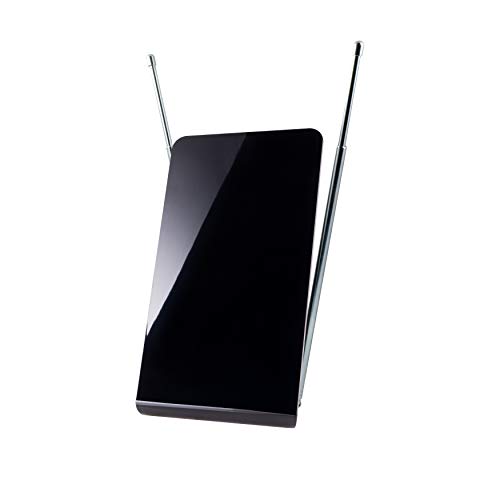
Adjustable rabbit-ear dipoles make this indoor model distinct from the other antennas, which use amplified or outdoor designs. GE says it receives local broadcast signals up to 40 miles away and supports VHF and UHF; it is also compatible with 4K and ATSC 3.0 broadcasts where available. A stand and 5-foot coax cable are included, so it can be positioned away from the TV while staying indoors. The range claim is lower than those of the amplified or outdoor options, making this less suited to buyers who prioritize a higher stated reach.
Bottom line: Choose this for an indoor antenna with adjustable dipoles and a stand.
GE Indoor Amplified Antenna 48732

The curved body and adjustable dipoles distinguish this amplified indoor antenna from the flat panel and top-mounted models. GE says PureAmp technology boosts reception and its 4G/5G LTE filter blocks interference, with a claimed reach up to 50 miles for VHF and UHF broadcasts. It sits on a flat surface and connects to the TV’s cable input; an AC adapter powers the antenna. This option suits a fixed indoor surface near a power outlet. It is not the choice for travel or weather-exposed mounting, unlike the portable and outdoor designs.
Bottom line: Pick this for an amplified indoor antenna with adjustable dipoles.
How to choose a TV antenna
Choose by installation location first, then treat the range claim as a planning estimate rather than a guarantee. Indoor antennas are easiest to place but walls, metal surfaces and nearby electronics can weaken reception; attic and outdoor antennas avoid some indoor obstructions but need a suitable mounting point and coaxial cable route. Directional antennas generally need aiming, while an omnidirectional design receives across a wider arc without the same aiming step. The portable model here claims 360-degree reception. For a room where the antenna must stay beside the television, compare the top-mounted and tabletop options; for a roof or attic location, choose a model expressly designed for that placement.
Indoor, outdoor and portable antenna differences
Indoor antennas trade installation simplicity for greater sensitivity to the building and room layout. Outdoor antennas can be placed above more obstructions, but installation involves securing the mount and routing cable safely. Portable antennas prioritize compact storage and flexible placement over a home-reception distance. The table gives a starting point for matching the antenna type to the setup; local terrain, transmitter direction and building materials still affect reception.
| Need | Type to consider |
|---|---|
| Fixed exterior or attic setup | Outdoor-rated antenna with a mount |
| No permanent installation | Indoor antenna on a TV, stand or flat surface |
| Moving between locations | Portable antenna with compact storage |
Where to place an antenna for reception
Start near a window facing the broadcast transmitters, then try higher positions if channels are missing; walls and large metal objects can block or reflect broadcast signals. Indoor reception can change substantially with a move of only a few feet, so scan for channels again after relocating the antenna. An outdoor or attic mount can improve the line of sight, but secure it to a stable structure and keep the coax connection protected from weather. For a magnetic-base travel model, use a stable metal surface and verify that the antenna cannot slide or fall during travel.
What range and ATSC 3.0 claims mean
A maximum-mileage claim is not a promise that every channel will arrive clearly at that distance. Hills, buildings, transmitter power, frequency band and antenna placement all affect reception, and two stations in the same area may behave differently. ATSC 3.0 is a broadcast standard available only in markets where stations provide it; a compatible antenna alone does not guarantee access to a particular station or program. Check local channel availability and transmitter locations before choosing based only on range. Reception also depends on a TV or converter box that can tune over-the-air broadcasts through its coaxial input.
Frequently Asked Questions
Do TV antennas need to point in one direction?
Directional antennas usually need to face the transmitters for the channels you want. An omnidirectional antenna receives across a wider arc, though placement and obstructions still affect the signal.
How often should I rescan for local channels?
Rescan after moving an antenna or when local stations change their broadcast arrangements. A channel scan tells the TV to search for receivable broadcasts at its current antenna position.
Can an indoor antenna work through a wall?
Broadcast signals can pass through some building materials, but walls, metal siding and reinforced concrete can weaken reception. Try a window-facing position and rescan after each meaningful move.
Does an ATSC 3.0-ready antenna receive every NextGen TV channel?
No; ATSC 3.0 reception requires broadcasts to be available in your area and a compatible TV or receiver. Check local station availability before choosing based on that feature.
Can I use an antenna while driving an RV?
A portable antenna can be carried in an RV, but a magnetic base alone does not establish secure mounting for travel. Place or secure the antenna so it cannot shift or obstruct the driver.