
Diamond and Gold Tester Kits Compared by Tools

Gemtone All-in-One Jewelry Test Kit suits most buyers because it combines a diamond tester with gold, silver, and platinum test solutions, a touchstone, and a digital scale. Choose JSP GTE Purity Testing Kit if you want a kit that specifically highlights karat testing with a touchstone; the pen-style diamond testers are for gemstone checks and do not test gold.
We earn a commission if you buy through links on this page. As an Amazon Associate I earn from qualifying purchases. Products are compared on manufacturer specifications, not hands-on testing.
- Best overall: Gemtone All-in-One Jewelry Test Kit – Combines diamond testing, precious-metal test solutions, a touchstone, and a 100 g scale.
- Best for touchstone testing: JSP GTE Purity Testing Kit – Specifies gold, silver, and platinum karat testing with a 3-by-6-inch touchstone.
- Best for USB power: HMKIS Diamond Tester with 60X Loupe – Offers Type-C or 9V power and includes a 60X loupe.
| Product | Best for | Metal testing | Diamond tool | Extra tools | Shop |
|---|---|---|---|---|---|
| Gemtone All-in-One Jewelry Test Kit | Broad jewelry checks | Gold, silver, platinum | Portable electronic tester | Scale, touchstone, 30X loupe | Check Price on Amazon |
| JSP GTE Purity Testing Kit | Touchstone testing | Gold, silver, platinum | Electronic diamond tester | 3-by-6-inch touchstone, loupe | Check Price on Amazon |
| HMKIS Diamond Tester with 60X Loupe | USB-powered checks | No | Electronic diamond selector | 60X loupe | Check Price on Amazon |
| Diamond Selector II with 9V Battery | Battery-powered checks | No | Electronic diamond selector | 9V battery included | Check Price on Amazon |
| Siziviki Diamond Tester Pen Pro | Gemstone readings | No | Electronic gemstone tester | Battery powered | Check Price on Amazon |
Diamond and Gold Testers
Compare each option by whether it tests precious metals as well as stones and what accessories it adds.
Gemtone All-in-One Jewelry Test Kit

For buyers who want more than a diamond pen, this kit combines precious-metal test solutions with a diamond tester and a digital scale. The scale weighs up to 100 g with 0.01 g accuracy, and the kit also includes a touchstone, magnifier, files, and reference bars. Its multiple tools suit home appraisal work across different jewelry types. The tradeoff is that this is a larger assortment to manage than a standalone tester; someone checking only a loose stone may not need the added scale and metal-testing accessories.
Bottom line: Pick this if you want one kit for stones, precious metals, and weighing.
JSP GTE Purity Testing Kit

This kit centers its metal-testing claim on determining karat for gold, silver, and platinum, while also including a diamond tester and triplet magnifier. Its 3-by-6-inch touchstone provides a surface for jewelry testing, and the kit includes an acid neutralizer. It is a practical fit for buyers focused on metal purity checks alongside stone screening. The tradeoff is that its contents do not include a digital scale, so buyers who need jewelry weights for appraisal should choose a kit that includes one.
Bottom line: Choose this for touchstone-based metal checks plus diamond screening.
HMKIS Diamond Tester with 60X Loupe

Unlike the combination kits, this pen-style selector is for diamonds rather than gold or other metals. It has an LCD, LED indicator, audible signals, and large/small switches, and it comes with a 60X jewelry loupe. Power options are Type-C or a 9V battery; the unit is non-rechargeable, so Type-C is a power input rather than battery charging. This suits buyers who want a portable diamond-checking tool and magnifier, but it cannot answer a gold-karat question.
Bottom line: Pick this for diamond screening when metal purity testing is unnecessary.
Diamond Selector II with 9V Battery
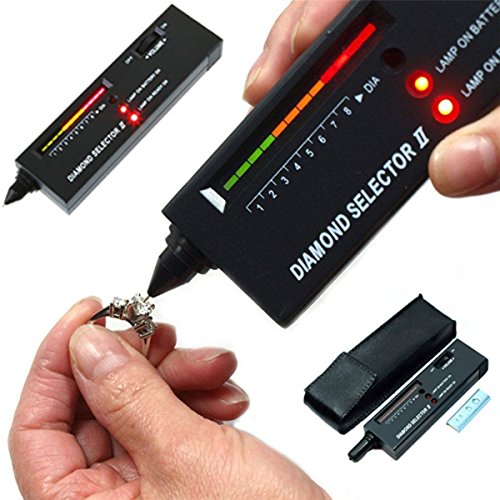
This diamond selector arrives with a 9V battery, unlike the other standalone pen, which offers Type-C power as an option. An LCD, LED indicator, audible signals, and large/small switches support its diamond-checking function. The operating instructions require bare hands and two-hand contact, so buyers who prefer gloved handling should account for that before choosing it. This is a focused stone-testing tool rather than a gold tester, and it does not provide the metal-testing supplies found in the combination kits.
Bottom line: Choose this if you want a battery-included diamond selector and can test bare-handed.
Siziviki Diamond Tester Pen Pro
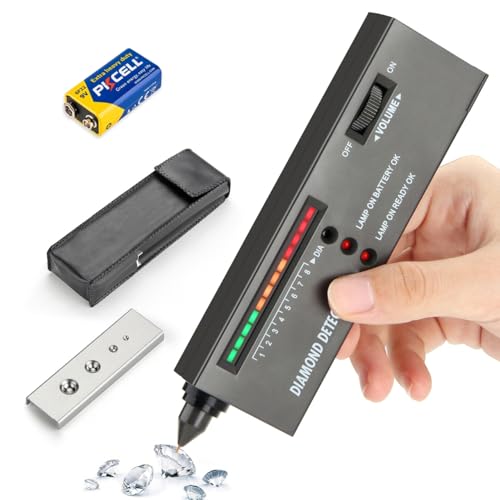
This pen differs from the other standalone options by giving light-and-beep reading ranges for several gemstone categories: diamonds and moissanite at 9 or more lights, jade at 5–6, and crystal or glass at 5–7. Its instructions call for a 30-second preheat, adjustment to the fourth mark, and a probe held perpendicular to the gemstone. It is specifically unsuitable for metal or gold testing, so it works only for a buyer whose need is gemstone screening and who can follow its setup steps.
Bottom line: Pick this for gemstone screening when you do not need gold testing.
How to choose a diamond and gold tester
Choose a combined kit when you need both stone screening and precious-metal checks; a diamond-only pen cannot determine gold karat. A diamond tester probes a stone for a physical response, while touchstone-and-solution kits assess metal using a streak and test solutions. Neither kind of result alone establishes a full appraisal value. For a mixed jewelry box, look for both a metal-testing method and a diamond tool; for loose stones only, a standalone pen avoids extra supplies. A scale is useful when weight is part of your record: 0.01 g resolution means each displayed increment is one-hundredth of a gram, not that the item’s purity or value has been verified.
What diamond testers can and cannot tell you
Most handheld diamond testers are intended to screen a stone, not certify its identity or grade. Thermal-conductivity testers can be confused by moissanite because moissanite can produce a diamond-like thermal response; a separate moissanite check may be needed when that distinction matters. Use the probe on an accessible facet and keep the tip from touching the setting, since metal contact can interfere with a reading. A pen’s lights, display, or beeps are indicators, not a substitute for gemological identification. If a stone is mounted or the result is uncertain, seek an independent assessment rather than treating a single electronic reading as conclusive.
Touchstone and solution testing for jewelry metals
Touchstone testing uses a mark rubbed from the item and a reagent response to compare metal purity; it is a different process from probing a gemstone. A touchstone test can leave a small mark on the jewelry, so use a discreet area and take care with solutions, which can be corrosive. Keep test chemicals away from skin and eyes and follow the kit’s handling directions. A result applies to the sampled area, not necessarily every component: clasps, solder joints, plating, and mixed-metal parts may differ from the main piece. For a valuable or delicate item, avoid relying on a scratch-based check unless you are prepared for the risk of a visible mark.
Match the kit to the job
The combination kits add metal-testing supplies, while pen-style models focus on stones; that distinction matters more than accessory count. Use this guide to start with the task rather than the number of included parts.
| Need | Suitable tool type | Key limit |
|---|---|---|
| Check a diamond-like stone | Electronic diamond tester | Screening is not a full gem identification |
| Check jewelry metal purity | Touchstone and test solutions | Sampling can mark the item |
| Record jewelry weight | Digital scale | Weight does not establish purity |
A kit that includes all three functions makes sense when the jewelry being assessed varies; a single-purpose task calls for fewer tools. Before testing a mounted stone, make sure the probe can reach a facet without contacting the setting.
Frequently Asked Questions
Can a diamond tester tell if gold is real?
No; a diamond tester screens a gemstone, while gold purity requires a metal-testing method such as a touchstone and solutions. Choose a kit that explicitly includes precious-metal testing when karat is the question.
Can a diamond tester mistake moissanite for diamond?
Yes, a thermal-conductivity tester can give moissanite a diamond-like response. If distinguishing those stones matters, use a separate moissanite check or professional identification.
Does touchstone testing scratch jewelry?
Touchstone testing can leave a small mark where metal is rubbed onto the stone. Test only a discreet area, and avoid scratch-based testing on delicate or valuable jewelry unless the mark risk is acceptable.
Why do diamond tester instructions require bare hands?
Some testers use hand contact as part of their electrical circuit, so gloves can interrupt operation. One included tester specifically calls for bare-hand use and contact with its conductive panel.
What does 0.01 gram scale accuracy mean?
A 0.01 g increment is one-hundredth of a gram on the display, and the included scale has a maximum capacity of 100 g. Scale readings measure weight; they do not determine the metal purity of an item.