
Best Markers for Glass Dry Erase Boards Compared

Quartet Glass Markers, Bullet Tip, 8 Pack suits most people because its eight assorted colors and broad bullet tips give you more color choices for notes meant to be seen across a room.
Choose Quartet Glass Markers, Fine Tip, Neon 6 Pack instead for fine handwriting or a black glass board, where its white and neon colors are designed to stand out; Quartet Glass Markers, Bullet Tip, 4 Pack is the smaller broad-tip set.
We earn a commission if you buy through links on this page. As an Amazon Associate I earn from qualifying purchases. Products are compared on manufacturer specifications, not hands-on testing.
- Best overall: Quartet Glass Markers, Bullet Tip, 8 Pack – Eight assorted colors and broad bullet tips suit shared notes and visible writing.
- Best for fine writing: Quartet Glass Markers, Fine Tip, Neon 6 Pack – Fine tips make thin lines, and the set includes two white markers plus neon colors.
- Best for a small set: Quartet Glass Markers, Bullet Tip, 4 Pack – Four assorted bullet tip markers provide broad lines in a smaller set.
| Product | Best for | Tip | Colors | Count | Shop |
|---|---|---|---|---|---|
| Quartet Glass Markers, Bullet Tip, 8 Pack | Shared board notes | Bullet | Assorted | 8 markers | Check Price on Amazon |
| Quartet Glass Markers, Bullet Tip, 4 Pack | Fewer markers | Bullet | Assorted | 4 markers | Check Price on Amazon |
| Quartet Glass Markers, Fine Tip, Neon 6 Pack | Fine neon writing | Fine | White and neon | 6 markers | Check Price on Amazon |
Glass dry erase markers compared
Match tip thickness and color visibility to the way you use your glass board.
Quartet Glass Markers, Bullet Tip, 8 Pack

Quartet Glass Markers, Bullet Tip, 8 Pack gives you twice the marker count of the four-pack, while keeping the broad bullet tip format suited to visible, thicker writing. Quartet says the markers are optimized for glass boards, use free-flowing liquid ink, and wipe away cleanly without streaks. The assorted eight-color set suits a team board or a workspace where color coding helps separate topics. A broad tip is less suited to compact handwriting or fine diagrams, so choose a fine-point set if detail matters more than visibility at a distance.
Bottom line: Pick this set for colorful, easy-to-see notes on a shared glass board.
Quartet Glass Markers, Bullet Tip, 4 Pack
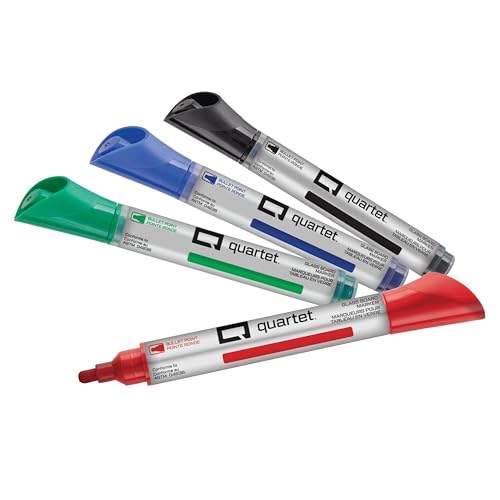
Quartet Glass Markers, Bullet Tip, 4 Pack is the smaller assorted-color bullet tip set, making it a straightforward match for a personal board or a workspace that does not need as many markers on hand. Quartet says its liquid ink is designed for glass boards and wipes away smoothly. Its broad bullet points favor bold strokes over small lettering, so it is less suited to dense notes or precise drawings. The four-marker count is the key distinction from the larger assorted bullet tip set; choose based on how many colors you expect to use at once.
Bottom line: Choose this set when four broad-tip colors are enough for your board.
Quartet Glass Markers, Fine Tip, Neon 6 Pack

Quartet Glass Markers, Fine Tip, Neon 6 Pack trades broad strokes for fine lines, a better fit for handwriting, small diagrams, and precise marks. Its six markers include two white plus one each of pink, green, blue, and yellow; the white and neon palette is intended for black glass boards. Quartet says the liquid ink is designed for glass and wipes away smoothly. The limited neon palette differs from the assorted-color sets, and fine lines may be harder to read from a distance than broad lettering.
Bottom line: Pick this set for detailed writing or drawing on a black glass board.
How to choose glass dry erase markers
Choose a tip and color palette for the distance and background of your writing. Broad bullet tips make thicker strokes that are easier to see across a room, while fine tips suit compact handwriting and precise drawings. Glass is nonporous, so compatible dry-erase ink sits on the surface rather than soaking into it; use markers intended for glass boards to match the surface. For a black board, favor white or bright colors made to contrast with the dark background. For a shared board with headings or categories, an assorted-color set gives you more ways to separate information. If notes will be read from several feet away, prioritize broad strokes over fitting more words into a small area.
Match marker tips to board use
Tip width changes legibility more than marker count does. Broad bullet tips work well for meeting agendas and reminders viewed from several feet away, while fine points give more control for small labels and diagrams. A fine point can still be difficult to read at a distance, especially when the writing is small; use larger letters rather than pressing harder. Glass boards also show color differently depending on whether the surface is clear, backed, or dark, so test a small mark in an unobtrusive corner before writing a full board. A simple decision rule: if you need lines thinner than a broad marker stroke, choose a fine tip; if the board is read across a room, choose a broad tip.
Choose colors for glass board contrast
Choose marker color against the board’s actual background, not just the marker cap. White and neon colors are intended for black glass boards, while assorted colors give more options for color-coded notes. Transparent or clear glass can have a wall color or objects behind it, so the same ink may look different as the background changes. Place a short test mark where the board will be used and check it from the farthest normal viewing position. Keep color coding simple: assign one color per category and write headings large enough to distinguish them. If the board is used by several people, reserve a consistent color for actions or deadlines rather than changing the scheme each session.
Erase glass dry erase ink cleanly
Wipe compatible dry-erase marks with a clean, dry eraser or soft cloth as part of regular board use. Glass does not absorb ink, but marks left for a long time can become harder to remove, so erase completed notes promptly instead of letting them sit for weeks. Use a soft cloth rather than an abrasive pad, which can scratch nearby trim or damage a coated board surface. For stubborn residue, use a cleaner suitable for the board and dry the surface before writing again; moisture can interfere with fresh marks. Before using a household cleaner across the full board, check that it is appropriate for that board’s finish, since not every glass board has an identical surface treatment.
Frequently Asked Questions
Do glass dry erase markers work on regular glass?
Markers made for glass boards can write on smooth glass, but visibility depends on the background behind it. Test a small mark first, especially on clear windows or mirrors where the surface may not provide enough contrast.
Are broad or fine tips easier to read?
Broad tips are generally easier to see from a distance because they create thicker strokes. Fine tips are better for small handwriting and diagrams, but use larger lettering if readers will stand several feet away.
How do you keep glass board writing from smudging?
Let marks settle before brushing near them, and avoid dragging a hand across fresh writing. Erase finished notes promptly with a soft dry cloth or eraser to limit residue buildup.
Can glass dry erase markers be used on a black board?
Yes, choose colors with strong contrast against black; white or bright neon inks are common choices. Test a short mark on the board and view it from the distance where it will be read.