
Lesson Plan Books for Teachers: 5 Formats Compared

Elan 7-Period Teacher Plan Book (W101) is the best fit for teachers who want a reusable, 7-period book with seating plans and substitute-teacher instructions. Choose a dated planner instead if you need monthly and weekly calendar pages for a specific school year, or a 6-period layout if that matches your daily schedule.
We earn a commission if you buy through links on this page. As an Amazon Associate I earn from qualifying purchases. Products are compared on manufacturer specifications, not hands-on testing.
- Best overall: Elan 7-Period Teacher Plan Book (W101) – Seven periods, horizontal day layout, seating plans, and substitute-teacher instructions suit a broad range of classroom routines.
- Best for eight periods: GoiUnlt 2026–2027 8-Period Teacher Planner – Its weekly pages distinguish eight periods and cover July 2026 through June 2027.
- Best for six-period weeks: Ward 6-Period Teacher Plan Book – The 44-week format combines a six-period, five-day planner with seating charts and an events calendar.
| Product | Best for | Period count | Planning coverage | Page size | Shop |
|---|---|---|---|---|---|
| Elan 7-Period Teacher Plan Book (W101) | Flexible 7-period planning | 7 periods | Not dated | 8.5 × 11 in. | Check Price on Amazon |
| GoiUnlt 2026–2027 8-Period Teacher Planner | Eight-period calendar planning | 8 periods | July 2026–June 2027 | 8.6 × 11 in. | Check Price on Amazon |
| 2026–2027 8.5 × 11-Inch Teacher Planner | Tabbed yearly planning | — | July 2026–June 2027 | 8.5 × 11 in. | Check Price on Amazon |
| Ward 6-Period Teacher Plan Book | Six-period weekly planning | 6 periods | 44 weeks | 8.5 × 11 in. | Check Price on Amazon |
| Elan 6-Period Teacher Plan Book (W202) | Vertical day layout | 6 periods | 40 weeks | 8.5 × 11 in. | Check Price on Amazon |
Lesson plan books for teachers
Compare the period layout and calendar span first, then choose the format that fits how you plan each week.
Elan 7-Period Teacher Plan Book (W101)

Elan 7-Period Teacher Plan Book (W101) is the only option here that pairs a 7-period schedule with supplementary planning sheets and substitute-teacher instructions. Its days run horizontally across the top, and the book also includes overview planning sheets, seating plans, and a school-events calendar. That combination suits teachers who want one place for class-by-class plans and classroom reference material without choosing a dated academic-year planner. The limitation is the 7-period format: teachers with six or eight daily classes may prefer a book whose period count matches their schedule more closely.
Bottom line: Choose this if you want a 7-period layout with classroom reference sheets in the same book.
GoiUnlt 2026–2027 8-Period Teacher Planner

GoiUnlt 2026–2027 8-Period Teacher Planner is the dated choice for teachers who need both weekly and monthly views across July 2026 through June 2027. Its weekly spread has six day columns, Monday through Saturday or Sunday, and visually distinguishes eight periods; two-page monthly spreads and reference calendars add a longer planning view. At 8.6 × 11 inches, it is slightly wider than the 8.5 × 11-inch books here. This format suits teachers who plan by academic-year calendar as well as class period, but its fixed date range is a limitation if you need an undated or different-year book.
Bottom line: Pick this for eight-period weekly planning tied to the July 2026–June 2027 calendar.
2026–2027 8.5 × 11-Inch Teacher Planner
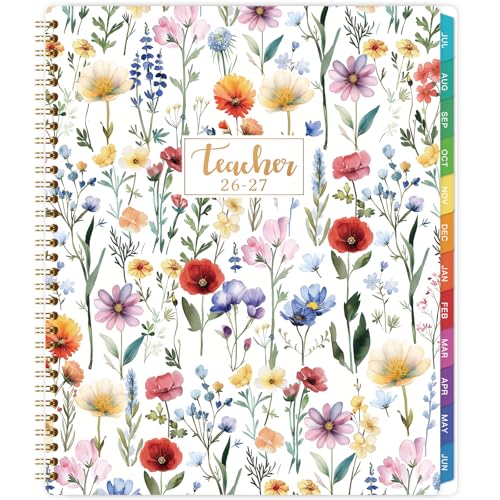
2026–2027 8.5 × 11-Inch Teacher Planner stands out for its colorful monthly tabs, back pocket, and dated monthly and weekly pages covering July 2026 through June 2027. The monthly views include previous, current, and next-month reference calendars, marked major holidays, and note sections, so it suits teachers who want to move quickly between months as well as plan weekly tasks. Its 8.5 × 11-inch pages match the size of several traditional lesson books in this group.
Bottom line: Choose this for a dated planner with monthly tabs and a back pocket.
Ward 6-Period Teacher Plan Book

Ward 6-Period Teacher Plan Book is the clearest match for a six-period schedule: it organizes 44 weeks into five-day weeks and includes a school-events calendar and seating charts. A durable green cover and semi-concealed wire binding distinguish its physical construction from the other options. This is a practical fit for teachers whose workweek follows a five-day pattern and whose lesson planning centers on six daily periods. Its 44-week coverage is shorter than a full 12-month calendar, so teachers who need dated monthly views or a longer planning span may prefer one of the academic-year planners.
Bottom line: Pick this if your week has five days and six teaching periods.
Elan 6-Period Teacher Plan Book (W202)

Elan 6-Period Teacher Plan Book (W202) differs from the other options by putting the days vertically down the side, a useful alternative for teachers who prefer to scan one day at a time rather than across a row. The maker refers to an eight-period planner, so confirm the printed period layout before ordering if an exact six-period count is essential. This is the more compact-span option for teachers who want a vertical weekly organization rather than a dated monthly calendar.
Bottom line: Choose this for a vertical day layout, after confirming the period count you need.
How to choose a lesson plan book by period count
Match the number of period slots to your regular teaching day before comparing extras. A planner with too few slots forces teachers to combine classes, while unused slots take up writing space; count your distinct daily teaching blocks, not prep periods, when choosing. For rotating schedules, check whether the book has enough room for the longest day in the cycle, since a six-period day and an eight-period rotation call for different layouts. Page direction matters too: days across the top make a week readable horizontally, while days down the side give each day a vertical column. Choose a dated planner when its printed academic-year span matches your calendar; select a non-dated format if you want to write in your own dates.
Weekly and monthly views in teacher planners
Weekly pages are for assigning lessons to specific class periods and days; monthly pages are better for deadlines, school events, and longer units. A two-page monthly spread typically gives a quick month-at-a-glance view, while reference calendars help orient planning around adjacent months. For a year-bound planner, compare the printed start and end months with your school calendar before buying; a planner that starts in July and ends in June won’t cover a different academic-year span exactly. If your school uses rotating days, make sure the weekly layout identifies enough separate day columns for that cycle. The table distinguishes dated coverage from period capacity so you can narrow choices without treating those as interchangeable features.
Use this quick guide to match a planning need to a format.
| Planning need | Format to prioritize |
|---|---|
| Specific number of daily classes | Period count matching the longest regular day |
| Month-at-a-glance scheduling | Dated planner with monthly spreads |
| Substitute or seating references | Book that includes those reference sheets |
Choosing planner size and page layout
Books around 8.5 × 11 inches offer near-letter-size writing pages, but the larger footprint can be less convenient to carry than a smaller notebook. Compare the width as well as the height: the 8.6-inch-wide planner here is only slightly wider than an 8.5-inch option, yet a rigid cover or wire binding can affect how easily it fits in a bag. Horizontal weekly layouts and vertical day layouts present the same schedule differently; choose based on whether you scan across a week or down an individual day. Before ordering, measure the space where you store the book and consider whether you need room for loose papers, since a back pocket is useful only if you plan to carry inserts.
Keeping a paper lesson planner useful
A paper planner works best when class names, recurring routines, and key deadlines are entered consistently. Use a stable color or abbreviation system for each class, and reserve monthly pages for major dates rather than duplicating every daily task there. For substitute readiness, keep essential classroom procedures and seating information current; a plan book’s included sheets only help when filled in and accessible. If your school calendar changes, note closures or schedule shifts in both the weekly and monthly views to prevent conflicting plans. Store the book away from spills and avoid overfilling a pocket, which can strain the binding and make pages harder to close flat.
Frequently Asked Questions
How many periods should a teacher lesson planner have?
Choose a planner with at least as many period slots as your longest regular teaching day. For a rotating schedule, use the longest day in the cycle rather than the average.
What size is a standard teacher plan book?
Many classroom plan books use pages around 8.5 × 11 inches, close to US letter size. Check the overall book dimensions too, because covers and binding can extend beyond the page.
Are dated teacher planners reusable next year?
A dated planner is organized around its printed calendar span, so it is less flexible for a different school year. An undated book lets you enter dates yourself, but requires more setup.
Should a teacher planner have monthly pages?
Monthly pages help track school events and longer deadlines, while weekly pages hold daily lesson plans. If you plan units across several weeks, a monthly view can make those dates easier to scan.
What should substitute plans include in a lesson book?
Keep the current schedule, class-specific directions, and seating information accessible for a substitute. Update those notes when class assignments or room routines change.