
Descale It Pool and Spa Cleaner: 5 Options Compared

Pool & Spa Cleaner, 32 fl oz is the closest match for a pool and spa cleaner aimed at lime, calcium buildup, water spots, and rust. Choose OCEANCARE Calcium Releaser Spray, 32 fl oz instead for a spray intended for tile, or consider the pool-water treatments when the goal is managing scale or metal staining in the water.
Pool scale removers target mineral deposits, while stain-and-scale controls are generally added to pool or spa water; check product directions for where and how each one should be used.
We earn a commission if you buy through links on this page. As an Amazon Associate I earn from qualifying purchases. Products are compared on manufacturer specifications, not hands-on testing.
- Best overall: Pool & Spa Cleaner, 32 fl oz – Targets lime and calcium buildup as well as water spots and rust.
- Best for tile: OCEANCARE Calcium Releaser Spray, 32 fl oz – A trigger spray formulated for porcelain, ceramic, and glass tile.
- Best for pool equipment: EASYCARE Scaletec Plus, 64 fl oz – Targets calcium scale, metal stains, and salt-cell care.
| Product | Best for | Size | Primary target | Use or surface | Shop |
|---|---|---|---|---|---|
| Pool & Spa Cleaner, 32 fl oz | Lime and spots | 32 fl oz | Lime, calcium, spots, rust | Pool and spa cleaner | Check Price on Amazon |
| AquaDoc Stain and Scale Remover, 64 oz | Metal buildup | 64 oz | Calcium, iron, copper, rust | Pools, spas, hot tubs | Check Price on Amazon |
| EASYCARE Scaletec Plus, 64 fl oz | Scale and salt cells | 64 fl oz | Calcium, iron, copper, manganese | Pool surfaces and equipment | Check Price on Amazon |
| OCEANCARE Calcium Releaser Spray, 32 fl oz | Tile deposits | 32 fl oz | Calcium, efflorescence | Porcelain, ceramic, glass tile | Check Price on Amazon |
| Clorox Pool&Spa Scale, Metal & Stain Control | Hard-water pools | 1 quart | Metal stains and scale | Pool water | Check Price on Amazon |
Descale It Pool and Spa Cleaner Alternatives
Compare each cleaner by its target and intended application before choosing one for a deposit or stain.
Pool & Spa Cleaner, 32 fl oz

Pool & Spa Cleaner, 32 fl oz is the closest fit for cleaning lime and calcium buildup alongside water spots and rust. The 32-fluid-ounce cleaner is described as softening deposits and removing spots, and its maker says it does not affect pH. The maker also says the formula has no abrasives or fumes and is biodegradable. This is a fit for someone seeking a cleaner for multiple types of visible buildup. Its target is surface cleaning, so buyers looking for an ongoing water-treatment product should consider a different type.
Bottom line: Pick this for a pool and spa cleaner aimed at lime, calcium, spots, and rust.
AquaDoc Stain and Scale Remover, 64 oz
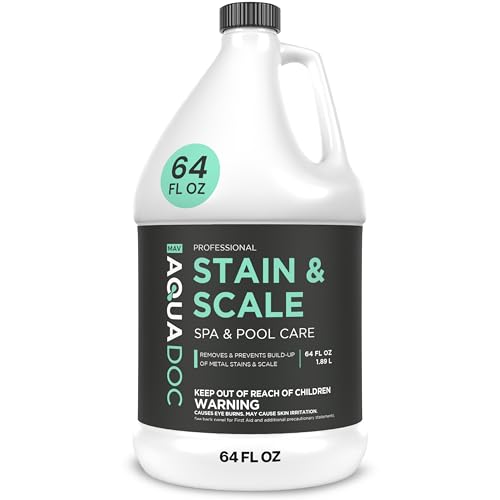
AquaDoc Stain and Scale Remover, 64 oz is a water-treatment alternative focused on stains and scale in pools, spas, and hot tubs rather than a general-purpose surface cleaner. Its maker says it helps reduce calcium, iron, copper, and rust buildup and is compatible with chlorine- and bromine-sanitized systems. The 64-ounce container suits buyers seeking scale and metal-stain control across several kinds of pool or spa equipment. Its purpose is ongoing stain and scale management, so choose a surface cleaner instead when the task is directly cleaning a particular deposit.
Bottom line: Choose this for pool or spa water stain and scale management.
EASYCARE Scaletec Plus, 64 fl oz

EASYCARE Scaletec Plus, 64 fl oz distinguishes itself with a focus on calcium scale, metal stains, and salt-cell care. The maker says its non-acidic formula removes calcium and mixed-composition scale, sequesters iron, copper, and manganese stains, and helps optimize salt-cell chlorine output. The 64-fluid-ounce bottle is suited to pool owners addressing deposits on surfaces or equipment as well as metal staining. It is specifically presented as a pool descaler, so it is less suited than a tile spray when the job is isolated cleaning of ceramic, porcelain, or glass tile.
Bottom line: Pick this when pool scale and salt-cell care are the priorities.
OCEANCARE Calcium Releaser Spray, 32 fl oz

OCEANCARE Calcium Releaser Spray, 32 fl oz is the surface-specific option: a trigger spray for calcium and efflorescence on tile. Its maker says the mineral-acid-free product is suitable for porcelain, ceramic, and glass, including sensitive tile finishes. That makes it the most targeted choice for visible mineral deposits on pool tile rather than for treating the pool water or a range of equipment. The 32-fluid-ounce quart spray format supports direct application. Buyers dealing with metal stains or broad pool-water scale control should look to a treatment designed for those tasks instead.
Bottom line: Choose this for calcium or efflorescence on compatible pool tile.
Clorox Pool&Spa Scale, Metal & Stain Control

Clorox Pool&Spa Scale, Metal & Stain Control is positioned as a pool-water treatment for hard-water conditions, scale formation, and fresh metal stains. The maker says it prevents metal stains and scale formation, removes fresh iron and copper stains, and protects pool surfaces and equipment from stains and scale. Its one-quart size is a useful distinction for shoppers comparing treatment volume. The product’s focus is pools, not spas or direct tile cleaning, so it is a less direct match when the intended job is cleaning a specific surface or treating a hot tub.
Bottom line: Pick this for pool treatment focused on hard-water scale and fresh metal stains.
How to choose a pool and spa scale cleaner
Choose by where the deposit is: a surface cleaner is for a visible spot, while a pool-water treatment is for managing scale or metal staining in the water and on equipment. Calcium carbonate is a common source of pool scale, and high pH, high alkalinity, and hard water can encourage it to form. Pool water is commonly maintained around pH 7.2–7.8; test before adding a treatment, since chemistry affects both scale formation and sanitizer performance. If deposits cover tile, choose a product explicitly intended for that surface. For stains appearing across a pool or on equipment, choose a water-treatment product whose targets match the problem.
Match the cleaner to the pool surface
Tile material matters: ceramic, porcelain, and glass can have different finishes and grout, so confirm compatibility before applying a cleaner to a small area. Mineral deposits often collect at the waterline as evaporation leaves dissolved minerals behind; wiping routine splashes and keeping water chemistry balanced can limit buildup. Avoid assuming a cleaner suitable for tile is also suitable for liners, painted surfaces, or metal fittings. For a deposit on a specific surface, use a product that names that surface and follow its label for contact time and rinsing. Never mix pool chemicals or cleaners; incompatible products can release hazardous gases or cause burns.
Pool-water treatments versus surface sprays
Water treatments and surface sprays do different jobs: water treatments are added to pool or spa water, while sprays are applied directly to a compatible surface. The chart can help narrow the type before you select a formula.
| Need | Product type | Decision point |
|---|---|---|
| Spot or deposit on tile | Direct surface cleaner | Confirm material compatibility |
| Scale or metal staining in pool water | Water-treatment control | Match the target to the stain |
| Hot tub scale and stains | Pool-and-spa treatment | Confirm sanitizer compatibility |
Hard-water scale and metal stains can look similar but call for different targets. White, chalky crust is often mineral scale; colored brown, green, or blue marks may be associated with iron or copper. Test the water and identify the affected surface before choosing a treatment, rather than applying multiple products in sequence without checking compatibility.
Frequently Asked Questions
What causes calcium scale around a pool waterline?
Calcium scale forms when dissolved minerals precipitate from water, commonly encouraged by high pH, high alkalinity, and hard water. Evaporation at the waterline leaves minerals behind, so deposits often collect there.
Can I use a tile cleaner on a vinyl pool liner?
Do not assume a tile cleaner is suitable for vinyl; tile-specific formulations may not be compatible with liners. Use only a product whose label confirms the surface, and test an inconspicuous area first.
What pool pH range helps limit scale?
A commonly recommended pool pH range is 7.2–7.8. Higher pH can encourage calcium scale, so test the water before adjusting chemistry or adding a scale treatment.
Can pool chemicals or cleaners be mixed together?
No; never mix pool chemicals or combine a surface cleaner with another chemical in a container. Some combinations can release toxic gas or cause burns, so apply products separately according to their labels.