
12 Volt PWM Controller: 5 Options Compared by Fit

For a flexible 12V setup, EC Buying ZK-BMG Digital Controller stands out because it accepts 9–60V and lets you adjust duty cycle and PWM frequency. Choose AEDIKO 12–40V Knob Controller, 2-Pack instead if you want a simple knob controller with reverse-polarity, over-voltage and fuse protection; choose a lower-current option when your motor draws less current.
A PWM controller changes motor speed by switching power on and off, rather than reducing the supply voltage continuously.
We earn a commission if you buy through links on this page. As an Amazon Associate I earn from qualifying purchases. Products are compared on manufacturer specifications, not hands-on testing.
- Best overall: EC Buying ZK-BMG Digital Controller – Its 9–60V input range, 12A rated current and adjustable frequency suit a range of 12V setups.
- Best for simple knob control: AEDIKO 12–40V Knob Controller, 2-Pack – It accepts 12–40V and uses a knob, with a 10A fuse and listed input protections.
- Best for higher current: Hosyond 7–70V 30A Controller – Its 30A capacity and 7–70V input range cover higher-current applications.
| Product | Best for | Input voltage | Current limit | PWM frequency | Shop |
|---|---|---|---|---|---|
| EC Buying ZK-BMG Digital Controller | Adjustable settings | 9–60V DC | 12A rated; 20A max | 1–99 kHz adjustable | Check Price on Amazon |
| AEDIKO 12–40V Knob Controller, 2-Pack | Basic knob control | 12–40V DC | 10A max | 13 kHz | Check Price on Amazon |
| Hosyond 7–70V 30A Controller | Higher current | 7–70V DC | 30A | — | Check Price on Amazon |
| 12–60V Forward/Reverse Controller | Reversing direction | 12–60V DC | 10A applicable | — | Check Price on Amazon |
| Gebildet 1.8–12V 2A Controller, 2-Pack | Low-voltage motors | 1.8–12V DC | 2A max | — | Check Price on Amazon |
12 Volt PWM Controllers Compared
Compare input range, current capacity and control features against your motor and power supply before choosing.
EC Buying ZK-BMG Digital Controller

EC Buying ZK-BMG Digital Controller is the most adjustable option here: it supports a 9–60V DC supply, has a 12A rated current and 20A maximum current, and lets you set duty cycle and frequency. The frequency range is 1–99 kHz, with 20 kHz as the default; settable parameters are retained when power is off. Its digital display and rotary control suit buyers who want more than a basic speed knob. Its 12A rating matters more than the 20A maximum for continuous operation, so match the motor’s current draw to that rating.
Bottom line: Choose this when adjustable frequency and stored settings matter.
AEDIKO 12–40V Knob Controller, 2-Pack

AEDIKO 12–40V Knob Controller, 2-Pack keeps speed adjustment simple with a knob and offers a 12–40V input range, a 13 kHz PWM frequency and a 10A maximum current. The package contains two controllers, and each has reverse-polarity and over-voltage protection plus a 10A fuse for overload protection. This is a practical fit for someone who wants straightforward adjustment rather than a digital display or selectable frequency. The 10A ceiling is the key limit: check motor startup or stall current as well as its normal running draw before connecting it.
Bottom line: Pick this for a simple control knob and two units.
Hosyond 7–70V 30A Controller

Hosyond 7–70V 30A Controller has the highest current capacity among these options at 30A, along with a 7–70V input range and an included 30A fuse. Its board switch provides run, stop and brake functions, while the detachable potentiometer cable is about 5.9 inches long for flexible placement. The wider voltage range can suit setups beyond 12V as well. The fuse rating is not a substitute for checking the controller’s current limits against the motor’s startup load; choose another option if you need a PWM frequency.
Bottom line: Choose this when the motor’s current demand calls for its 30A capacity.
12–60V Forward/Reverse Controller
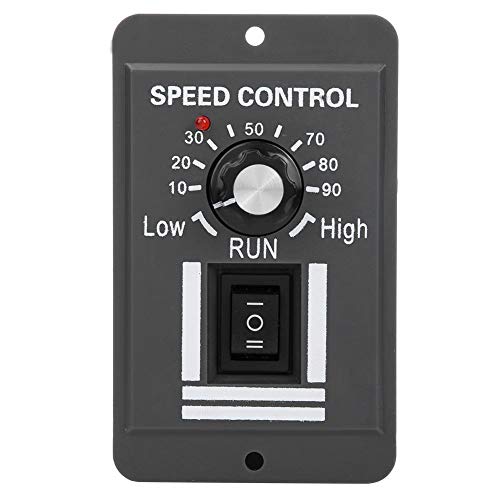
12–60V Forward/Reverse Controller stands apart with stop, forward and reverse functions for DC brush motors, and its input range begins at 12V. The product name gives a 20A rating, but its maker says the applicable current is within 10A; use the lower 10A figure when checking fit. The compact form may suit a tight installation space, and a knob controls direction and speed. Buyers needing a documented PWM frequency or a higher current limit should compare another controller in this group.
Bottom line: Pick this for a 12V brush motor that needs forward and reverse.
Gebildet 1.8–12V 2A Controller, 2-Pack

Gebildet 1.8–12V 2A Controller, 2-Pack is the low-voltage choice: its 1.8–12V input accommodates 12V, but its continuous output current tops out at 2A and maximum output power is 30W. The package includes two controllers, each using a knob with a switch function, a power indicator and a 2A resettable fuse. That lower ceiling makes it better suited to small motors than the higher-current choices here. Do not treat the resettable fuse as extra capacity; the motor must remain within the 2A continuous limit.
Bottom line: Choose this for a small, low-current motor and knob control.
How to Choose a 12 Volt PWM Controller
Match the controller’s continuous current rating to the motor’s load, not just its 12V supply. A DC motor can draw substantially more current when starting or stalled than when spinning freely, so check the motor’s stall-current specification and keep it within the controller’s rated limit. The maximum current figure is not necessarily a continuous rating.
PWM speed control switches the supply rapidly; duty cycle is the share of each cycle that power is on. A 50% duty cycle does not guarantee exactly half the motor’s speed, because speed also changes with load and motor characteristics. Choose a digital controller if adjustable duty cycle or frequency matters; a basic knob is simpler when those settings are unnecessary.
Voltage, Current and Motor Fit
A controller’s input range must include the power supply’s actual voltage, not merely the motor’s nominal voltage. For a 12V supply, an input range that begins at 12V is suitable on paper, while a wider range offers flexibility for other supply voltages. Never exceed the controller’s maximum input voltage.
Motor type matters too: these options are described for DC motor speed control, and 12–60V Forward/Reverse Controller specifically identifies DC brush motors. PWM controllers intended for brushed DC motors should not be assumed compatible with brushless motors; brushless motors require electronic commutation. Before wiring, confirm motor type, supply polarity and current demand. Disconnect power while making connections, and use a fuse appropriate to the circuit rather than relying on a controller’s protection feature alone.
What PWM Frequency and Duty Cycle Mean
PWM frequency is the number of on-off switching cycles per second, measured in hertz; 1 kHz equals 1,000 cycles per second. EC Buying ZK-BMG Digital Controller allows adjustment from 1 to 99 kHz and defaults to 20 kHz, while AEDIKO 12–40V Knob Controller, 2-Pack operates at 13 kHz. Higher switching frequency can reduce audible motor or controller noise in some setups, but it can also increase switching losses, so frequency is a tradeoff rather than a guaranteed performance upgrade.
Duty cycle describes the proportion of each cycle that the output is on, usually expressed as a percentage. A 0% setting means no commanded on-time and 100% means continuously on; actual motor speed depends on load and motor design. Start at a low duty cycle and increase gradually, keeping the motor securely mounted and clear of moving parts.
Controller Types at a Glance
Choose the control style and current range that match the job: a digital interface adds setting options, while a knob-only unit keeps adjustment direct. The table groups these options by their distinguishing features; verify motor current against the appropriate rating before connecting any of them.
| Need | Option | Deciding feature |
|---|---|---|
| Adjustable speed and frequency | EC Buying ZK-BMG Digital Controller | Digital display; 1–99 kHz range |
| Simple knob adjustment | AEDIKO 12–40V Knob Controller, 2-Pack | 13 kHz; 10A maximum |
| Higher stated current | Hosyond 7–70V 30A Controller | 30A; run, stop and brake |
| Direction reversal | 12–60V Forward/Reverse Controller | Forward and reverse for DC brush motors |
| Low-voltage, low-current use | Gebildet 1.8–12V 2A Controller, 2-Pack | 1.8–12V; 2A continuous |
Frequently Asked Questions
Can a 12V PWM controller run a 6V motor?
A 12V-rated supply can overdrive a 6V motor if the controller’s output reaches the full supply voltage. A PWM controller reduces average delivered power by duty cycle, but it does not automatically enforce the motor’s voltage limit; keep the supply and setting within the motor’s rating.
How much current should a PWM controller handle?
The controller should handle the motor’s startup and stall current, not only its no-load current. Keep continuous current within the controller’s continuous rating; for example, a 2A continuous controller is not a fit for a motor that can draw more than 2A continuously.
Can a PWM speed controller reverse a motor?
Only if the controller provides a direction-reversing circuit or switch. Among these options, 12–60V Forward/Reverse Controller explicitly provides forward and reverse functions for DC brush motors; a basic speed-control knob alone does not indicate reversal capability.
Does PWM frequency affect motor noise?
It can: switching within the audible range may produce a whine, depending on the motor and setup. EC Buying ZK-BMG Digital Controller offers an adjustable 1–99 kHz range, while AEDIKO 12–40V Knob Controller, 2-Pack specifies 13 kHz; higher frequency is not automatically better because switching losses can rise.
Can a PWM controller be used with a brushless motor?
A brushed DC motor controller should not be assumed to work with a brushless motor. Brushless motors need electronic commutation, so select a controller specifically designed for the motor’s brushless drive system.