
Foam for Portable AC Window: 4 Types Compared

For portable AC window vent kits, Forestchill Double-Layer Panels, 3-Pack is the most versatile choice when you need cut-to-fit insulation panels that adjust up to 50 inches. Choose a different option if you need foam tape to compress between a unit and window, or need a specific adhesive or non-adhesive strip.
We earn a commission if you buy through links on this page. As an Amazon Associate I earn from qualifying purchases. Products are compared on manufacturer specifications, not hands-on testing.
- Best overall: Forestchill Double-Layer Panels, 3-Pack – Three double-layer panels adjust to a maximum 50 inches and can be cut to fit a vent plate.
- Best for compact panels: Flamorrow Gray Insulated Panels, 3-Pack – Three gray panels measure 16.5 by 6.25 inches and can be trimmed.
- Best for no-adhesive strips: Yotache Non-Adhesive Foam Strips, 13 Ft – Two flexible 6.5-foot rolls total 13 feet and have no glue.
- Best for adhesive tape: Ninsula Adhesive CR Foam Tape, 6.5 Ft – A self-adhesive 6.5-foot CR foam roll suits buyers who need adhesive backing.
| Product | Best for | Format | Size or length | Adhesive | Shop |
|---|---|---|---|---|---|
| Forestchill Double-Layer Panels, 3-Pack | Wide vent plates | 3 panels | Up to 50 in. | — | Check Price on Amazon |
| Flamorrow Gray Insulated Panels, 3-Pack | Compact openings | 3 panels | 16.5 × 6.25 in. | — | Check Price on Amazon |
| Yotache Non-Adhesive Foam Strips, 13 Ft | No-glue sealing | 2 foam strips | 13 ft. total | No adhesive | Check Price on Amazon |
| Ninsula Adhesive CR Foam Tape, 6.5 Ft | Adhesive backing | 1 foam strip | 6.5 ft. | Self-adhesive | Check Price on Amazon |
Foam for Portable AC Window Seals Compared
Choose panels for a vent plate or strips for compressing a narrow gap around the window and unit.
Forestchill Double-Layer Panels, 3-Pack

Forestchill is the only option here with an adjustable span of up to 50 inches, making it the clearest fit for a wide portable AC vent plate. The three panels use a double-layer structure and can be cut to the shape of an existing sealing plate. The maker says the layers insulate against heat and block light and noise. Choose this set when you need panel coverage rather than a compressible perimeter strip; the maximum span is a fit limit, not a guarantee that the panel matches every window opening.
Bottom line: Pick this set for a wide vent plate that needs cut-to-fit panel coverage.
Flamorrow Gray Insulated Panels, 3-Pack

Flamorrow gives you three compact gray foam panels measuring 16.5 by 6.25 inches each, unlike the longer adjustable Forestchill panel system. The panels are designed to trim for portable AC seal plates and windows, so they suit buyers who want to adapt smaller pieces around an existing vent kit. The maker says they reinforce the seal to limit heat entry and cold-air escape and reduce outside noise. Their individual dimensions make them a less suitable choice when one continuous broad span is the priority.
Bottom line: Choose these when small trim-to-fit foam panels suit your plate better than one broad span.
Yotache Non-Adhesive Foam Strips, 13 Ft

Yotache is the no-glue option: two open-cell foam strips, each 1 by 1 inch and 6.5 feet long, for 13 feet total. The strips are intended to sit between the AC unit and lower window and compress to close a gap, rather than cover a vent plate like the panel sets. The maker identifies the material as NBR+PVC and gives a temperature range of -40°C to 90°C. Because the foam has no adhesive, it suits a setup where the strip can be held in place by compression.
Bottom line: Pick these strips when compression, not adhesive backing, will hold the seal.
Ninsula Adhesive CR Foam Tape, 6.5 Ft
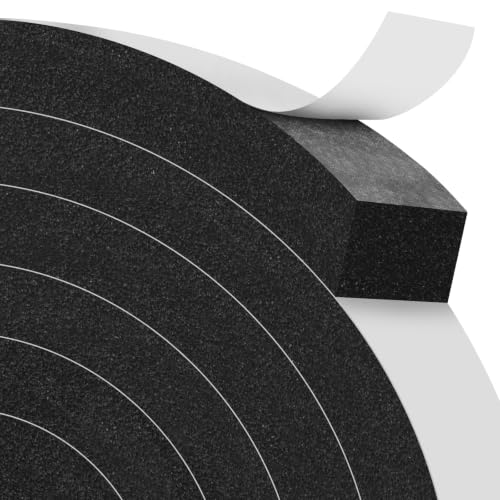
Ninsula supplies one self-adhesive CR foam strip, while Yotache uses non-adhesive strips that rely on compression. The strip measures 1 inch wide by 1 inch thick and 6.5 feet long, making it a match for buyers who want adhesive backing for a narrow window or door gap. The maker gives a temperature range of -40°C to 130°C and says compressed packaging may take 24–48 hours to regain its original size. Allow for that expansion time before fitting the foam.
Bottom line: Choose this roll when adhesive-backed CR foam and a 6.5-foot length fit the gap.
How to Choose Foam for a Portable AC Window
Match foam format to the gap: broad vent-plate openings call for cut-to-fit panels, while narrow seams call for compressible strips. Portable AC exhaust kits typically use a window plate with an adjustable opening around the hose; foam fills small remaining edges, not the hose connection itself. Measure the opening’s width and height, then check whether a panel can cover the area or whether the gap is a uniform strip-sized seam. A practical rule: if the opening spans more than 13 feet around its perimeter, two 6.5-foot rolls will not cover the full edge. For larger spans, compare panel systems by their maximum length before cutting.
Panels Versus Foam Strips for AC Sealing
Panels cover broad surfaces, while foam strips compress into narrow seams; the shape of the leak matters more than the word “insulation.” Portable AC vent plates can leave irregular corner gaps, which are easier to patch with trim-to-fit panel material. A long, even gap along a sash is often better suited to a strip that compresses between two surfaces. Foam alone cannot replace a properly fitted vent plate or secure an exhaust hose. Use this table to match the format to the task.
| Need | Foam format | Measure first |
|---|---|---|
| Broad opening around vent plate | Cut-to-fit panel | Opening width and height |
| Narrow edge seam | Foam strip | Gap width and perimeter length |
| Irregular corners | Trimmed panel or compressible strip | Corner shape and depth |
Measure and Fit Portable AC Window Foam
Measure the gap at several points because old windows and vent plates may not sit squarely. For a strip, measure both the largest gap width and the total length to be covered; a 1-inch-wide strip works only if its thickness can compress into the seam without preventing the sash from closing. For a panel, mark the vent-plate outline and trim gradually, checking the fit before removing more material. Leave the exhaust hose’s airflow path unobstructed and keep the hose connected to its designated plate opening. Do not use foam to bridge a gap that allows the plate or hose to shift.
Adhesive, Temperature, and Seasonal Use
Adhesive-backed foam can be convenient on a clean, dry surface, while non-adhesive foam depends on compression to stay in place. Dirt, moisture, and peeling paint can weaken tape adhesion, so clean and dry the contact area before applying adhesive and avoid stretching foam during placement. Temperature capability belongs to the material, not necessarily every window assembly: one roll here gives a range of -40°C to 130°C, while another gives -40°C to 90°C. Remove seasonal foam slowly to reduce the chance of pulling paint or finish. Check whether the window still locks securely after sealing; foam should not compromise the sash or vent plate’s stability.
Frequently Asked Questions
Can I cut foam panels for a portable AC window?
Yes, both panel sets are designed for trimming to fit a portable AC seal plate. Measure the plate first and trim in small increments so the foam does not leave an uncovered edge.
How much foam strip do I need around a window?
Measure the full length of the seams, not just one side of the opening; two 6.5-foot rolls cover 13 feet total. Add the lengths of each edge where the sash and vent plate leave a gap.
Does foam tape need an adhesive backing to seal?
No, non-adhesive foam can seal when compression holds it firmly between the window and unit. Adhesive-backed tape can attach to a suitable clean surface, but a loose fit may still need a different size or format.
Should foam cover the portable AC exhaust hose?
No, keep the exhaust hose and its plate connection unobstructed so hot air can vent outdoors. Foam belongs around the remaining gaps at the window plate and sash.
How long does compressed AC foam tape take to expand?
Ninsula’s foam tape may take 24–48 hours after unpacking to return to its original size, according to the maker. Allow that expansion period before measuring its final fit.