
ECO-WORTHY Batteries: 4 Models Compared by System Fit

For ECO-WORTHY batteries, choose ECO-WORTHY 12V 314Ah LiFePO4 when your system needs 12.8V and 314Ah, while ECO-WORTHY Powermega 48V 314Ah suits a 51.2V system that needs 16.07kWh. Match the battery voltage to your inverter and charging equipment before choosing.
Choose a different model if your system calls for a 48V server-rack format or a metal-case 12.8V battery with a safety switch.
We earn a commission if you buy through links on this page. As an Amazon Associate I earn from qualifying purchases. Products are compared on manufacturer specifications, not hands-on testing.
- Best overall: ECO-WORTHY 12V 314Ah LiFePO4 – Its 12.8V, 314Ah capacity fits a common 12V battery-system category, with Bluetooth and status LEDs.
- Best for high capacity: ECO-WORTHY Powermega 48V 314Ah – It provides 16.07kWh at 51.2V and supports parallel expansion up to 15 units.
- Best for server racks: ECO-WORTHY Cubix100 48V 100Ah – It is a 51.2V, 100Ah rack battery with UL9540, UL1973 and CEC credentials.
| Product | Best for | Voltage | Capacity | Weight | Shop |
|---|---|---|---|---|---|
| ECO-WORTHY Powermega 48V 314Ah | Large 48V storage | 51.2V | 314Ah; 16.07kWh | 279.99 lb | Check Price on Amazon |
| ECO-WORTHY 12V 314Ah LiFePO4 | 12V RV systems | 12.8V | 314Ah; 4.019kWh | 60.4 lb | Check Price on Amazon |
| ECO-WORTHY Cubix100 48V 100Ah | Rack battery setups | 51.2V | 100Ah; 5.12kWh | 103 lb | Check Price on Amazon |
| ECO-WORTHY EnergyRock 12V 314Ah | Metal-case 12V use | 12.8V | 314Ah; 3.584kWh max | 70.4 lb | Check Price on Amazon |
ECO-WORTHY Batteries Compared
Start with your system voltage, then compare capacity and battery weight for the installation you have in mind.
ECO-WORTHY Powermega 48V 314Ah

The Powermega is the largest-capacity option here, with 16.07kWh in a 51.2V battery. It has a 200A active-balancing BMS, breakers, aerosol fire protection, a 7-inch LCD and Bluetooth. ECO-WORTHY says it supports parallel expansion to 15 units and carries UL 1973 certification and a 10-year warranty. Its size and weight make it better suited to a planned stationary installation than a portable setup. The 279.99-pound weight and 33.13-inch height are important constraints for access, floor support and placement.
Bottom line: Choose this for a 51.2V installation that needs high capacity and has room for a 279.99-pound battery.
ECO-WORTHY 12V 314Ah LiFePO4

The 12.8V 314Ah battery is the lightest of the two 12.8V options here, at 60.4 pounds. It has Bluetooth, state-of-charge LEDs and low-temperature protection, so buyers can monitor its status and should consider whether its protections suit their climate and charging setup. ECO-WORTHY claims up to 15,000 deep cycles. This battery may suit an RV or solar setup built around 12V equipment. Its 16.3-inch length and 10.2-inch height still need to fit the battery compartment, and nominal capacity alone does not establish runtime without the load.
Bottom line: Pick this for a 12.8V setup where lighter weight and Bluetooth status monitoring matter.
ECO-WORTHY Cubix100 48V 100Ah
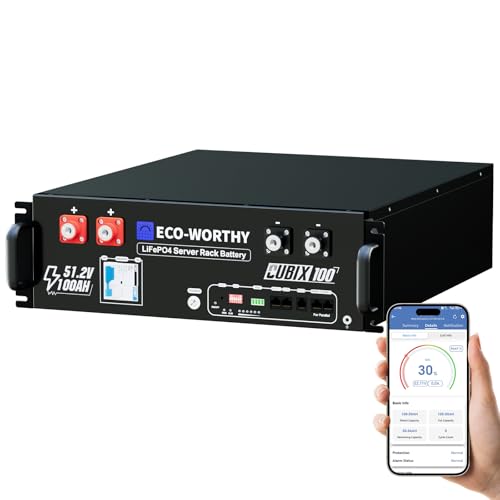
The Cubix100 is the rack-oriented choice, with a 51.2V, 100Ah format and 5.12kWh of energy. It is the only model here whose features name UL9540, UL1973 and CEC credentials. ECO-WORTHY says it supports Bluetooth and Wi-Fi, and describes closed-loop communication for a compatible system. That makes inverter and monitoring compatibility a key selection point; a shared voltage does not guarantee that equipment can communicate. At 103 pounds, the battery also needs an appropriately supported installation space, despite its rack form factor.
Bottom line: Choose this for a rack-style 51.2V system where its certifications and communication features fit your setup.
ECO-WORTHY EnergyRock 12V 314Ah
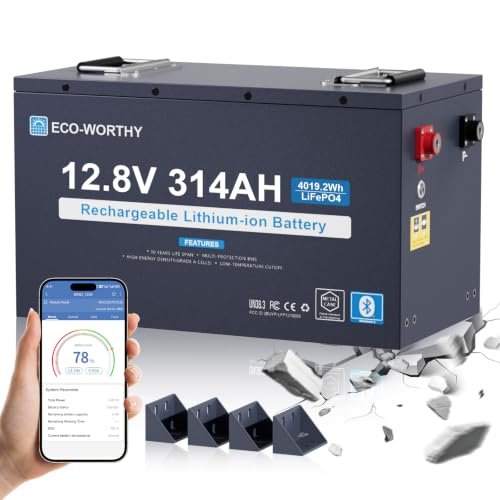
The EnergyRock differs from the other 12.8V option with its metal case and built-in safety switch. ECO-WORTHY says the enclosure offers enhanced heat resistance and fire protection, and the switch disconnects the discharge circuit when turned off. It also has Bluetooth, low-temperature protection and a built-in 200A BMS. Its 70.4-pound weight is 10 pounds more than the other 12.8V 314Ah model, so lifting and compartment access may matter. ECO-WORTHY gives a maximum energy figure of 3,584Wh; compare the usable-energy requirements of your loads before selecting it.
Bottom line: Pick this for a 12.8V installation where a metal enclosure and an output safety switch are priorities.
How to choose an ECO-WORTHY battery
Choose by system voltage first: a 12.8V battery belongs with compatible 12V equipment, while a 51.2V battery belongs with compatible 48V-class equipment. The voltage labels are not interchangeable; charging voltage limits and inverter settings must match the battery maker’s requirements. Next compare energy in watt-hours, calculated as volts multiplied by amp-hours: 12.8V × 314Ah is about 4,019Wh, while 51.2V × 314Ah is about 16,077Wh. For an approximate runtime estimate, divide usable watt-hours by the load in watts, then account for conversion losses and reserve capacity. If the equipment voltage does not match the battery, do not choose it based only on amp-hours.
12V and 48V battery fit
Most 12V-class LiFePO4 batteries use four cells in series, while 51.2V-class batteries typically use 16; check that the charger and inverter support the battery’s chemistry and voltage range. A higher-voltage bank can deliver the same power with less current: at 1,000W, current is roughly 78A at 12.8V versus 20A at 51.2V, before losses. Cable, fuse and disconnect sizing still depends on maximum current, cable length and installation conditions. This comparison shows which system range each model fits; confirm your equipment’s required voltage and battery communication compatibility before ordering.
| System need | Battery category | Selection check |
|---|---|---|
| 12V-class equipment | 12.8V battery | Charger voltage and compartment fit |
| 48V-class equipment | 51.2V battery | Inverter and communication compatibility |
Battery capacity and runtime
Battery amp-hours describe charge capacity, but watt-hours are more useful when comparing batteries at different voltages. Multiply nominal volts by amp-hours to estimate nominal energy; then use a conservative usable-energy figure from the battery maker for load planning. A 500W load running for 4 hours needs 2,000Wh before inverter losses, so a nominal 4,019Wh battery is not automatically a four-hour battery at 1,000W. Motor startup, inverter efficiency, temperature and reserve settings change actual runtime. Build in a reserve rather than planning to drain a battery completely, and check continuous discharge limits against the equipment load.
Installation and battery safety
Battery weight and enclosure dimensions determine whether a location is practical: the models here range from 60.4 to 279.99 pounds, so lifting access and floor support matter. LiFePO4 batteries still require correctly sized DC conductors, overcurrent protection and secure terminals; a battery management system does not replace a properly sized fuse or disconnect. Keep the battery away from unapproved heat sources and protect exposed terminals from accidental contact with tools or metal objects. Follow the applicable electrical code and equipment manuals for fixed installations, and have a qualified installer check conductor sizing and protection when the system’s fault current or wiring path is unclear.
Frequently Asked Questions
Can a 12V ECO-WORTHY battery run a 48V inverter?
No, a single 12.8V battery does not match a 48V-class inverter input. Use a battery bank designed for the inverter’s voltage and only connect batteries in series if both battery and equipment makers permit that configuration.
How do I estimate battery runtime for my appliances?
Divide usable battery watt-hours by the appliance load in watts to estimate hours, then reduce the result for inverter losses and reserve capacity. For example, a 2,000Wh usable battery serving a steady 500W load gives about 4 hours before those adjustments.
Can I connect ECO-WORTHY batteries in parallel?
Parallel connection increases capacity while retaining the same voltage, but batteries should be compatible in voltage, chemistry and permitted configuration. The Powermega feature data says parallel expansion is supported up to 15 units; verify the allowed arrangement for other models before connecting them.
What does low-temperature protection mean for charging?
Low-temperature protection can prevent charging under conditions that are too cold for the battery, but the exact cutoff is model-specific. Check the battery’s charging-temperature limit and avoid bypassing protection with an external charger.
How much space does a battery installation need?
Allow enough room for the full battery dimensions, terminal access, wiring bend radius and any clearance required by the manufacturer. Measure the compartment opening as well as the interior, since a battery that fits inside may not pass through the access hatch.