
Women’s Credit Card Wallets Compared by Capacity and Size

FurArt Compact Zipper Wallet suits most people seeking a women’s credit card wallet because it combines 16 slots with two cash compartments in a compact format. Choose Tipmile Mini Zipper Card Wallet instead if keeping bulk down matters more than carrying many cards, or Chelmon Slim Bifold Card Holder if you want a zippered coin pocket.
A card wallet organizes payment cards and commonly adds storage for identification, cash or coins; compare its dimensions with the space available in your bag or pocket.
We earn a commission if you buy through links on this page. As an Amazon Associate I earn from qualifying purchases. Products are compared on manufacturer specifications, not hands-on testing.
- Best overall: FurArt Compact Zipper Wallet – Its 16 slots and two cash compartments offer the broadest storage mix.
- Best for coins: Chelmon Slim Bifold Card Holder – A zippered pocket provides a dedicated place for coins and small items.
- Best for minimal carry: Tipmile Mini Zipper Card Wallet – Six card slots and a 0.11-inch listed thickness suit a smaller load.
| Product | Best for | Card slots | Dimensions | Coin storage | Shop |
|---|---|---|---|---|---|
| FurArt Compact Zipper Wallet | More card storage | 16 slots | 4.1 × 3.0 × 1.1 in | — | Check Price on Amazon |
| Chelmon Slim Bifold Card Holder | Coins and cards | 14 card slots | 5.5 × 3.2 × 0.4 in | Zippered pocket | Check Price on Amazon |
| Tipmile Mini Zipper Card Wallet | Light card carry | 6 card slots | 4.4 × 3.14 × 0.11 in | Side compartment | Check Price on Amazon |
Women’s Credit Card Wallets
Compare the capacity, size and storage layout to find a wallet that matches what you carry.
FurArt Compact Zipper Wallet

FurArt Compact Zipper Wallet offers the largest capacity in this group, with 16 slots and two cash compartments. Its feature description also specifies 13 credit-card slots, so confirm the slot layout before ordering if you need every slot for a particular item. The wallet measures 4.1 × 3.0 × 1.1 inches in the feature specifications and includes a key chain. The maker says two outer RFID-blocking layers help prevent unnoticed scans. Choose it if you carry several cards and want cash storage; its 1.1-inch stated depth may be more bulk than a slim wallet user wants.
Bottom line: Pick this if carrying many cards and cash matters more than keeping a very slim profile.
Chelmon Slim Bifold Card Holder

Chelmon Slim Bifold Card Holder is the only option here with a dedicated zippered pocket for coins and small items, alongside 14 card slots and an ID slot. Its bifold format measures 5.5 × 3.2 × 0.4 inches, making it longer than the other options by the measurements. The maker says its RFID-blocking design protects sensitive information, and identifies the material as vegan leather. This wallet suits someone who wants coin storage without giving up room for cards. Its longer shape may be less convenient when a compact footprint is the priority.
Bottom line: Choose this for a bifold layout with card capacity and a zippered coin compartment.
Tipmile Mini Zipper Card Wallet
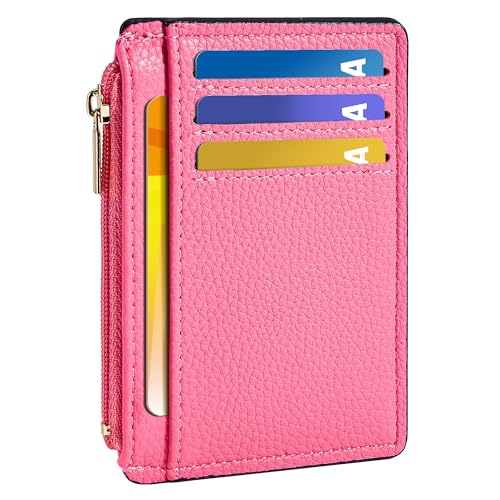
Tipmile Mini Zipper Card Wallet has the fewest card slots in this comparison, with six slots, an ID window and a side compartment for cash. Its dimensions are 4.4 × 3.14 × 0.11 inches, and the specifications gives a weight of 1.05 ounces. The maker says its RFID-blocking technology helps protect card and ID information from unauthorized scans. This layout fits a lighter everyday carry where quick access to identification is useful. The six-slot limit makes it a poor match for someone who regularly carries a large collection of cards.
Bottom line: Pick this if you carry a few cards and want an ID window and cash compartment.
How to choose a women’s credit card wallet
Start with the number of cards you carry every day, then allow room for an ID and any cash or coins. A standard credit card measures 3.37 × 2.125 inches, so wallet dimensions alone do not tell you how many cards fit comfortably; slot construction and the thickness of a loaded wallet matter too. Count your regular cards and choose a capacity with a little headroom rather than filling every slot from day one. If you carry six cards or fewer, a six-slot design may cover the basics; if you carry more than 14, look for a higher stated capacity and confirm which slots are intended for cards. Also compare the wallet’s depth with the space in your bag or pocket.
Wallet size and everyday fit
Wallet measurements can help rule out a poor fit before you buy, but length, width and thickness describe an empty wallet, not its loaded bulk. Measure the pocket or bag compartment you plan to use, then leave clearance for a wallet that will expand with cards, cash or coins. A difference of even half an inch can matter in a narrow pocket, while a larger purse can accommodate a longer bifold. Slot count is not the same as comfortable capacity: embossed cards and folded bills add thickness, and overfilling can strain seams or make cards harder to remove. For a close fit, prioritize the longest and thickest measurement rather than relying on a “slim” label.
RFID blocking and card protection
RFID blocking is intended to reduce radio-frequency communication with compatible contactless cards; it does not replace ordinary care against loss, damage or unauthorized use. Contactless payment cards commonly use 13.56 MHz NFC technology, but not every card or credential communicates the same way. Treat an RFID claim as one feature, not a guarantee against all forms of theft. Keep wallets dry, avoid bending cards, and remove cards you do not need to reduce both bulk and clutter. If the wallet’s main appeal is electronic protection, compare the maker’s exact claim and the wallet’s construction rather than assuming that every pocket is shielded.
Wallet storage types compared
A card holder, bifold and zippered wallet trade compactness against the kinds of items they can organize. Card-only layouts take less space, while an ID window saves you from removing an identification card for a quick view. A zippered pocket helps contain loose coins, but it adds a separate compartment and can increase bulk when full. Use this guide to match the storage style to what you carry most often; slot count alone does not show whether there is room for bills or coins.
| Everyday need | Storage feature to prioritize | Trade-off |
|---|---|---|
| Several cards | Higher stated card-slot count | More slots can mean more bulk |
| Coins | Zippered pocket | Extra compartment takes space |
| Quick ID access | Clear ID window | May reduce space for other storage |
| Minimal carry | Fewer slots and low thickness | Less room for spare cards |
Frequently Asked Questions
How many cards should a credit card wallet hold?
Choose a wallet with enough slots for your daily cards plus an ID, rather than relying on the maximum advertised capacity. A standard payment card is 3.37 × 2.125 inches, but embossing and loaded pockets affect how comfortably a wallet closes.
Will a credit card wallet fit folded cash?
A wallet needs a cash compartment to store bills without relying on card slots. Bills add thickness when folded, so test the fit with your usual cash load before carrying the wallet every day.
Does RFID blocking stop every kind of card theft?
No, RFID blocking is aimed at compatible radio-frequency reads, not loss, card skimming through other means or misuse of stolen credentials. Contactless cards commonly use 13.56 MHz NFC, but the technology is not universal across every card.
How can I keep a wallet from getting too bulky?
Carry only the cards you use regularly and remove expired cards, receipts and loose items. A wallet loaded beyond its intended slots can become harder to close and can strain the stitching.