
Best RMSc Footprint Optics Compared by Reticle and Design

OSIGHT SE Enclosed RMSc Green Dot suits most buyers seeking an RMSc footprint optic because it combines an enclosed design, side-load battery, and three green reticle options. Choose a simpler dot or built-in backup rear sights instead if those features better match your priorities.
We earn a commission if you buy through links on this page. As an Amazon Associate I earn from qualifying purchases. Products are compared on manufacturer specifications, not hands-on testing.
- Best overall: OSIGHT SE Enclosed RMSc Green Dot – Enclosed construction, side battery access, and selectable dot-and-circle, dot-only, or circle-only reticles.
- Best for built-in backup sights: Triton Nautilus2 Micro Red Dot – Integrated rear sights pair with a 3 MOA red dot and RMSc/407K/507K direct-mount footprint.
- Best for a larger dot: OSIGHT SE Enclosed RMSc Red 6 MOA – The enclosed optic uses a 6 MOA red dot and side-loading battery.
| Product | Best for | Reticle | Emitter design | Battery access | Shop |
|---|---|---|---|---|---|
| OSIGHT SE Enclosed RMSc Green Dot | Reticle flexibility | 2 MOA dot / 32 MOA circle | Enclosed | Side-load | Check Price on Amazon |
| Triton Nautilus2 Micro Red Dot | Backup rear sights | 3 MOA red dot | — | — | Check Price on Amazon |
| OSIGHT SE Enclosed RMSc Red 6 MOA | Larger red dot | 6 MOA red dot | Enclosed | Side-load | Check Price on Amazon |
| Monstrum Nitro RMSc Red Dot | Shake-activated dot | 3 MOA red dot | Open | — | Check Price on Amazon |
RMSc Footprint Optics
Compare reticle size, housing style, and battery access to match an optic to your slide and aiming preference.
OSIGHT SE Enclosed RMSc Green Dot

OSIGHT SE Enclosed RMSc Green Dot stands apart with three selectable green reticles: a 2 MOA dot, a 32 MOA circle, or both together. The enclosed housing and side-load battery suit buyers who want a sealed emitter and battery access without removing the optic. Its aspherical lens is presented as parallax-free and distortion-free by the maker. The dimensions are 1.59 inches long, 0.98 inches wide, and 0.97 inches high. The limitation is color: buyers who specifically want a red dot should consider a different option.
Bottom line: Choose this if you want green reticle choices and a side-access battery.
Triton Nautilus2 Micro Red Dot
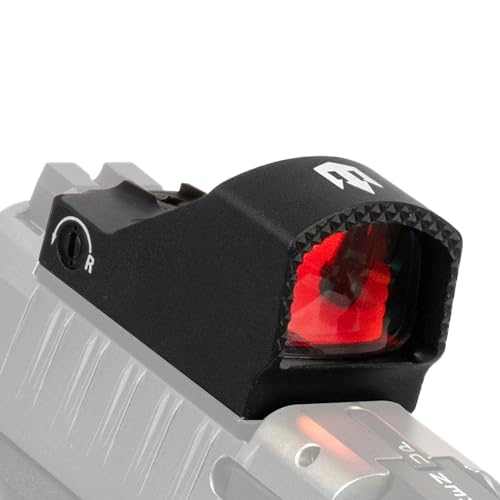
Triton Nautilus2 Micro Red Dot is differentiated by rear iron sights machined into its housing, alongside a 3 MOA red dot. The maker says it fits RMSc, 407K, and 507K footprints directly, including RMSc-cut slides such as the 43X MOS, P365, and Hellcat, without an adapter plate. That makes it the clearest choice here for a buyer seeking integrated backup sights and a direct-fit footprint. Its battery life is 50,000 hours. The tradeoff is that its emitter style and battery access are not established here, so buyers prioritizing either should compare another option.
Bottom line: Pick this for integrated rear sights and the direct-mount compatibility.
OSIGHT SE Enclosed RMSc Red 6 MOA

OSIGHT SE Enclosed RMSc Red 6 MOA uses a single 6 MOA red dot rather than selectable dot-and-circle reticles. The maker positions the larger dot for quicker pickup, while the enclosed housing and side-loading battery offer the same practical design advantages of a sealed emitter and battery replacement without removing the optic. The maker also describes the lens as parallax-free. This is a focused option for buyers who prefer a larger red aiming point and do not need multiple reticle modes. Confirm that the slide has an RMSc cut or that a suitable adapter plate is available.
Bottom line: Choose this for an enclosed optic with a single larger red dot.
Monstrum Nitro RMSc Red Dot

Monstrum Nitro RMSc Red Dot differentiates itself with a 3 MOA red dot and Shake Awake motion sensing. The maker says it automatically shuts off after one hour and reactivates with movement once the mode is enabled; button controls adjust illumination. Its compatibility includes RMSc cuts, Holosun K Series, 407K, 507K, and Modified RMSc, and it comes with multiple screw sets. The maker describes the optical system as parallax-free. Unlike the enclosed choices, the features do not establish a sealed housing, so buyers needing enclosed-emitter protection should choose accordingly.
Bottom line: Pick this if motion-activated operation and multiple screw sets are priorities.
How to choose an RMSc footprint optic
Start with the slide cut, then choose a reticle and housing that fit your priorities. RMSc describes a compact mounting footprint used on optics-ready pistols; a matching cut avoids relying on an adapter, but screw length and the maker’s fit chart still matter. Dot sizes are measured in minutes of angle: 1 MOA spans about 1 inch at 100 yards, so 3 MOA covers about 3 inches at that distance and 6 MOA about 6 inches. A larger dot is easier to see quickly but obscures more of a small aiming point. If a pistol does not have the footprint, verify the adapter and screw compatibility before ordering.
Enclosed and open pistol optics
Enclosed optics place the emitter inside a covered housing, while open-emitter sights leave the emitter exposed beneath the hood. Enclosure can keep debris and moisture away from the emitter, though the lens surfaces still need cleaning. Open optics are often simpler in profile, but exposure makes emitter cleanliness more important. These listings include three enclosed designs and one optic whose features do not establish an enclosed housing. Choose an enclosed model if shielding the emitter is a priority; do not assume an optic is waterproof or impact-rated unless its manufacturer gives that rating. Keep the optic’s window clear, and confirm the slide cut before choosing based on housing style alone.
Reticle size and aiming preferences
Reticle choice changes how much of the target is covered and how quickly the aiming point stands out. A 2 MOA dot is finer for precise aiming, while 6 MOA is larger and can be easier to acquire at a glance; a circle-and-dot option combines a central point with a broader visual reference. These differences matter more than choosing color by itself: compare dot size, circle availability, and red versus green illumination against your usual lighting and sight picture. Practice with the selected reticle at the distances you intend to use. A reticle preference cannot compensate for an optic that does not fit the slide correctly.
Mounting and battery checks
Before mounting, verify that the pistol cut, optic footprint, and screws match; similar-looking compact footprints are not automatically interchangeable. Direct-mount compatibility is explicitly claimed for the RMSc/407K/507K optic here, while another model says non-RMSc slides require an adapter. Side-loading batteries can be replaced without removing the optic, which avoids disturbing the mounted sight during routine battery changes. Motion-sensing controls also differ: one optic requires enabling Shake Awake, then shuts off after an hour and wakes on movement. Follow the maker’s mounting and zeroing directions, and confirm screw length rather than forcing a screw that bottoms out.
Frequently Asked Questions
What does an RMSc footprint mean on a pistol optic?
RMSc refers to a compact optic mounting pattern used on some optics-ready pistol slides. Confirm the slide cut and screw fit, since other small footprints can look similar without being interchangeable.
Is a 6 MOA dot easier to see than 3 MOA?
A 6 MOA dot covers about 6 inches at 100 yards, compared with about 3 inches for a 3 MOA dot. The larger aiming point may be quicker to pick up, while the smaller dot covers less of the target.
What is the advantage of an enclosed pistol optic?
An enclosed housing shields the emitter from debris and moisture more than an open-emitter design. The window can still collect dirt or water, so keep both lens surfaces clean.
Can I mount an RMSc optic on a different footprint?
A different slide cut may need a purpose-made adapter plate, and some combinations may not be compatible. Check the optic maker’s fit chart and use compatible screws before mounting.
How often should I replace a pistol optic battery?
Battery intervals depend on the model, brightness, and use pattern. One optic here has a maker-claimed 50,000-hour battery life; treat that figure as a specification, not a reason to skip periodic function checks.