
Longest Sawzall Blades for Wood: 15-Inch Picks

For the longest Sawzall blades for wood, choose a 15-inch pruning blade when extra reach and coarse teeth matter most; EZARC Arc Edge 15-Inch Pruning Blade is the strongest match because it pairs that length with 6 TPI Japanese-style teeth. Choose a different option for nail-embedded lumber, where bi-metal construction and 4/6 TPI are more relevant.
Reciprocating saw blades cut on the push-pull stroke, and their length is not the same as usable cutting depth: the saw shoe, workpiece shape, and blade support affect reach.
We earn a commission if you buy through links on this page. As an Amazon Associate I earn from qualifying purchases. Products are compared on manufacturer specifications, not hands-on testing.
- Best overall: EZARC Arc Edge 15-Inch Pruning Blade – A 15-inch blade with 6 TPI teeth and an arc-edge profile for pruning larger branches.
- Best for nail-embedded wood: ALEXEX 12-Inch Bi-Metal Blade, 10-Pack – A 12-inch bi-metal blade with 4/6 TPI, specified for wood with embedded nails.
- Best for high-carbon steel: RONGDA 15-Inch Japanese-Tooth Pruning Blades – A 15-inch, 6-TPI pruning blade made from high-carbon steel.
| Product | Best for | Blade length | Tooth pitch | Blade material | Shop |
|---|---|---|---|---|---|
| EZARC Arc Edge 15-Inch Pruning Blade | Long-reach pruning | 15 in | 6 TPI | — | Check Price on Amazon |
| ALEXEX 12-Inch Bi-Metal Blade, 10-Pack | Nail-embedded wood | 12 in | 4/6 TPI | Bi-metal, 8% cobalt | Check Price on Amazon |
| RONGDA 15-Inch Japanese-Tooth Pruning Blades | High-carbon steel | 15 in | 6 TPI | High-carbon steel | Check Price on Amazon |
| 15-Inch Japanese-Tooth Pruning Blades, 3-Pack | Green-wood pruning | 15 in | 6 TPI | — | Check Price on Amazon |
Longest Sawzall Blades for Wood Compared
The key differences are blade length, tooth pitch, and whether a blade is built for pruning or nail-embedded wood.
EZARC Arc Edge 15-Inch Pruning Blade

EZARC Arc Edge 15-Inch Pruning Blade combines a 15-inch reach with 6 TPI Japanese-style teeth and an arc-edge profile, making it a direct fit for pruning branches and limbs. The maker says its triple-ground, offset teeth provide three cutting angles and its deep gullets aid cutting; those features target coarse wood cutting rather than finish work. Its 3-pack gives multiple blades for ongoing trimming. The limitation is its pruning focus: choose another blade for wood containing nails, since this product is presented for branches and limbs rather than mixed-material demolition.
Bottom line: Choose this for long-reach cuts in branches and limbs.
ALEXEX 12-Inch Bi-Metal Blade, 10-Pack
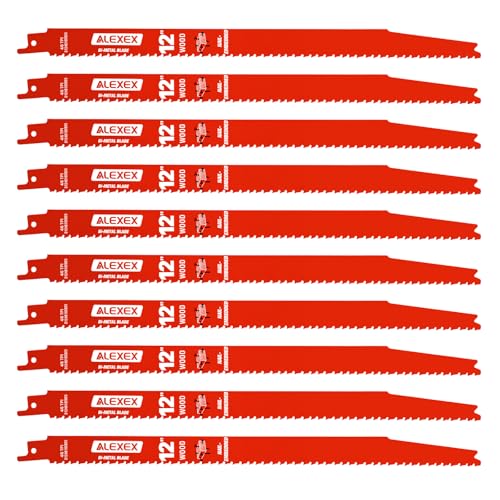
ALEXEX 12-Inch Bi-Metal Blade, 10-Pack is shorter than the 15-inch pruning options, but it is the only set here specifically aimed at nail-embedded wood. Its 12-inch bi-metal blades use 4/6 TPI teeth and the maker says the steel contains 8% cobalt; a nonstick coating and alternating tooth design are also claimed. The ten-pack suits repeated demolition cuts where nails are expected. The tradeoff is reach: at 12 inches, it does not match the longest blades in this comparison, and its 4/6 TPI profile is not the same as a dedicated 6-TPI pruning blade.
Bottom line: Pick this for lumber that may contain nails, not maximum reach.
RONGDA 15-Inch Japanese-Tooth Pruning Blades

RONGDA 15-Inch Japanese-Tooth Pruning Blades offers a 15-inch, 6-TPI pruning blade in a three-piece set, with high-carbon steel as its distinguishing material. The maker says the arc edge and triple-ground teeth are intended to reduce resistance and blade deflection while cutting wood. Its target includes branches up to 300 mm in diameter, though actual reach and control depend on the saw and how the branch is supported. This is a pruning choice, not a nail-cutting blade; buyers handling demolition lumber should favor a blade identified for embedded nails.
Bottom line: Choose this if you want 15-inch pruning blades in high-carbon steel.
15-Inch Japanese-Tooth Pruning Blades, 3-Pack

15-Inch Japanese-Tooth Pruning Blades, 3-Pack is another 15-inch, 6-TPI pruning set, with the maker naming green wood, wet wood, and branches among its intended uses. Its arc-edge profile and deep gullets are presented for smoother cutting and chip removal during trimming. That makes the wood conditions its useful distinction within these picks. The limitation is that the product facts do not identify its blade material, so buyers who need to match a specific material should choose an option whose material is named. It is still a pruning blade, not the choice for nail-embedded lumber.
Bottom line: Pick this for pruning green or wet wood when 15-inch reach is the priority.
How to choose the longest wood Sawzall blade
Choose blade length by the material thickness and the control you can maintain, not by length alone. A 15-inch blade gives more reach than a 12-inch blade, but extra blade extending past the work can flex and wander if the branch or board is unsupported. Tooth pitch also matters: coarse blades around 4 to 6 TPI are common for fast cuts in wood, while finer teeth make slower, more controlled cuts. For wood with embedded nails, use a bi-metal blade identified for that task; pruning blades are intended for branches, not mixed wood and metal.
Match the blade shank to the saw and keep the shoe firmly against the work where practical. Longer blades also need enough clearance behind and around the cut so the blade does not strike framing, soil, or another obstruction.
What 15-inch blade length means in practice
A 15-inch blade measures overall blade length, not guaranteed cutting capacity. Usable reach depends on how much blade is inside the saw clamp, the shoe position, workpiece shape, and access around the cut. One 15-inch pruning blade here claims a branch capacity up to 300 mm in diameter, but that maker claim should not be treated as a universal cut limit for every saw or setup.
For a branch near the blade’s reach, support the branch on both sides of the cut and keep bystanders clear of the fall path. For logs or framing where the far side cannot be seen, stop short of hidden obstructions and reposition rather than forcing a long blade through a blind cut.
Pruning blades versus nail-cutting blades
Pruning blades and nail-cutting blades solve different wood-cutting jobs. A 6-TPI pruning blade with aggressive teeth and deep gullets is shaped for branch fibers and chip removal; a 4/6-TPI bi-metal blade is the better match when cuts may encounter nails. The distinction is important because using a wood-only pruning blade against metal can damage teeth and cause the blade to bind.
The table separates the choices by intended material and length.
| Cutting need | Blade type | Length in this group |
|---|---|---|
| Branches and limbs | 6-TPI pruning blade | 15 in |
| Nail-embedded lumber | 4/6-TPI bi-metal blade | 12 in |
Safe setup for long reciprocating blades
Long reciprocating blades can flex, so clamp or support the work and keep hands away from the blade path. A stable branch cut generally needs support on both sides; if a limb is under tension, its kerf can close and pinch the blade. Make a controlled cut from a secure stance, and do not twist the saw to steer a stuck blade.
Wear eye protection and hearing protection, and use gloves appropriate to the task. Remove the battery or unplug the saw before changing blades, and allow a recently used blade to cool before handling; the blade and cut material can be hot after prolonged cutting.
Frequently Asked Questions
Can a 15-inch Sawzall blade cut a 15-inch branch?
Not necessarily; blade length is not the same as cut capacity. Clamp the branch securely and allow for the saw clamp and shoe, which reduce the length available past the work.
What TPI is best for cutting wood with a Sawzall?
A coarse 4-to-6 TPI blade is a common choice for fast wood cutting. Choose a blade identified for nail-embedded wood if the cut may encounter nails.
Are pruning blades suitable for cutting lumber with nails?
No; a pruning blade is intended for wood fibers, while nails can damage its teeth. Use a bi-metal blade specified for nail-embedded wood instead.
How do I keep a long reciprocating blade from bending?
Support the work close to the cut and avoid twisting the saw. Extra blade extension can flex more readily, especially when a branch or board is unsupported.