
Best Adhesive for Concrete Roof Tiles: 4 Options Compared

Tile Bond Roof Tile Adhesive, 28 oz is the best fit for most concrete roof tile work because it is a one-component polyurethane foam made for roof tiles and approved underlayments. Choose a general construction adhesive only for a repair where its maker confirms the roof exposure and materials are suitable; products made for general tile or concrete bonding are not automatically roof tile adhesives.
We earn a commission if you buy through links on this page. As an Amazon Associate I earn from qualifying purchases. Products are compared on manufacturer specifications, not hands-on testing.
- Best overall: Tile Bond Roof Tile Adhesive, 28 oz – A roof-specific polyurethane foam with a straw applicator for attaching tiles to pre-approved underlayment.
- Best for interior projects: Loctite Power Grab, 9 fl oz – The maker says it bonds concrete and ceramic tile, with up to 15 minutes to reposition.
- Best for clear bonds: Heavy-Duty Construction Adhesive, 8.8 fl oz – A clear, waterproof construction adhesive that bonds tile and concrete and allows up to 30 minutes of repositioning.
| Product | Best for | Adhesive type | Package size | Working time | Shop |
|---|---|---|---|---|---|
| Tile Bond Roof Tile Adhesive, 28 oz | Roof tile attachment | Moisture-cured polyurethane foam | 28 oz per can | — | Check Price on Amazon |
| Loctite Power Grab, 9 fl oz | Interior repairs | All-purpose construction adhesive | 9 fl oz | Up to 15 minutes | Check Price on Amazon |
| Heavy-Duty Construction Adhesive, 8.8 fl oz | General repairs | Heavy-duty construction adhesive | 8.8 fl oz | — | Check Price on Amazon |
| Gorilla Max Strength, Clear, 7 oz | Clear surface bonds | Construction adhesive | 7 oz | Up to 30 minutes | Check Price on Amazon |
Adhesive for Concrete Roof Tiles Compared
The key distinction is whether an adhesive is made for roof tile attachment or only for general construction bonding.
Tile Bond Roof Tile Adhesive, 28 oz

Tile Bond Roof Tile Adhesive, 28 oz is the only option here specifically made for roof tile attachment. The one-component, moisture-cured polyurethane foam comes in a disposable 28-ounce can with a reusable straw and is intended for clay and concrete tiles on pre-approved underlayment. The maker says it has minimal expansion and is qualified for hurricane zones. It suits tile installation across several profiles, including low, flat, medium, high, and two-piece barrel tile. Its limitation is substrate approval: the underlayment must be approved for this adhesive, so verify compatibility before work begins.
Bottom line: Choose this for roof tile attachment when the underlayment is approved for the adhesive.
Loctite Power Grab, 9 fl oz

Loctite Power Grab, 9 fl oz is a general-purpose construction adhesive rather than a roof tile attachment foam. The maker says it bonds concrete, masonry, ceramic tile, and other common building materials, and that it is repositionable for up to 15 minutes before a 12-hour full cure. That makes it a better match for interior repairs involving compatible construction surfaces than for securing roof tiles. The maker frames it for interior projects, so do not assume it is suitable for roof exposure or tile attachment; use it only when the specific repair and exposure are approved.
Bottom line: Choose this for compatible interior construction repairs, not as a substitute for roof tile adhesive.
Heavy-Duty Construction Adhesive, 8.8 fl oz
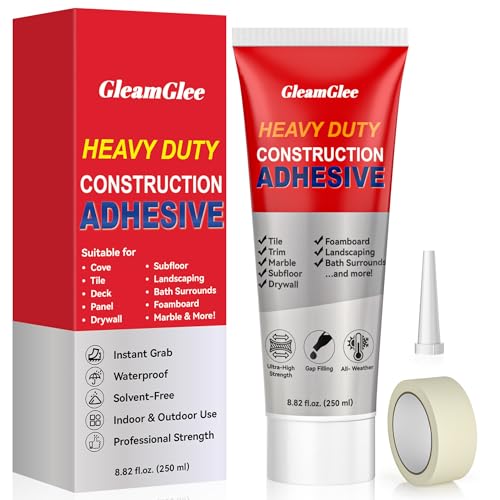
Heavy-Duty Construction Adhesive, 8.8 fl oz is a heavy-duty construction adhesive in an 8.8-fluid-ounce tube, with a medium-thick paste promoted for vertical and uneven surfaces. Its bonding range includes concrete, cement, tile, stone, wood, and brick, so it may suit general repair work on compatible materials. The maker also describes the formula as waterproof and suitable for indoor and outdoor use. Those broad construction claims do not establish that it meets a roof tile system’s attachment requirements, however. Treat it as a general repair adhesive unless its maker specifically confirms the intended roof use.
Bottom line: Choose this for general compatible construction repairs, not roof tile installation without confirmation.
Gorilla Max Strength, Clear, 7 oz
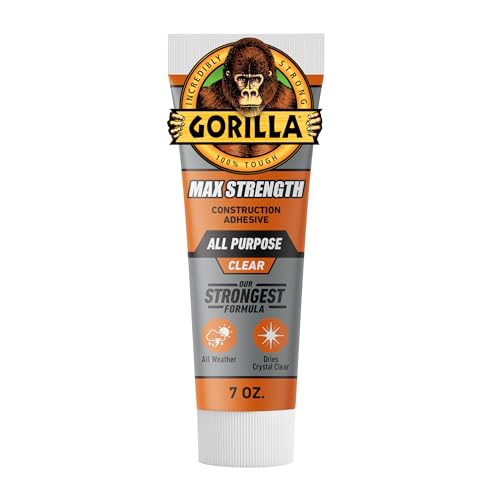
Gorilla Max Strength, Clear, 7 oz differs from the roof-specific option with a clear, non-foaming construction adhesive in a 7-ounce tube. The maker says it bonds concrete, ceramic tile, stone, and other materials, works on wet surfaces, and allows up to 30 minutes for repositioning; it is paintable after 2 hours and sandable once cured. Those features can help with visible general repairs where a clear finish matters. The product is not identified as a roof tile attachment adhesive, so its waterproof claim alone is not proof that it can secure concrete tiles on a roof.
Bottom line: Choose this for clear general bonding where its surface and exposure claims fit the repair.
How to choose adhesive for concrete roof tiles
For roof installation, choose a product explicitly intended for roof tile attachment and verify that the tile, underlayment, and application pattern are approved together. Roof systems may use foam adhesive, mortar, nails, screws, wire ties, or clips; these methods are not interchangeable, and the local building code and roof-system instructions determine what is allowed. A general construction glue can bond concrete or ceramic tile without meeting roof uplift or weather-exposure requirements. If the underlayment is not approved for the adhesive, do not proceed with that pairing. Roof work also involves fall hazards: use suitable fall protection and avoid working on a wet or unstable surface.
Roof adhesive versus construction glue
A roof tile adhesive is formulated and marketed for attachment of roof tiles, while a construction adhesive is intended for broader building repairs. Polyurethane roof foam is dispensed from a can and can be applied with a straw; a typical construction adhesive comes in a squeeze tube or caulking-gun cartridge. Waterproofing and bonding to concrete describe material compatibility, not proof of wind-uplift performance. Foam, mortar, and mechanical fasteners each have distinct placement and curing requirements. Use a general adhesive for roof tiles only if its manufacturer approves that exact roof use and the roof system accepts it; otherwise, choose the specified roof tile attachment method.
Check roof and tile compatibility before applying
Compatibility is the first go/no-go check: confirm the tile profile, underlayment, and adhesive are approved as a system before opening the container. Concrete roof tiles include multiple profiles, and application locations such as field, eave, hip, ridge, rake, and valley can require different attachment details. The roof-specific can here includes a straw applicator and is described for several profiles, but its use still depends on pre-approved underlayment. Do not extrapolate a product’s concrete-bonding claim to a roof assembly. If an adhesive maker or roof-system specification does not confirm the substrate or placement, stop and confirm the required attachment method before installation.
Application and curing considerations
Working time and cure time are different: a product may allow repositioning for a period yet still need longer to fully cure. The general adhesives here give specific intervals—up to 15 minutes of repositioning and 12 hours to full cure for one, and up to 30 minutes for another—while the roof foam is moisture-cured. Temperature, humidity, bead size, and contact conditions can affect adhesive cure, so observe the product’s application requirements rather than treating those times as interchangeable. Keep uncured adhesive off skin and eyes, ventilate the work area, and use protective gloves; roof work should also use fall protection appropriate to the roof and task.
Frequently Asked Questions
Can construction adhesive hold concrete roof tiles?
Some construction adhesives bond concrete and tile, but that alone does not show approval for roof tile attachment. Use one only when its maker and the roof-system requirements approve that exact use and substrate.
Does waterproof adhesive mean it is roof-rated?
No; waterproofing describes resistance to water, not whether an adhesive meets roof tile attachment or wind-uplift requirements. Confirm the specified tile, underlayment, and attachment method before use.
How long does roof tile adhesive take to cure?
Cure time depends on the specific formula and application conditions, and the roof foam here is moisture-cured. As a comparison, one general adhesive gives a 12-hour full-cure time, while another allows repositioning for up to 30 minutes; those figures do not establish cure time for the roof foam.
Can I use roof tile adhesive on any underlayment?
No; the roof-specific foam here is intended for pre-approved underlayment. If the underlayment is not approved for that adhesive, confirm the compatible roof-system method before applying it.